Otra puse releases album, collaborates with other Latvian musicians

image

One of the most remarkable comebacks in Latvian popular music was the return of Otra puse. Having stayed relatively quiet during the end of the 90s and most of the first decade of the 21st century, the group released the album Nakts vai rīts in 2009, which was a major success and signalled the return of the group to the forefront of Latvian popular music, from where they had long been gone. Nakts vai rīts went on to win best pop album of 2009 and the song ‘Nakts vai rīts’ also won the “Radio Hit” award the same year at the Latvian Great Music Awards.

Of course, following up on a hit record is no easy matter, and Otra puse took their time crafting the follow-up (though there was a Christmas-themed album – Piparkūku sirsniņa – also in 2009), and in 2013 released Uzzīmē mani.

Though in the early 1990s Otra puse began as a project of Aigars Grāvers, of the band Jumprava, as the years went by the core of Otra puse became vocalist Normunds Pauniņš and keyboardist Ivars Makstnieks. As the group is an off-shoot of Jumprava, a band known for their use of synthesizers, Otra puse’s music is also synthesizer-based.

Otra puse’s songs are often about relationships, and their lyrics (many of which are written by long-time lyrical collaborator Ivars Kurpnieks), which are often in a direct, heart on one’s sleeve manner, have kept their songs on a very personal level, resonating with many listeners. The first song on the album, ‘Uzzīmē mani’, lyrics by veteran Latvian DJ Roberts Gobziņš, contains all of the trademark Otra puse elements – catchy, synthesizer-based introduction, Pauninš’s deep baritone, and personal lyrics. Pauninš sings “Esmu tā, kā tu mani uzzīmē” (I am how you draw me), while Makstnieks’ keyboards provide the solid foundation to one of the best songs on the album. The song also features co-lead vocalist Antra Stafecka, of the “Okartes skatuve” talent show, and her voice provides a distinctive contrast to Pauniņš’ vocals.

One of the major occurrences in springtime Latvia is the breaking of the ice in rivers, called “pali”, and lyricist Kurpnieks has used this imagery as a metaphor for a relationship in the song “Ave Pali”. “Saplaisās ledus, pāri upei tā nebūs, kas tad nokļūs pie tevis” (The ice breaks, there will be no path over the river, who will be able to reach you) describing with an aching sincerity the loneliness of two people who are unable to reach each other, in what is yet another standout track on the album. The song also features co-lead vocals by Aija Andrejeva (formerly known as Aiša).

Though the core of the group remains Pauniņš and Makstnieks, they are backed up by varied musicians, such as guitarists Arnolds Kārklis, Jānis Čubars, and Egons Kronbergs, bassist Jānis Olkešs, and drummer Mārtiņš Miļevskis, among others. Due to the album having taken four years to record, musicians came and went, and, perhaps because of that, Uzzīmē mani is slightly more uneven than Nakts vai rīts, and more of the songs have a ‘techno’ feel to them (since not many of the songs have an actual drummer, but have programmed drums), which at times gives the songs an overly ‘slick’ feeling to them. Songs like ‘Balss’ and ‘Kā nav tā nav’ would have worked better with a more organic feel with actual rather than programmed instruments.

Uzzīmē mani is a worthy follow-up to Nakts vai rīts, with a number of very strong songs and memorable melodies. Otra puse, who celebrated their 20th anniversary in 2013, are still going strong after their comeback, recording songs that still affect listeners with their personal lyrics and catchy hooks. The tandem of Pauniņš and Makstnieks are still a formidable combination, and Uzzīmē mani shows them at the top of their game.

Otra puse website: http://www.otrapuse.net

Details

Uzzīmē mani

Otra puse

Otra puse,  2013

OP001

Track listing:

1. Uzzīmē mani

2. Neaizej

3. Balss

4. Mana pilsēta

5. Ave Pali

6. Uguns ledus

7. Dejo ar lietu

8. Kā nav tā nav

9. Asaras par dimantiem

10. Bez tevis

11. Paldies Tev

12. Kā nav tā nav (remixed by Ivars Tiliks)

Egils Kaljo is an American-born Latvian from the New York area . Kaljo began listening to Latvian music as soon as he was able to put a record on a record player, and still has old Bellacord 78 rpm records lying around somewhere.

Latvian composer Ešenvalds’ works performed by State Choir Latvija

The State Choir Latvija, conducted by Māris Sirmais, have released a CD dedicated to the works of Latvian composer Ēriks Ešenvalds. Entitled At the Foot of the Sky and recorded at the Rīga St. John’s Church in April of 2013, the CD collects eight of Ešenvalds’ choir compositions.

Ešenvalds, who has become one of the most popular and best known Latvian composers, and many of his choir works have become beloved by both singers and audiences alike, with “Dvēseles dziesma”, the closing song at the 2013 Song Festival, being a recent example of his ability to compose music that resonates with performers and listeners. Ešenvalds also spent two years at Trinity College at Cambridge University in the United Kingdom as the Fellow Commoner in Creative Arts, a position he held from 2011 to 2013.

The State Choir Latvia, who celebrated their 70th anniversary in 2012, is a seven time recipient of the Latvian Great Music Award, and has been conducted by Sirmais since 1997. The Choir has performed worldwide, from Singapore to New York, and from Oman to Russia.

The CD also features biographies of the State Choir, Ešenvalds and Sirmais in both English and Latvian, as well as an introduction by British composer Gabriel Jackson (whose works were also recorded by the choir on the CD A Ship with Unfurled Sails).

For further information, please visit the State Choir Latvija website at http://www.koris.lv and Ēriks Ešenvalds’ website at http://www.eriksesenvalds.com

Track listing:

1. Tāls ceļš

2. Northern Lights

3. Vineta

4. Seneca’s Zodiac

5. Stars

6. Sun Dogs I: The Witnesses

7. Sun Dogs II: The Beauty of This Miracle

8. In Paradisium

image

Egils Kaljo is an American-born Latvian from the New York area . Kaljo began listening to Latvian music as soon as he was able to put a record on a record player, and still has old Bellacord 78 rpm records lying around somewhere.

New silver commemorative coin Jāzeps Vītols, circulation kokle

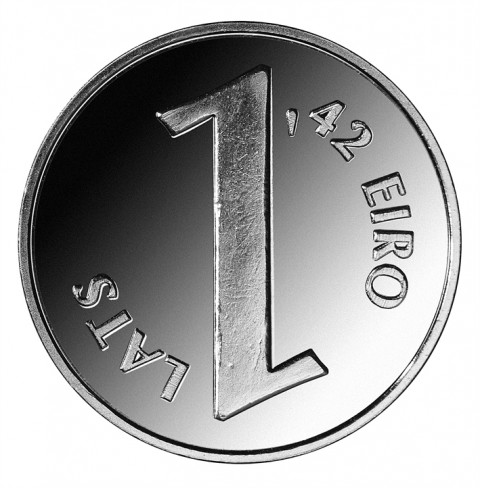
The Bank of Latvia has released a new silver commemorative one Lats coin in honor of composer Jāzeps Vītols, as well as a new circulation one Lats coin with the image of the kokle, a Latvian folk instrument.

Composer Jāzeps Vītols, who celebrates his 150th birthday in 2013, is considered by many to be the father of Latvian choir music. His choir works, including works like “Ziemeļblāzma”, “Karaļmeita”, “Beverīnas dziedonis”, among many others, are a fixture of Latvian Song Festival programs. “Gaismas pils”, his best known choir work, is considered to be the most often performed Latvian choir piece (considering that the Latvian national anthem was not performed during Soviet times, but “Gaismas pils” was). Though well known for his choir music, Vītols also composed many solo songs, as well as piano and symphonic music.

The proof quality Vītols coin was minted by Koninklijke Nederlandse Munt (the Netherlands), and the artists were Arvīds Priedīte (graphic design) and Jānis Strupulis (plaster model). The coin has a mintage of 3000.

The kokle, a stringed Latvian folk instrument, according the Bank of Latvia website “…is an instrument originating with the ancient Balts and borrowed by the nearby Finno-Ugric tribes (e.g. the Liv kāndla, Finnish kantele, Estonian kannele) and Slavic peoples (Russian gusli), it is also a symbol of kinship and friendly relations.” The instrument is also mentioned in many Latvian folk songs, including “Krauklīts sēž ozolā”. Even today, this ancient instrument is played and studied and continues to be an essential aspect of Latvian folk music.

The circulation coin was minted by Staatliche Münzen Baden-Württemberg (Germany), and the artists were Anna Heinrihsone (graphic design) and Ligita Franckeviča (plaster model).

Both coins are available for purchase at Latvian Bank locations and at Latvian numismatic shops.

For further information, please visit the Bank of Latvia website http://www.bank.lv


image
image

Egils Kaljo is an American-born Latvian from the New York area . Kaljo began listening to Latvian music as soon as he was able to put a record on a record player, and still has old Bellacord 78 rpm records lying around somewhere.