The Latvian Music Information Centre is a Latvian state organization whose “focus of activity is Latvian contemporary and classical music, composers, performers, concert organizers and devotees”, according to its website. A recent noteworthy and ambitious project is to, in collaboration with the Latvian concert agency Latvijas koncerti, regularly release CDs of Latvian artists and composers to provide a showcase for the exceptional musical talent in Latvia today. All recordings are released under the Skani label, and the plan is to release multiple recordings every year.
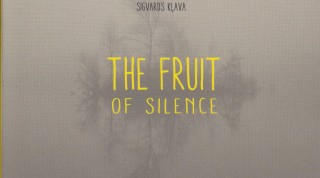
The first CD released was E(GO), a collection of the works of Latvian composer Andris Dzenītis (also the first entry in the series “Latvian composers”). The second CD to be released (and the first entry in the series “For the Latvian Centennial”) focuses on modern Latvian choir music. It is entitled The Fruit of Silence and features choir works by Latvian composers performed by the Latvian Radio Choir and conducted by Sigvards Kļava.
The Latvian Radio Choir, who celebrated their 75th anniversary in 2015, has long been known for its masterful and professional interpretations and performances of modern choir music and has always had a close collaboration with Latvian and international composers. They have recorded CDs of the music of Pēteris Vasks, Imants Kalniņš, Artūrs Maskats, Estonian Arvo Pärt, among many others. In preparation for the approaching Latvian Centennial in 2018, the choir recorded seven compositions by both young and established composers for the release The Fruit of Silence.
The collection begins with Kristaps Pētersons’ work “Incessant Jealousy”, which as its text has William Shakespeare’s Sonnet No. 40 (“Take all my loves, my love”). Shakespeare’s text, with a bitterness bordering on anger, provides the inspiration for Pētersons’ work. The work features soloist Dace Strautmane, whose performance combines both sadness and resentment, as the rest of the choir provide a discordant backdrop appropriate for this text about someone struggling with their emotions.
Composer Mārtiņš Viļums’ contribution to this collection is “La temps scintille” (Time Scintillates), a quiet and ruminative work that combines texts by poets Paul Valéry and Rainer Maria Rilke with sonic and vocal experiments. The work is Viļums’ contemplation of life – it glitters and flashes, and the weaving of the various voices is like the flow of thoughts within one’s subconscious.
Maija Einfelde’s music is often harsh and abrasive, such as her award winning work “Pie zemes tālās” (At the Edge of the Earth), and has had a long and fruitful collaboration with the Latvian Radio Choir. The choir performs Einfelde’s “Lux Aeterna” (text from the Roman Catholic requiem mass), an arrangement of the work for choir and Tibetan bells. Using few words, Einfelde has composed a work of great power and depth.
On this collection, composers Ēriks Ešenvalds and Pēteris Vasks, both greatly influenced by spiritual matters, have both provided works inspired by Mother Theresa. Ešenvalds’ work – “A Drop in the Ocean” – combines texts by Theresa, Pater Noster (The Lord’s Prayer), and St. Francis of Assisi and results in a deeply spiritual work. Vasks’ “The Fruit of Silence”, which also uses a text by Theresa, begins with a simple, slow progression of single piano notes (performed by renowned Latvian pianist Vestards Šimkus), with the choir joining in later with their meditative yet enrapturing singing.
There are also works by composers Juris Karlsons (“Le lagrime dell’anima”) and Santa Ratniece (“Fuoco Celestis”). The CD booklet includes extensive notes in Latvian and English on the choir, the guest artists, the composers and each individual work, as well as the text of the works.
The Latvian Radio Choir once again displays their mastery of modern choir music on The Fruit of Silence. Conductor Sigvards Kļava leads the choir and the listener on a journey of some of the most distinctive and memorable Latvian choir compositions. Each composition is unique and noteworthy, displaying not just the talent of Latvian composers, but also their diversity and adeptness in composing in various styles. The Fruit of Silence is a welcome and exceptional recording, and a worthy addition to the Skani series.
For further information, please visit the Latvian Radio Choir website at www.radiokoris.lv and the Skani record label website at www.skani.lv
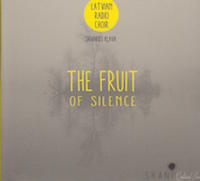
The Fruit of Silence
Laimas Muzykanti
Latvian Music Information Centre, SKANI039, 2015
Track listing
- Incessant Jealousy – Kristaps Pētersons
- Lux Aeterna – Maija Einfelde
- Le lagrime dell’anima – Juris Karlsons
- Fuoco Celestis – Santa Ratniece
- A Drop in the Ocean – Ēriks Ešenvalds
- Le temps scintilla… – Mārtiņš Viļums
- The Fruit of Silence – Pēteris Vasks