Folklorists Rūta and Valdis Muktupāvels tour North America

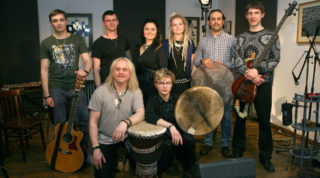
Latvian folklore duo Rūta and Valdis Muktupāvels are performing throughout the United States and Canada, and one of their stops included a performance at the Latvian Lutheran Church in Yonkers, New York, on Saturday, November 16th, as part of the Latvian independence celebration event.

Their performance included Latvian folk songs from all the historical regions of Latvia, including Kurzeme, Vidzeme, Latgale, Zemgale, as well as Selonia (Sēlija). Additionally, the duo performed songs from throughout the Baltic region, including songs from Lithuania, ancient Prussia and Yotvingia.

Rūta and Valdis Muktupāvels perform in a very traditional and authentic style, singing either unaccompanied or with a single instrument. The repertoire was varied, with folk songs of many styles and themes, from wedding songs to dances to children’s songs. The duo incorporated many different instruments in their performance, including the kokle, vargāns (Jew’s harp), guitar, bagpipes, among others.

They were joined by the students of the Yonkers and New Jersey Latvian schools for three songs – two Latvian folk songs ‘Ar vilciņu Rīgā braucu’ and ‘Maza, maza ābelīte’, as well as an original work by Valdis Muktupāvels, ‘Mīl katrs baltu maizes riku’ (words by Imants Ziedonis).

This concert and the duo’s tour were made possible by the Latvian Cultural Society TILTS, with support from the World Federation of Free Latvians (PBLA), the Latvian Ministry of Culture, as well as the American Latvian Association (ALA).

For further information, please visit the TILTS website.

Photo: Kristina Rathode

Rūta Muktupāvela and Valdis Muktupāvels at the Latvian Lutheran Church in Yonkers, NY with the New Jersey and Yonkers Latvian Schools’ combined children’s choir.

Egils Kaljo is an American-born Latvian from the New York area . Kaljo began listening to Latvian music as soon as he was able to put a record on a record player, and still has old Bellacord 78 rpm records lying around somewhere.

Gaudeamus’ refreshing take on Prauliņš’ song cycle “Pagānu gadagrāmata”

Composer Uģis Prauliņš has often melded together many different styles and sounds in his works, balancing modern and ancient elements, like on his song cycle Odi et Amo, which mixed synthesizer music with Latin poetry. Prauliņš also has combined modern sounds with Latvian folk songs, such as on his 1999 song cycle Pagānu gadagrāmata (or ‘Pagan Yearbook’). Originally recorded with members of the post folk ensemble Iļģi, the collection was meant to portray a Latvian year in song, from the thaw of the spring to the cold of the winter and the end of the year. Combining Latvian folk songs, original music, and some more recent texts, the album and its arrangements provided for an engrossing journey through the seasons in Latvia.

After almost twenty years, the idea arose to revisit the song cycle. The original recording often featured synthesized male voices, so perhaps that inspired Prauliņš to record a new version with an actual men’s choir – Gaudeamus. Along with a number of well-known Latvian musicians and soloists, a new version of Pagānu gadagrāmata was released in 2018. The song cycle is mostly unchanged, with a few new songs added in, but the presence of the choir and a new set of a performers give this new version additional layers and colors.

A major element of the original was the presence of members Iļģi and singers Ilga Reizniece and Māris Muktupāvels, and the new version also includes similar folk singing specialists, and features singers Asnate Rancāne and Lauma Bērza, both from the folk ensemble Tautumeitas. Rancāne’s and Bērza’s authentic singing is an integral aspect of the album, on such songs like the tragic ‘Balādīte’, based on a poem by Ojārs Vācietis, a heartbreaking song of a young man who is executed by the guards of the local lord. ‘Es gulu gulu’, a similarly sad and tender folk song about a young woman who dreams about her lover leaving her, is given an appropriately dreamy and haunting interpretation by the singers and instrumental ensemble.

Though Gaudeamus do have a large role on the album, one does occasionally wish that there were more choir harmonies to be heard, as the men in the choir often sing in unison, or often simply provide background vocalizes. Still, on songs like the thunderous ‘Ar vilciņu Rīgā braucu’ (a song not in the original cycle), the powerful voices of the choir come together to make for a brawny performance – though some may find that this song with its drums and distorted electric guitar might not fully flow together with the rest of the songs. The choir’s conductor and vocalist Ivars Cinkuss also lends his robust and vigorous voice throughout the album, notably on ‘Man jāsteidzas’, a forceful and energetic performance which is then balanced by the voices of Rancāne and Bērza.

The song collection concludes in winter, with the rousing winter solstice song ‘Kaķeišami tāvs nūmyra’, which is then followed by the quiet, meditative ‘Vecgada vakars’, an instrumental about New Year’s Eve, an appropriate conclusion with a rather sudden ending that brings the year to a close, but foretells of a new year to come.

This release of Pagānu gadagrāmata provides for a refreshing new take on the song cycle. The men’s voices add both power and nuance to many of the performances, while the instrumentalists give the collection a more organic feel, compared to the often synth-heavy original. Uģis Prauliņš, along with Gaudeamus, have created a new version of this collection that maintains the spirit of the original, but still adds new dimensions with the sound and performance of the men’s choir. providing an added vitality to the music as the songs bring the listener through the Latvian calendar year.

For further information, please visit the choir Gaudeamus website and Uģis Prauliņš’ website

Gaudeamus

Pagānu gadagrāmata

Lauska, CD080, 2018

Track listing:

  1. Zaļa zied zālīte
  2. Atiti leldīna
  3. Pirmais pērkons
  4. Balādīte
  5. Meitas(e) gula ābolāje
  6. Ganiņš biju
  7. Es gulu gulu
  8. Iesēju liniņus
  9. Baltaitiņa
  10. Saucējs sauc aiz upītes
  11. Aiz kalniņa
  12. Sauleite lēce
  13. Tas vējiņš pūta / Nāk rudentiņis
  14. Kaķeišami tāvs nūmyra
  15. Vecgada vakars

Egils Kaljo is an American-born Latvian from the New York area . Kaljo began listening to Latvian music as soon as he was able to put a record on a record player, and still has old Bellacord 78 rpm records lying around somewhere.

Baltic Jazz Trio celebrates centenaries of three Baltic States

The Baltic Jazz Trio is one of the premiere jazz ensembles in the Baltics, and have been performing together for more than a decade. As their name indicates, the trio is made up of three musicians from the Baltic States – drummer Māris Briežkalns from Latvia, double bassist Toivo Unt from Estonia, and pianist Dainius Pulauskas.

To celebrate the recent centenaries of the three Baltic states, the ensemble came together to record jazz versions of compositions by Baltic composers, and the album, simply entitled Centenary, was released in 2018.

One of Estonian composer Arvo Pärt’s best known works is ‘Für Alina’. Originally for solo piano, the work, dedicated to a daughter’s friends whose family had split up, is very quiet and tender, and the Trio’s interpretation of this work preserves the intimacy and longing that is imbued throughout the piece, particularly in Pulauskas’ piano performance.

Originally written for string orchestra, Latvian composer Pēteris Vasks’ ‘Viatore’ loses none of its quiet intensity and weightiness in the trio’s performance. The music is in a near constant state of motion, with Unt’s double bass providing the backbone for this entrancing interpretation.

The Trio performs two preludes by Lithuanian composer Mikalojus Čiurlionis. Čiurlionis was also well known as a painter, and considered a major force in European abstract art. Many of his musical works could also be considered paintings, and the Trio brings forth the vivid colors and elements in the two preludes – Op. 11 No. 3 and Op. 7 No 4. Briežkalns’ drums are used not just to keep time but also to add to the sonic palette, particularly in the expressive No. 3 and the rhythmic and pulsating No. 4.

The album concludes with the Baltic Jazz Trio’s performance of Latvian popular music composer Raimonds Pauls’ ‘For Mother’. Pauls, with his peerless knack for composing catchy and memorable melodies, provides a sentimental and nostalgic mood, and the Trio captures the essence of the work, bringing this musical journey through the Baltics to a satisfying close.

According to Briežkalns, the album was meant to flow together as a cohesive musical narrative, rather than having disparate tempos and styles. Though some may find that the works are very similar in nature and style, the reserved and even occasionally somber performances do allow for an absorbing, engrossing listen, with no musical shocks along the way.

Centenary is a significant musical accomplishment, particularly considering that many of the works on the album were originally more academic music compositions, and presenting these in a jazz style could have been a challenge. However, these three talented and accomplished Baltic musicians have revealed new elements in these works with their jazz interpretations. The Baltic Jazz Trio has confirmed themselves as a truly masterful ensemble, and Centenary is a worthy gift to the Baltic States on their 100th anniversaries.

Centenary

Baltic Jazz Trio

MMC, MMCCD021, 2018

Track listing

  1. For Alina – Arvo Pärt
  2. Viatore – Pēteris Vasks
  3. Prelude Op.11. Nr.3 – Mikalojus Konstantinas Čiurlionis
  4. Prelude Op.7. Nr.4 – Mikalojus Konstantinas Čiurlionis
  5. Siin On Oja – Olav Ehala
  6. Chestnut Blossom – Dainius Pulauskas
  7. Nostalgia – Dainius Pulauskas
  8. For Mother – Raimonds Pauls

Egils Kaljo is an American-born Latvian from the New York area . Kaljo began listening to Latvian music as soon as he was able to put a record on a record player, and still has old Bellacord 78 rpm records lying around somewhere.