Latvian Voices’ album “Sudrabs” reconfirms group’s versatility

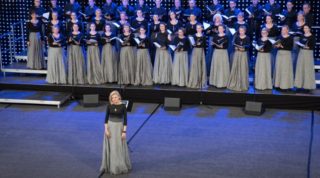
The women’s a capella singing ensemble Latvian Voices has become one of Latvia’s best known musical exports – performing worldwide, and enrapturing audiences and listeners with their beautiful singing and soaring harmonies. The group, who will celebrate their 10th anniversary in December 2019, also recently organized their own vocal festival in Valmiera, Latvia. Their most recent album (their seventh) – Sudrabs (or ‘Silver’) was released in 2018, and the singers on the album are Laura Jēkabsone, Laura Leontjeva, Zane Stafecka, Beāte Locika, Marta Lortkipanidze, Dita Belicka and Elīna Ose.

According to the group, the title Sudrabs was chosen because ‘Silver is a very versatile material … silver is often associated with human emotional and spiritual maturity’, which is appropriate, considering the maturity displayed throughout the album.

Latvian folk songs continue to be an essential element of the ensemble’s repertoire, and the selections on Sudrabs reconfirm their innate ability to interpret and perform these songs, even in markedly different styles than the originals. There is the exuberant energy of ‘Kad es gāju tauteņos’ and ‘Es par bēdu nebēdāju’, and the playfulness of ‘Aiz upītes es uzaugu’, with its jazzy interlude in the middle. The group also offer their version of one of the most beautiful folk songs from Latgale, ‘Kur gaismeņa zyla ause’, a song about a man courting a young girl, but her family is reluctant for her to leave the homestead, but she insists she is ready to go. Though a lovely interpretation, the group has inserted unrelated verses into the song, which slightly distract from the story.

Though not a folk song, ‘Piekūns skrien debesīs’, originally performed by the group Jauns mēness, receives a similarly reverent interpretation, bringing forth the mystical and spiritual aspects of this song, creating a kind of hypnotic meditation.

The group also continue to display their abilities to compose new music as well – Jēkabsone proves to be an accomplished songwriter with songs like ‘Sudraba mēness’, ‘August Clouds’ (lyrics by Jānis Strazdiņš), and ‘In Time of Silver Rain’ (lyrics by American poet Langston Hughes), with the vocal performances providing a memorable musical interpretation of this poem of rebirth.

Though their arrangements and performance of well known pop songs like Seal’s ‘Kiss from a Rose’ and Cyndi Lauper’s ‘True Colors’ are impeccable, one does get a feeling that perhaps a capella versions of these once ubiquitous songs might not have been necessary. Still, that is balanced out with their achingly beautiful arrangement of Coldplay’s ‘Fix You’, which even enhances the original – no mean feat, considering how big a hit the song was for the band. The melancholy, though hopeful song, reaches an emotional climax with the voices reproducing the fifths of the guitar solo in the original, and, with just their voices, create a moving version of this cathartic song.

Combining their mastery of singing with both popular songs and Latvian folk songs, Sudrabs is a remarkable achievement. With their soaring voices, engrossing arrangements, and singular talent, the women of Latvian Voices confidently show their ability and skill over a variety of styles and genres, making for a transcendent and emotionally rich listen.

For further information, please visit the Latvian Voices website.

Sudrabs

Latvian Voices

2018

Track listing

  1. MLK
  2. Keidas
  3. Kad es guoju tauteņos
  4. Es par bēdu nebēdāju
  5. Aiz upītes es uzaugu
  6. Kur gaismeņa zyla ause
  7. Piekūns skrien debesīs
  8. Sudraba mēness
  9. August Clouds
  10. Kiss from a Rose
  11. In Time of Silver Rain
  12. True Colors
  13. Life is a Game
  14. Fix You

Egils Kaljo is an American-born Latvian from the New York area . Kaljo began listening to Latvian music as soon as he was able to put a record on a record player, and still has old Bellacord 78 rpm records lying around somewhere.

Percussion ensemble Kanisaifa melds Latvian folk songs and world music elements

Latvian percussionist Nils Īle has, for decades, been working with and investigating world drumming techniques and sounds. He has traveled all over world, from Africa to Asia and throughout Europe, gathering knowledge and musical experience. He also has founded a drumming studio, which is, according to his website, a “place where both seasoned musicians and the musically curious can come to learn about rhythmic composition”.

That creative atmosphere at Īle’s studio led to the foundation of the ensemble Afroambient in 2001, considered to be the first such ethno-percussion ensemble in Latvia. Over time, the ensemble evolved, and adopted a new name – Kanisaifa – a name that Īle says came to him in a dream. The group released their first album – Atdzīvinot vēju (Or ‘Reviving the Wind’) in 2018. The album mixes percussion together with Latvian folk songs and world music elements.

Much of the album has an atmospheric and dreamy quality to it, such as in the introductory track, appropriately called ‘Sākums’ (or ‘Beginning’), an instrumental work that combines percussion, stringed instruments, sound effects and a wordless vocalization. Using various instruments and sounds, over the course of the track’s eleven minutes, the ensemble creates a multi-layered musical painting.

The mystical ‘Melni vērši’ is based on a Latvian folk song, and Kanisaifa’s performance of this song is particularly memorable, as their percussion-heavy interpretation brings out the otherworldly elements of this song about what appear to be black bulls swimming in the water, but are actually horses with silver bridles.

There are quite a few Middle Eastern elements throughout the album, such as on the hypnotic ‘Vilku deja’ and the passionate ‘Ja dust’. Both songs feature guest musician and vocalist Hamidreza Rahbaralam from Iran, who some will know from his work with the instrumental ensemble Dagamba. Rahbaralam’s vocals and percussion add an additional dimension to these songs, enhancing the world music elements even further.

The record concludes with the – as the group call it – ‘intuitive improvisation’ ‘Atdzīvinot vēju’. As it is an improvisation, the work has a formless, meandering quality to it, but, at almost eighteen minutes in length, some listeners may find it a bit hard to follow. Particularly the last five minutes, which are almost entirely just the sounds of a vargan (or Jew’s harp), a single pitched instrument. Though this gives this performance an ethereal quality, it goes on a bit longer than might be necessary.

Nils Īle and the members of Kanisaifa have brought together not just their musical talents, but a wide variety of percussive instruments (more than a dozen different percussive instruments are listed in the credits) to create a broad sonic palette that is woven throughout Atdzīvinot vēju. Though there is an abundance of percussion, the performances are never noisy or overpowering – quite the opposite, using these drums and other instruments, the group has put together a meditative, melodious and immersive record.

For further information, please visit the Kanisaifa website and the Nils Īle Studio website.

Atdzīvinot vēju

Kanisaifa

NABA Music / Melo Records, 2018

Track listing

  1. Sākums
  2. Melni vērši
  3. Vilku deja
  4. Kalnos jau snieg
  5. Piesaukšana
  6. Sabāra
  7. Senegāla
  8. Princes ar pērtiķi
  9. Ja dust
  10. Atdzīvinot vēju

Egils Kaljo is an American-born Latvian from the New York area . Kaljo began listening to Latvian music as soon as he was able to put a record on a record player, and still has old Bellacord 78 rpm records lying around somewhere.

Compositions by Kalniņš released as part of Latvian Centenary collection

Latvian composer Imants Kalniņš, throughout his long career, has composed many beloved songs and melodies. Though perhaps slightly better known for his popular songs, performed by groups like Menuets and Turaidas roze, many of his symphonic works have had enduring appeal and remain in the public consciousness. His 4th symphony, with its rock inspired rhythms and arrangement, has long been a defining work in Latvian academic music.

Beyond his 4th symphony, Kalniņš has composed many noteworthy and memorable symphonic works. Recognizing this, the Liepāja Symphony Orchestra, along with conductor Atvars Lakstīgala, as well as guest conductor Māris Sirmais, recorded a number of Kalniņš’ orchestral works, both past and recent compositions. The two disc collection, simply entitled Imants Kalniņš, was released in 2018 by the Latvian national music label Skani as part of their Latvian Centenary collection. The album includes Kalniņš’ 5th and 7th symphonies, his Oboe Concerto, and the orchestral work entitled ‘Santa Cruz’.

‘Santa Cruz’, conducted by Māris Sirmais, was composed in 2015 and includes many of the elements that have endeared Kalniņš to many listeners. This brief orchestra miniature, with its gently flowing melody in the sounds of the plucked strings, manifests a musical landscape with picturesque scenery.

Kalniņš has also composed for theater and film, and many of the dramatic elements from those mediums can be heard in his 5th symphony, composed in 1979. The first movement is full of tension, with the strings in constant motion, and then this tension transitions to a slower, more ominous theme, before the agitation returns towards the end, with pointed horn bursts to accentuate the drama. The work comes to a harmonious end in the fourth movement, with expands to a triumphant, celebratory theme, punctuated with cymbal crashes and a percussive rhythm, and then a slow fade continues all the way to the end of the work, and the somber melody dissipates into silence. Conductor Lakstīgala accentuates the dramatic in this work to great effect, creating a truly cinematic interpretation of Kalniņš’ composition.

The Oboe concerto, composed in 2012, is one of Kalniņš more playful and joyful works. This performance features oboist Pēteris Endzelis, and his adept and vivid interpretation results in a memorable rendition of this composition. The first movement, with its almost dainty melody, presents a mystical song of conjuring, which may remind some of Kalniņš’ popular music, which often had mystical and mythological lyrical themes. The calm and hopeful beginning of the second movement gives way to Kalniņš’ trademark undulating strings, setting the stage for the dance that begins the final movement, which ends on a reassuringly hopeful note.

Kalniņš’ most recent symphony, his seventh, was composed in 2015, has sentimental and nostalgic elements. Pastoral elements fill the first movement, perhaps suggesting a rural landscape of childhood. However, there are still elements of foreboding throughout the work, as things reach a climax in the third movement, where elements of conflict appear in the horns and percussion, almost like an alarm. The military-like beginning of the final movement, with its deliberate rhythm and relentless advance, continues with clocklike precision with the help of Sirmais’ exact conducting.

Imants Kalniņš, for many decades, has been a leading and defining figure in Latvian music. His signature style can be heard throughout the performances on this album, and are given vivid textures and rich colors, aided by the Liepāja Symphony Orchestra and conductors Atvars Lakstīgala and Māris Sirmais. These recordings display Kalniņš’ acute sense of melody and dramatic abilities, and provide for an engrossing and enjoyable journey through Imants Kalniņš’ symphonic works.

For more information, please visit the Skani website and Liepāja Symphony Orchestra website.

Imants Kalniņš

Liepāja Symphony Orchestra

Skani 067, 2018

Track listing

CD 1

1. Santa Cruz (2015)

Symphony No. 5 (1979)

2. Allegro appassionata

3. Sostenuto dolce

4. Allegretto festivo

5. Largo con grazia

CD 2

Oboe Concerto (2012)

1. ♩= 120

2. ♩ = 60

3. ♩.= 80

Symphony No. 7 (2015)

4. Allegro

5. Andante

6. Allegro

7. Grave

Egils Kaljo is an American-born Latvian from the New York area . Kaljo began listening to Latvian music as soon as he was able to put a record on a record player, and still has old Bellacord 78 rpm records lying around somewhere.