Songs about love, babies and much more

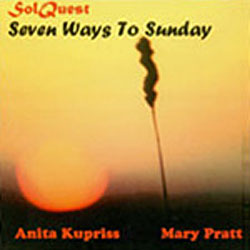
I am normally not a fan of folk rock, especially not women’s folk rock. I guess I haven’t been in touch with my feminine side for a while, or perhaps decades of listening to rock music have taken their toll on me, but it seems that hearing women sing songs about love, flowers and babies (and other such girly things) usually leaves me rolling my eyes and getting sleepy. So much to my surprise I really liked Seven Ways to Sunday, the debut album from SolQuest, two women singers and songwriters from Boston.

The reason I even have this album is due to my participation in a Latvian music camp in Ogre, Latvia, in the summer of 2000. In one of my more daring moves, I decided to take part in the choir there, although I wasn’t much of a singer. My singing remained mediocre, but the choir experience was particularly memorable because one of the choir directors was Anita Kupriss, a Latvian from Boston. Besides being a great instructor and having a tremendous voice, the one thing I will always remember about Kupriss was her incomparable enthusiasm—she had the energy of a dozen people (or one person with a dozen cups of coffee). This energy was infectious and was one of the main reasons why in just a few short days the choir was able to perform a number of pieces successfully. Kupriss also has been a member of Kolibri, the Latvian vocal and instrumental ensemble, and has more than a dozen recordings to her credit.

In the group SolQuest, Kupriss teams up with Mary Pratt, who has been singing in selective choral groups large and small since her youth. A vocalist, guitarist and songwriter she has appeared at coffee houses and clubs, weddings, parties and church-related functions. Pratt combines her classical voice training with years of experience in folk, jazz and popular genres, and this all comes together in SolQuest’s album.

One of my favorite songs on the record is the opening number, “I’ve Changed,” a soulful song sung by Kupriss about a woman who’s no longer “that girl you knew” and whose “soul wants to move on.” I particularly like the jazzy guitar introduction to the song. This song also shows that even though it is folk music, that doesn’t mean it cant have attitude.

A reason I like this recording so much is the ease by which Kupriss and Pratt move between styles and genres. From the bluesy “Why Cats are Like Men” (featuring some great slide guitar by Pratt), to the more traditional-sounding “Out in the Fields of God” (lyrics by Elizabeth Browning) and “The Journey,” Pratt’s and Kupriss’s voices adapt to the new styles without any difficulty. No surprise then when they describe their music as “eclectic acoustic.”

Another favorite is “Sing with Joy, Delight and Grace,” a very beautiful song by Pratt that is based upon a Latvian funeral song, and is a “positive perspective on death.” This song features Kurpiss playing the kokle. Particularly touching is the final line of the song, “I have sung my evensong, I will see this world no more.”

“Winter Solstice” is another beautiful song based on two Latvian folk melodies—“Pūti, pūti ziemelīti” and “Sudrabiņa lietiņš līja”—but in an interesting variation the refrain “Kaladū” has been replaced with “This I know.”

The blues are also present in “Managed Care Blues,” a song about the wonders of managed care in the United States. Pratt tells a story about seeing her feet turn blue, and then her troubles getting to the hospital (which include not being able to get through because of an answering service maze, not being able to afford an ambulance, and a rather disasterous attempt to get there by bicycle).

And, of course, there are songs about love and babies. A folk record without songs about them is like a western movie without a cowboy riding off into the sunset. I especially like “Bittersweet Love,” due to the very pretty piano part. The appropriately titled “Lullaby (for Anne)” is a simple melody, yet it is effective through its simplicity. This is a song that could very well be sung to a small child.

Traditional in certain ways, non-traditional in others, Seven Ways to Sunday is a record full of great songs and performances. Even though there are many different styles represented on this release, the songs flow very well together to produce the truly eclectic and distinct picture that is SolQuest. Folk fans will find this a refreshing twist on the genre, and even non-folk fans (like myself) can find much to enjoy on this well-crafted work, as you can tell that Pratt and Kupriss had a blast making this album. If you are ever in Boston, you can see them play at open mike nights at Moonshadow Cafe, Acton Jazz Cafe and Passims. I’m looking forward to hearing more from this very talented duo.

Details

Seven Ways to Sunday

SolQuest

SolQuest,  2000
Egils Kaljo is an American-born Latvian from the New York area . Kaljo began listening to Latvian music as soon as he was able to put a record on a record player, and still has old Bellacord 78 rpm records lying around somewhere.

Tumsa offers memorable hooks and melodies

Katram savu Atlantīdu

Looking over the handful of reviews that I have done for Latvians Online, one thing that seems to be in common is that almost all the groups are old. Most of the groups I review have been around since the 1970s or 1980s. Groups such as Līvi, Jumprava, Credo and Bumerangs have all enjoyed lengthy careers in the Latvian music world. This troubled me considerably. It made me feel much older than I am and I began to wonder if there were any new groups that would carry the flag of rock music. Or has the slow creep of mass-produced pop infected Latvia the same way it has infected most of the world?

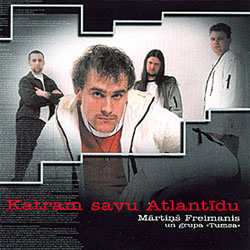
One of the reasons that I liked the recent SuperIzlase compilation so much is that it provided a good balance of old and new and of pop and rock, and I bought it not for the all the groups that I already knew, but in search of new faces and sounds. One of the songs I liked the most from that compilation was the tune “Lietus dārzs” by a band called Tumsa. Though a melancholy song, it was very catchy and I really liked the lyrics: “Un saulē izdeg viss Tavs lietus dārzs” (Your entire garden of rain dried in the sun). I liked the song so much that I picked up the album, Katram savu Atlantīdu, and I can safely say that Tumsa is well-equipped to carry on the mantle of rock well into the future.

Actually, the full name of the group is “Mārtiņš Freimanis un grupa Tumsa.” Freimanis wrote all the lyrics and most of the music, sings and plays guitar, so I suppose he deserves top billing. The rest of the group includes Jānis Daugalis on bass guitar and vocals, Haralds Drekslers on rhythm and lead guitar, Kaspars Boroduško on drums and Einars Kokins on “skaņa” (which I guess means he’s the one doing the sound effects on the record).

Tumsa is based out of Liepāja. Katram savu Atlantīdu is the group’s second album, the first being Putni.

My favorite track on the album is the opening song, “Viņš (ir mazliet savādāks),” a great, uptempo introduction to the album. An infectious song, it practically begs for the listener to sing along on the “Hei la la” part.

Most of the album has a melancholy feel, but thankfully it never descends into the whiny, mopey, “woe is me” style that is in a lot of music today. “Klauns” is a sad song that is criticial of the phoniness that people adopt sometimes: “Tu esi tikai klauns, tavs mūžs deg cauri smiekliem, tu neesi nekas daudz” (You are only a clown, your future burns through laughter, you are not much of anything).

Other favorite songs on the album are “Vēlreiz, nekad vairs” and “Katram sava Atlantīda,” both catchy songs that encourage me to hit the “back” button on my CD player—and both songs I think would go over well live in concert.

The album hits a few rough spots in the home stretch. That’s where Freimanis exercises his English language ability, and the results are about what you would expect. A few awkward lyrics here, a few unusually pronounced words there, but otherwise solid efforts. You would think by now MICREC would have hired an English language consultant (I’ll do it!) to polish up stuff like this. But no matter, as writing songs in English is something I would still encourage these guys to do. It can only get better from here. However, with four songs in a row in English (“Lucky,” “I’m in Love,” “Someone” and “Freak”) it might be one or two too many.

Overall, a great album, full of memorable hooks and melodies, and an album I’d recommend to anyone looking for something new in the Latvian music world. Tumsa is currently in the studio working on their third record, so I expect big things from these guys in the future.

Details

Katram savu Atlantīdu

Tumsa

MICREC,  2000

MRCD 137

On the Web

Tumsa

The Liepāja-based group’s official Web site. LV

Egils Kaljo is an American-born Latvian from the New York area . Kaljo began listening to Latvian music as soon as he was able to put a record on a record player, and still has old Bellacord 78 rpm records lying around somewhere.

As compilations go, this one is super

The compilation album has long been a part of Latvian music history. In earlier years, very few groups were able to record full-length albums. In fact, unless you had the clout (and not to mention the Soviet sympathy) of someone like Raimonds Pauls, putting out an entire album was next to impossible. However, many compilation records were being released during Soviet times, the most well known being the long running Mikrofons yearly release. These would allow many bands that would normally not be able to get their music heard on a record to do just that, even if only one song.

Those days have passed, and now most any band that has a bit of money, a few songs and maybe a moderate amount of talent can release an album—visit your local šlāgermūzikas section to see this in action. So where does this leave the compilations? As record executives in the United States have recently realized, and as their counterparts in Western Europe have long since known, a compilation can be a good marketing tool. Put together a bunch of songs from many different artists on one album and maybe people will buy it for the selection… and then continue to buy albums of specific artists they like.

This idea is not lost on Latvian record executives either. SuperIzlase, released late last year, contains recent hits from the entire spectrum of Latvian artists from three of the major labels—UPE, Platforma and Mikrofona ieraksti. The executives realize that by working together they can promote their own artists with little cost but ideally with high return. Because compact discs in Latvia are expensive, few consumers will throw down their hard-earned money on a CD from which they haven’t heard any songs.

Reviewing such compilations is a difficult task, however, mainly due to the incredibly varied nature of the songs contained on one. Though I like to think of myself as a fairly open-minded music listener, there are certain styles of music that are simply not for me. So instead of critiquing the music contained on this record, I will do my best to describe what I hear and you can make your own informed decision about what you might like.

Many of the songs on this record I had known before even purchasing this record, probably due to the fact that in marketing terms, I fall into the category of “loyal rock fan.” In other words, if I have been a fan of a rock band for a while, and they release a new record, I am likely to purchase it, sound unheard, simply because I am loyal. Established rock groups are well represented on this record, with groups like Līvi (“Mana vienīgā ziņģe”), Prāta Vētra (”Īssavienojums,”  the Latvian version of their Eurovision hit “My Star,” but with different lyrics), Credo (“Dzīvē gadās arī tā”), Labvelīgais tips (“Es nav redzējis Tevi jau sen”), Bet Bet (“Es vaicāju mātei”) and Ainars Mielavs (“Labradors”). Igo also checks in with an uncharacteristically (at least compared to his newer material) hard rocking song, “Cerību laiks”.

Though already well-schooled in the subject of Latvian rock, I did learn a few things from this record, as there were groups that I was unfamiliar with, but enjoyed their songs. These included Tumsa (“Lietus dārzs”), Autobuss debesīs (“Sitiet bungas, mani mīļie”) and The Hobos (“Midnight Lover”). All three of these groups are now on my shopping list for the next time I return to Latvia.

But of course, it is not only rock. Dance and pop make up a bulk of this record as well. The album starts off with the A-Eiropa (or Austrum Eiropa) dance hit “Tuvumā, tālumā.” The group Braithouse contribute their dance song, “So Much Fun,” while Lilita Ozoliņa and Viesturs Dūle offer “Tu mans mīļais čipendeils.”

If “diva pop” (such Mariah Carey or Whitney Houston) is your bag, then you will most likely like Linda Leen and her song “Let’s Go Insane.” She is an amazing singer and has learned how to sing in English remarkably well. Dāmu pops also have a new version of their older song, “Varbūt rīt,” on this record, complete with new dancable beat and thumping bass line. However, I prefer the original version on the Mikrofons 1990 rokaptauja.

“Kiddie” or “bubblegum” pop (such Backstreet Boys or Britney Spears) is also alive and well in Latvia, evidenced by the Gunārs Kalniņš and Kristena duet “Baltā dziesma.” This song also proves the existence of some requirement that every compilation ever released in Latvia has to have a Raimonds Pauls song on it (which is not necessarily a bad thing sometimes).

Songs in a more humorous vein also are here: from Savādi gan there’s “Dzīve ir skaista,” while Reigani, Prata Vētra’s Estonian alter egos, have their song “Tere, tere traktors” (which also includes the lyric, “Bulle, bulle, buldozers”).

The only complaint I have about this release is that we are never told what album these songs can be found on. Knowing that would make shopping for further releases from these artists slightly easier.

Of the very many compilations released in Latvia throughout the years, I would count this as one of the better ones. The range and diversity of the artists makes this a good investment for anyone, even if you don’t know a thing about what music is popular in Latvia these days or are a dyed-in-the-wool, long-time music fan. Thankfully, the music companies got together for this compilation and even promise there will be another SuperIzlase in 2001. If it is as good as this one, then we have something to really look forward to.

Details

SuperIzlase

Various artists

MICREC,  2000

Egils Kaljo is an American-born Latvian from the New York area . Kaljo began listening to Latvian music as soon as he was able to put a record on a record player, and still has old Bellacord 78 rpm records lying around somewhere.