Latest by Labvelīgais Tips lacks classic song

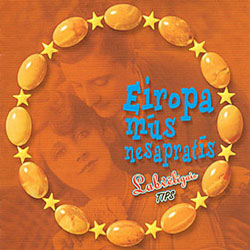
Eiropa mūs nesapratīs

One of the few things left to depend on in this world is the yearly arrival of a Labvelīgais Tips album every April 1. For the last seven years, each April Fool’s Day brings another release from this ensemble, making them probably the most prolific band in Latvia. This past April 1 came Eiropa mūs nesapratīs, a collection of 14 songs.

Labvelīgais Tips is a band that is hard to categorize. Humor is a major part of their arsenal, and many of their songs are in the schlager style (though a more "modern" interpretation of that form). Their songs are about simple topics, finding the humor in everyday occurences. The band itself is larger than your everyday rock band: besides the usual guitar, bass and drums, they add trumpet, flute and accordion, not to mention a string quartet.

I only became a fan of Tips upon the release of their "best of" collection in 1999. I had heard a few of their songs prior to that, but I suppose I wasn’t yet able to get the joke at that point, as Labvelīgais Tips have a very unique sense of humor that takes a certain mentality to appreciate. But after listening to the collection, and hearing tales of omnibuses in people’s backyards and brothers in Chicago, I was hooked. And though I didn’t get all the jokes (it seems most are geared towards people who have spent their lives in Latvia), I began to listen to them much more frequently. I also picked up their 2000 release Atkārtot!, which was another great collection of songs.

Surprisingly, I found Eiropa mūs nesapratīs a bit disappointing. Though the classic Tips "sound" was there, after listening to the album a number of times it seemed to me that something was missing: a truly classic Tips song. The "best of" collection was full of these classic songs, and Atkārtot! added a few more, but there aren’t really any songs on Eiropa that can stand alongside their earlier material. Not that the songs are bad: All the songs are solid, but there aren’t any songs that I would look forward to hearing if I were to see these guys in concert.

The songs continue to have an even more eclectic sound, with influences ranging from reggae to Latin. "Koka klucis Konstantīns" sounds like a combination of Latin and lounge music. The song "Pazudis ir miegs" also has a Latin sound, but also strikes me as that "Russian-Latin" sound that many Raimonds Pauls songs in the 1970s seemed to have.

The old Latvian standard, "Augstu laimi un prieku" (the "Lai dzīvo sveiks!" song), is redone a la Tips, this time in a Mexican mariachi style.

Many of the songs here defy description, which is part of the charm of Labvelīgais Tips, though some may be turned off by the constant changing of styles. There is always some new sound, some new surprise on each of their records. Even the lyrics defy description, as some of the songs left me scratching my head and thinking, "What was THAT about?" Songs such as "Smilšu krasas portfelīts", "Dubļi mani dubļi" and "Tu, mana ģeometriskā" either show off the creativity of the band or leave some thinking, "These guys will write a song about anything."

"Eiropa mūs nesapratīs" is a song in waltz style that tells the story of a Latvian guy and his great-great-great-great-great (and a few more greats) grandfather, both of whom have been to neither Germany nor Denmark and don’t have any Hungarian or Irish friends. This probably alludes to the fact that to truly appreciate and understand Labvelīgais Tips you have to be a Latvian living in Latvia.

The packaging of this album, though it looks nice, also is lacking in a few ways. Particularly annoying is the absence of lyrics. Having those would make a lot of their jokes easier to understand. Also, though the members of the band are listed, nowhere is it written what they do or what instruments they play.

Maybe the need to release an album every year has started to take its toll and isn’t giving them enough time to properly craft an album. Many of the songs wind up sounding a bit repetitive, often repeating verses and choruses a few more times than necessary. Perhaps the reason that Atkārtot! was such a good album was that it was two years after the last recording of new material.

Die-hard Tips fans will like this record. I don’t dislike it, but don’t think it will be making it into my CD player with any great frequency. If you don’t have any Tips recordings, this is probably not the one to start with. I’d recommend starting with the "best of" release. If you really like what you hear there, you might just like Eiropa mūs nesapratīs.

Details

Eiropa mūs nesapratīs

Labvēlīgais Tips

MICREC,  2001
Egils Kaljo is an American-born Latvian from the New York area . Kaljo began listening to Latvian music as soon as he was able to put a record on a record player, and still has old Bellacord 78 rpm records lying around somewhere.

Latest Piecīši re-releases recall the 1960s

Čikāgas piecīši

This time around, the venerable Čikāgas Piecīši have dug even further into their historical archives to present to their fans around the world some of their classic albums. These albums date back to the 1960s, but have been converted to compact disc format so that a completely new generation can hear what the Piecīši experience was all about.

And how do these latest re-releases fare today in the 21st century? After all, they were recorded in a completely different time—a time of Kennedy and Johnson, Vietnam, the Cold War in full swing and the thought of Latvian independence an impossible fantasy. Are these records merely relics of a long-gone age, or are they still relevant today in the Latvian world? Is it possible for a reviewer to review albums released years before he was born?

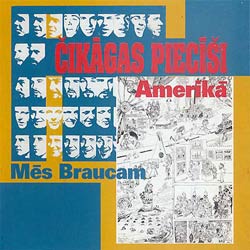
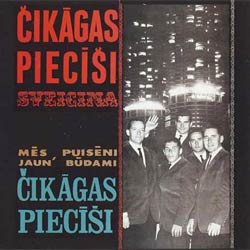
We will get to those questions in a moment. But a bit about the records themselves. Over two CDs you get four Piecīši original recordings: Amerikā, Mēs braucam, Čikāgas Piecīši sveicina and Mēs, puisēni, jaun’ būdami. Over the years the Piecīši have evolved as a band, starting as a more humorous, satirical group, but later developing into a more serious ensemble. These records show them in their earliest phase, as satirists singing about growing up Latvian and living a Latvian lifestyle far away from Latvia. The ups and downs of such an experience are taken in stride, but never with an overly critical eye.

From listening to these records, it seems not much has changed since the 1960s in the thoughts and beliefs of American Latvians. The song “Sabiedriskā tiesā” from the Amerikā album is a rebuttal against an older generation’s belief that the younger generation is not doing enough to maintain their “cultural heritage.” The song mixes Latvian and English words (for example, “What the heck jūs gribiet, actually, no mums?”) to prove the point that even though you can’t escape the American influence, the Latvian culture is still present.

Another concern that existed then and still exists today is the fear of slow death by assimilation. This is parodied in the song in the song “Latvieši mēs esam” off the Čikāgas Piecīši sveicina album, in which Jānis Bērziņš is now known as John Birch, but as the Piecīši point out, “Latvieši kā tauta, nav maisā bāžama!” Though you can’t escape assimilation, that doesn’t mean you have to abandon the fight.

The soul of the Piecīši has always been Alberts Legzdiņš, their principal songwriter. But the Piecīši have always been a team effort, as the other members take part in songwriting as well. Most every member of the band sings at one point or another. Ironically, these records were recorded by six “piecīši”; besides Legzdiņš, other participants were Juris Strautmanis, Jānis Rinkuss, Ilmārs Dzenis, Uldis Ievāns and Ģirts Puriņš.

The Piecīši had not just songs in their repertoire, but also would do outright comedy bits during their concerts. A few of these are captured here. “Pie tālruņa,” off the Amerikā album, contains a few telephone conversations from a Latvian who is being assaulted by every Latvian group imaginable—scouts, the choir, folk dancing group and others. “Sestdienas skola,” also off the Amerikā album, contains an argument between a husband and wife about who should take the kids to Latvian school.

A few Latvian folk songs and other Latvian classics show up as well, proving that the Piecīši are well aware of their cultural background—“Āzīti, bucīti,” “Zaļā krūze,” “Dzeltens manis kumeliņš,”  “Es redzēju jūriņā” and a personal favorite, “Mēs puisēni jaun’ būdami.” Of course each song gets the Piecīši treatment. “Zaļā krūze,” for example, gets additional lyrics, after the “Pretīm nāca jauni puiši…” part, the Piecīši add “Lieli puiši, resni puiši, dumji puiši, klīvlandieši!”

But it’s not just humor and comedy. The Piecīši also get serious on a number of songs. The aforementioned folk song “Es redzēju jūriņā” is a particularly sad song about a poor guy who gets jewelry from the Jūras māti (Sea mother) to give to his fiancee, only to return to find that she took off with some other guy. Another sad song is “Rudens vēji,” a song of separation.

One of my favorite albums when I was really little was Mēs, puisēni, jaun’ būdami, and I used to play that record so often that after a while it was so scratched up and beaten up that it became practically unplayable, so I was very happy to get this great album on CD again. One of my favorite songs from that record was “Skudru kāzas,” which practically sounds like a children’s song, and has a great banjo part (not an instrument you expect in Latvian music!). Another favorite is “Ak tu mūžiņ’,” a song about a girl who finds a toad prince and brings him home, only to have her father throw the guy out of the house after his transformation from toad to man. The moral of the story? As the father says, “Kas krupis bijis, tas krupis būs, un krupis paliksies” (What was a toad, will be a toad, and will always stay a toad). Words to live by!

In their quest to bridge the gap between the younger generation and older generation, the Piecīši believe that singing American songs, but with Latvian lyrics, can help the two generations communicate better. In fact, every record (not including “Mēs, puisēni, jaun’ būdami”) has an “Amerikāņu popūrijs,” a compilation of bits and pieces of “Latvianized” American songs. The trick is figuring out exactly what song is being parodied. Sixties music is not my speciality, so I can only get the easy ones (like The Beatles’ “I Wanna Hold Your Hand” and “Yellow Submarine,” and a few others).

Of course, I don’t get all the jokes, but that doesn’t stop me from enjoying all of these albums. I don’t get all Labvelīgais Tips jokes either, but I like them, too. And some of the jokes (and references) are quite dated—Krushchev is mentioned a few times—belying the age of these recordings.

My only complaints about these releases are the same as in my previous Piecīši review. The packaging is from the school of minimalism. Also, the sound quality is lacking on a few of the tracks (in some places it sounds like the songs were directly lifted from an actual record, scratches and pops and all!) but I think that adds to the charm.

But is it still relevant? Are these just museum pieces, simple curios for the younger generation? I would like to believe not—although these records predate my birth by more than a decade I enjoyed listening to all of them. Besides, I think they have withstood the test of time quite well. Themes from their songs still apply today. In a world where The Beatles can still today sell millions of records (witness their 1 compilation, all songs recorded more than 30 years ago but still flying out of the stores) I think there is still a place for old Piecīši records even in this oh-so-modern age.

Details

Čikāgas Piecīši sveicina and Mēs, puisēni, jaun’ būdami

Čikāgas piecīši

Balss,  2000

Egils Kaljo is an American-born Latvian from the New York area . Kaljo began listening to Latvian music as soon as he was able to put a record on a record player, and still has old Bellacord 78 rpm records lying around somewhere.

Latest Piecīši re-releases recall the 1960s

Čikāgas Piecīši

This time around, the venerable Čikāgas Piecīši have dug even further into their historical archives to present to their fans around the world some of their classic albums. These albums date back to the 1960s, but have been converted to compact disc format so that a completely new generation can hear what the Piecīši experience was all about.

And how do these latest re-releases fare today in the 21st century? After all, they were recorded in a completely different time—a time of Kennedy and Johnson, Vietnam, the Cold War in full swing and the thought of Latvian independence an impossible fantasy. Are these records merely relics of a long-gone age, or are they still relevant today in the Latvian world? Is it possible for a reviewer to review albums released years before he was born?

We will get to those questions in a moment. But a bit about the records themselves. Over two compact discs you get four Piecīši original recordings: Amerikā, Mēs braucam, Čikāgas Piecīši sveicina and Mēs, puisēni, jaun’ būdami. Over the years the Piecīši have evolved as a band, starting as a more humorous, satirical group, but later developing into a more serious ensemble. These records show them in their earliest phase, as satirists singing about growing up Latvian and living a Latvian lifestyle far away from Latvia. The ups and downs of such an experience are taken in stride, but never with an overly critical eye.

From listening to these records, it seems not much has changed since the 1960s in the thoughts and beliefs of American Latvians. The song “Sabiedriskā tiesā” from the Amerikā album is a rebuttal against an older generation’s belief that the younger generation is not doing enough to maintain their “cultural heritage.” The song mixes Latvian and English words (for example, “What the heck jūs gribiet, actually, no mums?”) to prove the point that even though you can’t escape the American influence, the Latvian culture is still present.

Another concern that existed then and still exists today is the fear of slow death by assimilation. This is parodied in the song in the song “Latvieši mēs esam” off the Čikāgas Piecīši sveicina album, in which Jānis Bērziņš is now known as John Birch, but as the Piecīši point out, “Latvieši kā tauta, nav maisā bāžama!” Though you can’t escape assimilation, that doesn’t mean you have to abandon the fight.

The soul of the Piecīši has always been Alberts Legzdiņš, their principal songwriter. But the Piecīši have always been a team effort, as the other members take part in songwriting as well. Most every member of the band sings at one point or another. Ironically, these records were recorded by six “piecīši”; besides Legzdiņš, other participants were Juris Strautmanis, Jānis Rinkuss, Ilmārs Dzenis, Uldis Ievāns and Ģirts Puriņš.

The Piecīši had not just songs in their repertoire, but also would do outright comedy bits during their concerts. A few of these are captured here. “Pie tālruņa,” off the Amerikā album, contains a few telephone conversations from a Latvian who is being assaulted by every Latvian group imaginable—scouts, the choir, folk dancing group and others. “Sestdienas skola,” also off the Amerikā album, contains an argument between a husband and wife about who should take the kids to Latvian school.

A few Latvian folk songs and other Latvian classics show up as well, proving that the Piecīši are well aware of their cultural background—“Āzīti, bucīti,” “Zaļā krūze,” “Dzeltens manis kumeliņš,”  “Es redzēju jūriņā” and a personal favorite, “Mēs puisēni jaun’ būdami.” Of course each song gets the Piecīši treatment. “Zaļā krūze,” for example, gets additional lyrics, after the “Pretīm nāca jauni puiši…” part, the Piecīši add “Lieli puiši, resni puiši, dumji puiši, klīvlandieši!”

But it’s not just humor and comedy. The Piecīši also get serious on a number of songs. The aforementioned folk song “Es redzēju jūriņā” is a particularly sad song about a poor guy who gets jewelry from the Jūras māti (Sea mother) to give to his fiancee, only to return to find that she took off with some other guy. Another sad song is “Rudens vēji,” a song of separation.

One of my favorite albums when I was really little was Mēs, puisēni, jaun’ būdami, and I used to play that record so often that after a while it was so scratched up and beaten up that it became practically unplayable, so I was very happy to get this great album on CD again. One of my favorite songs from that record was “Skudru kāzas,” which practically sounds like a children’s song, and has a great banjo part (not an instrument you expect in Latvian music!). Another favorite is “Ak tu mūžiņ’,” a song about a girl who finds a toad prince and brings him home, only to have her father throw the guy out of the house after his transformation from toad to man. The moral of the story? As the father says, “Kas krupis bijis, tas krupis būs, un krupis paliksies” (What was a toad, will be a toad, and will always stay a toad). Words to live by!

In their quest to bridge the gap between the younger generation and older generation, the Piecīši believe that singing American songs, but with Latvian lyrics, can help the two generations communicate better. In fact, every record (not including “Mēs, puisēni, jaun’ būdami”) has an “Amerikāņu popūrijs,” a compilation of bits and pieces of “Latvianized” American songs. The trick is figuring out exactly what song is being parodied. Sixties music is not my speciality, so I can only get the easy ones (like The Beatles’ “I Wanna Hold Your Hand” and “Yellow Submarine,” and a few others).

Of course, I don’t get all the jokes, but that doesn’t stop me from enjoying all of these albums. I don’t get all Labvelīgais Tips jokes either, but I like them, too. And some of the jokes (and references) are quite dated—Krushchev is mentioned a few times—belying the age of these recordings.

My only complaints about these releases are the same as in my previous Piecīši review. The packaging is from the school of minimalism. Also, the sound quality is lacking on a few of the tracks (in some places it sounds like the songs were directly lifted from an actual record, scratches and pops and all!) but I think that adds to the charm.

But is it still relevant? Are these just museum pieces, simple curios for the younger generation? I would like to believe not—although these records predate my birth by more than a decade I enjoyed listening to all of them. Besides, I think they have withstood the test of time quite well. Themes from their songs still apply today. In a world where The Beatles can still today sell millions of records (witness their 1 compilation, all songs recorded more than 30 years ago but still flying out of the stores) I think there is still a place for old Piecīši records even in this oh-so-modern age.

Details

Amerikā and Mēs braucam

Čikāgas piecīši

Balss,  2000

Egils Kaljo is an American-born Latvian from the New York area . Kaljo began listening to Latvian music as soon as he was able to put a record on a record player, and still has old Bellacord 78 rpm records lying around somewhere.