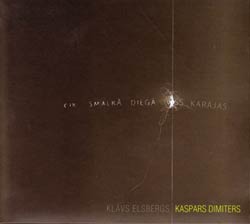
The poetry of Elsbergs gets the Dimiters treatment

Cik smalkā diegā viss karājās

Before Latvia regained independence, and before the rise of the Internet, information about things going on in Latvia was tough to get. This was especially so for those interested in Latvian music. In fact, unless you had relatives or friends living in Latvia, you wouldn’t know anything about Latvian music, except for the rare occasion when a Latvian musician or group was allowed to venture outside of Latvia.

Luckily for me, my family had friends who were still living in Latvia and who were as devout music listeners as I was, even though I was still in my early teen years then. They would send us records and cassette recordings of all the latest music, and this was my only source of information about the Latvian music world. I would listen to each tape and record numerous times until they wore out.

One of the tapes our friends sent us contained songs by Kaspars Dimiters. This cassette recording bore the brunt of my abuse, as I would listen to this one more than any other. The first time my family and I went to Latvia, I promptly went to the record store and found the album Mans kumoss pilsētas baložiem, which contained many of the songs I had loved on the cassette. This has become one of my favorite recordings by any artist and is an album I listen to frequently to this day.

As it turned out, Dimiters had written many other songs that I had liked, but I never had known who performed them. They included favorites such as “Princesīte” (from the 1981 Mikrofons record) and “Mana neveiksminiece” (from a 1982 Mikrofons “bonus” 7-inch record).

Dimiters was an important songwriter during the Soviet occupation, a time when the government often threatened him and prevented his songs from being played on the radio or television. However, as times changed so did Dimiters’ songwriting style. Many of his more recent work has slanted toward political themes and societal commentary. All in all, Dimiters has released about 10 albums.

Last year saw the release of the album Cik smalkā diegā viss karājās. Dimiters is a man of many talents. Not only does he sing, but he also plays the guitar and all the other instruments on the record, and even did all the recording and production work.

Normally, Dimiters writes both the lyrics and music to his songs, but this time he chose to add music to the poetry of Klāvs Elsbergs. All the lyrics on this record were taken from the Elsbergs collection Bēdas uz nebēdu. Elsbergs, son of famous Latvian writer Vizma Belševica, died under mysterious circumstances in 1987.

Elsbergs’ poetry contains a wide range of emotions and feelings that fit perfectly with Dimiters’ sincere and earnest delivery. Because the words are Elsbergs’, this album comes across differently than the rest of Dimiters’ recordings. Dimiters’ lyrics can be very biting and critical; in fact, some of his songs make certain listeners downright uncomfortable.

The album is on the mellow side. Many of the 19 tracks feature just guitar and vocals. However, that does not mean the record is dull, as the songs have varied tempos.

The opening track, and one of my favorites on the album, is the subdued “Viens.”

Another favorite on the record is the very sad song “Asaru krelles.” The lyrics describe a girl who makes a necklace of tears. Dimiters’ voice is ideally suited to tell the tale of this lonely girl who wonders whether someone will ever hold her.

“Es neesmu vientuļā” is a song about the dilemma of a songwriter: if you don’t feel lonely, how do you write songs for the lonely? Dimiters allows the words of Elsbergs to speak for themselves in this song, while providing a simple but effective guitar background.

Fans of the 1980s rock group Pērkons will recognize two of the songs here: “Neatvadīsimies” and “Pasniegtās rokas.” Pērkons’ interpretation of these two songs appeared on their 1987 album Labu vakar (“Pasniegtās rokas” was called “Lampas un zvaigznes” on that record). Although the lyrics are the same, it is quite a treat to hear the more stripped-down treatment of Dimiters, compared to the full band approach of Pērkons.

Many of the songs are on the slower side, but “Āmurzivs” is a more up-tempo offering from the album. The lyrics tell the tale of a boy who was thrown overboard from a ship and is struggling against the tide, trying to stay alive while watching the boat he was on get farther and farther away.

Cik smalkā diegā viss karājās is one of my favorite records of last year, from one of my favorite artists. Though most of the songs are laid back and mellow, it still strikes a chord in a listener, and Elsbergs’ lyrics are compelling listening. (Thankfully the lyrics are included, which helps the listener develop a better appreciation for his words). Dimiters’ songs, whether the lyrics were written by himself or by others, are about the importance of the words and text of the song—about getting certain thoughts across to the listener.

Hopefully this release will be a success, which will lead to Dimiters’ earlier works being re-released. Thankfully these days it is much easier to obtain music from Latvia, so perhaps this album will help introduce the rest of the world to one of Latvia’s most singular songwriters.

Details

Cik smalkā diegā viss karājās

Kaspars Dimiters

Gailītis-G,  2001
Egils Kaljo is an American-born Latvian from the New York area . Kaljo began listening to Latvian music as soon as he was able to put a record on a record player, and still has old Bellacord 78 rpm records lying around somewhere.

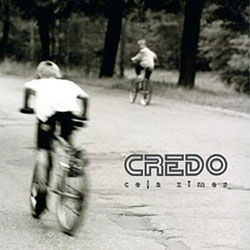
On comeback trail, Credo appears stuck in neutral

Ceļa zīmes

Hot on the heels of their excellent 2000 release Viss mainās…, Latvian rock institution Credo released their album Ceļa zīmes in 2001. With Credo on the comeback trail, Ceļa zīmes—though not a bad album—seems to find the band stuck in neutral, rather than moving forward.

The lineup on Ceļa zīmes is almost the same as on the 2000 album. Aivars Vīksna provides vocals, as well as Guntis Veits. Armands Alksnis is credited with guitar and keyboards. The change on this album is the presence of Gundars Lintiņš on drums.

The theme of the album seems to be "signals," whether by communication or by signs (hence the title of the album: Road Signs). A number of the songs are about communication of some kind.

My favorite song on the album is probably "Tāpat vien," an uptempo number about the most common of rock song topics: women! When meeting someone new, often a guy will be nervous, but if things are meant to happen, then, as the song goes, they will happen "just the same."

Guntars Račs is back to provide a number of the lyrics on the record, particularly for another favorite, "Tur aiz mākoņiem ir saule." This is a slower song, with perhaps overly simplistic lyrics, but it has a very pretty melody and perhaps the simple lyrics work best in this case. It is a song of hope, about looking beyond the clouds to the sun and the morning that lies there.

But besides those two songs, there was not that much on the album that got my attention. There are some more interesting lyrics from Račs, especially on the song "Es dzīvoju," including the line “Es jūtos kā mauka uz Marijas ielas" (I feel like a whore on Marijas Street). Perhaps Račs is lamenting how most every band in Latvia uses his lyrics!

"Īsziņa" is an ode to the mega-popular (at least in Europe) SMS message, called an "īsziņa" in Latvian. The singer is worried because he thinks he has lost a text message he received on his mobile phone. Fortunately, he is able to retrieve the message and to write back to his beloved to say that he will be there soon.

A poet whom a number of other Latvian artists (including Pērkons and Kaspars Dimiters) have put music to is Klāvs Elsbergs. On Ceļa zīmes, Credo put music to two of Elsbergs’s works: "Uz Meku" and "Spīdi spoži."

This is not a bad album at all, it just seems that there is nothing particularly memorable about it. After I’m done writing this review, I think it unlikely that I will listen to this album very often. Credo is obviously a very talented group, their long history a testament to their ability to write great songs. Their last album, Viss mainās…, was a great effort, but it seems that they are just coasting now, as if they realize that with their great degree of talent, putting together an album that is reasonably good is not too difficult. Instead of presenting a merely "average" album, one wishes they had put in a bit more effort to make a truly "great" album, which they are clearly capable of.

Details

Ceļa zīmes

Credo

MICREC,  2001

Egils Kaljo is an American-born Latvian from the New York area . Kaljo began listening to Latvian music as soon as he was able to put a record on a record player, and still has old Bellacord 78 rpm records lying around somewhere.

Tumsa: Not great yet, but getting better

Nesaprasto cilvēku zemē

After enjoying Tumsa’s 2000 release, Katram savu Atlantīdu, I picked up their 1997 debut, Putni. I also liked that album, which was far more "hard rock" than Atlantīdu. In terms of musicianship and songwriting, Tumsa had considerably evolved between the two albums. With Nesaprasto cilvēku zemē, it has became apparent that Tumsa is slowly perfecting their craft, making this the best and most consistent release of their career.

The core of the group has always been Mārtiņš Freimanis, who not only provides vocals and plays the acoustic guitar, but is the principal songwriter as well. Rounding out the band are Haralds Drekslers on rhythm and solo guitar, Jānis Daugalis on bass guitar, Kaspars Boroduško on drums and Einārs Kokins on sound. Joining them on this album is Aigars Šmits on keyboards.

Tumsa are first and foremost a rock band, and one of the better examples of that is the opening track "Tā nav lijis," with its catchy and sing-a-long chorus. This song also takes advantage of the presence of the new keyboardist, with the piano providing the hummable main melody.

In a more curious example of their evolution is the song "Tu neesi tāda." The drum beat reminds me of quite a few disco songs, though the song itself is very effective, but perhaps a bit out of place on the album.

Another song that deviates from the regular Tumsa sound is "Lai būtu tā," which sounds like it is from the early days of rock (although with a modernized sound). It reminds me a bit of the song "The Lion Sleeps Tonight," what with its constantly repeating backing vocals. Though it is a deviation from their regular style, this song is also very likable, since it has such a light touch, compared to some of the more serious and heavy songs on the album.

The lyrics on the album are also expansive in their subject matter. One of the more “disturbing” songs on the album is "Šupuldziesma slepkavam," which, as its title suggest, is a rather dark song—a lullaby for a murderer. Freimanis’ lyrics include the line "Guli mans asiņainais draugs" (Sleep my bloody friend).

However, many of the lyrics on the album do go over my head. Sometimes I’m not really quite sure what Freimanis is trying to say in a song, but that did not take away from my enjoyment of the album

My favorite song on the album is probably "Arī man ir sirds." With its great beat and driving rhythm, I think this is destined to be one of the all-time Tumsa classics. I would imagine it would be a hit in concert as well, with its oft-repeated phrase "Ša la la."

One criticism of the album would be that even though Tumsa have nearly perfected their songwriting craft, many of the songs wind up sounding very similar. One might ask, "Why mess with a winning formula?" However, Tumsa seem to be aware of this, judging by some of the afortementioned songs that try to break out of their regular mold.

The most apparent weakness of the Katram savu Atlantīdu was that it had a few too many songs in English (four in total). Perhaps wisely they decided to record every song on this album in Latvian.

Nesaprasto cilvēku zemē is a very solid and highly enjoyable rock record. But I am of the belief that Tumsa have not yet made a truly great album. These guys have incredible talent and I think they have a truly great album in them. In the meantime, Nesaprasto cilvēku zemē should delight all rock fans and help Tumsa reach an even broader audience, something these guys have worked hard to do and of which they are fully deserving.

Details

Nesaprasto cilvēku zemē

Tumsa

MICREC,  2001

Egils Kaljo is an American-born Latvian from the New York area . Kaljo began listening to Latvian music as soon as he was able to put a record on a record player, and still has old Bellacord 78 rpm records lying around somewhere.