In Dimiters’ Latvia, not every day is Jāņi

Ai, Latviya

Among the many things that Kaspars Dimiters can list on his resume—besides singer, songwriter, guitarist, drummer, arranger and producer—is “social commentator.”

Ten years after, now that the euphoria of independance has given way to the reality of life, Latvia has its share of problems and difficulties. Of course, many of us who live outside of Latvia, and who at best spend only a few weeks a year there, still have the perception that Latvia can be a bit of a fantasy place: full of people singing folk songs, drinking Latvian beer, dancing folk dances, and generally having a pretty good time.

Much of the new music in Latvia adds to that impression, especially the abundance of schlager, simple songs that almost always are about love, but sometimes about beer.

Taking his cue from this, Dimiters in October 2001 released his 11th album, Ai, Latviya (note that the “ja” in Latvija is replaced by the Russian “ya” letter—the backwards “R”). Although the album’s melodies do seem to have a sound schlager foundation, the lyrics are full of biting commentatry about the state of affairs in Latvia today.

Probably the only trait that this album shares with the satirical pop group Labvēlīgais tips is the fact that these lyrics were written for and likely only understood by Latvians living in Latvia. They refer specifically to certain people and events, and the lyrics themselves are loaded with Latvian jargon that few outside of Latvia will understand. However it is not all impenetrable, as the album, though not painting a particularly flattering picture of Latvia, provides for some good listening. Dimiters pulls no punches, and it is clear that he is speaking his mind and not caring if the listener likes it or not. Such honesty is refreshing.

It is more than likely that I have misinterpreted some of the lyrics along the way. Even with the help of Latvian-born friends, some of these songs are still a mystery to me! Due to my own foreign-born Latvian status, I am likely not the best person to review, or even appreciate this album, but I find myself listening to this record quite often, if only because of its simple melodies, honest lryics and matter-of-fact delivery.

The album opens up with “Latvju mežcirša dziesma jeb Zelma,” a song about a Latvian lumberjack whose beloved Zelma has gone off to Amsterdam. The woodcutter calls Zelma, only for her to tell him, “Mīļais esmu prostitūta, ne vairs jasmīns koši balts” (My love, I am a prostitute, And no longer a bright, white jasmine). The melody makes the song almost dancable, though its subject matter is less encouraging.

A major problem in Latvia is alcohol abuse, and alcohol makes an appearance in many of the songs on the album. The song “Kosmonauts” in particular, is about use and overuse of alcohol, describing how many people drink to become a “cosmonaut,” sailing among the stars in their drunkenness. “Iedzēris varu kā kosmonauts ar zvaigznēm un Venēru parunat” (When drunk I can talk with the stars and Venus like a cosmonaut). This song strangely reminds me of the Čikāgas Piecīši song “Man garšo alus,” a song about the same subject matter. But Dimiters takes a far more critical view of it.

The title track, “Ai Latviya,” comes across as Dimiters’ ode to the Latvia of today, how so much has been experienced, so much has been suffered, and there still is a long way to go before things get better. It is clear from this song that Dimiters does care very much about Latvia, even though it appears hopeless at times. He even compares Latvian progress to a bat’s progress: “Kā akli sikspārņi mēs tumsā redzam ceļu” (Like blind bats we see our road in the dark). Hopefully some progress will be made, even if slowly.

Dimiters has no love for the government of Latvia, and he unleashes some of his most scathing lyrics in the song “Intervija ar ministru” (Interview With a Minister). Taking the government to task for lies and corruption, Dimiters frequently and cynically uses the words “godīgi sakot” (speaking honestly), when it is clear the minister is doing anything but. Even more sarcastically Dimiters sings, “Cik labi mūsu ministram būt neaizskaramam” (How nice it is that our minister is untouchable).

The closes with a “country” version of “Ai, Latvija.” This is likely a dig at American country music, and general foreign influences (of which Dimiters is not particularly fond of). Not just limiting his criticisms to his lyrics, the art (created by his sister, Kristiāna Dimitere) on the compact disc itself has the word “Latviya” in the same typeface as used by the Laima chocolate company—perhaps a slight jab at the commercialization of much of Latvia.

Again, there’s a good chance I have missed the point of much of what he is saying. But that is one of the things that is great about Dimiters—the lyrics are extremely important, befitting his position as social commentator. It does make the listener stop and think. Though sometimes the blunt speaking takes you aback, the honesty of the lyrics is refreshing, in that someone is not afraid to speak their minds about the problems today.

Not every day is Jāņi in Latvia, and life is not as cheery and simple as schlager music sometimes suggests. Ai, Latviya is an honest, warts-and-all picture of Latvia. The situation is not completely hopeless, but there is a lot of work that needs to be done. Such a record would not have been possible 20 years ago, but now that the Iron Curtain has fallen, and Dimiters has been freed of any kind of restrictions, he is able to record and say anything he wants. Music listeners are better off for it.

Details

Ai, Latviya

Kaspars Dimiters

Baltic Records Group,  2001

BRG CD 110
Egils Kaljo is an American-born Latvian from the New York area . Kaljo began listening to Latvian music as soon as he was able to put a record on a record player, and still has old Bellacord 78 rpm records lying around somewhere.

Komersanti play professional country music

Komersanti

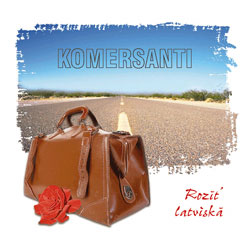
Komersanti (The Merchants) play music in a folksy, country style. I wouldn’t necessarily call it schlager, though I think this album would appeal to schlager fans. Actually, they remind me a bit more of Bet Bet than anyone else. In any case, their 2002 album, Rozīt’ latviskā, is a collection of 12 songs in a number of different kind of folk styles.

The group is made up of Juris Pavītols on vocals and guitar (he’s also the main songwriter), Norlands Millers on guitar and vocals, Aldis Žīmants on bass guitar and vocals, and Edijs Cionelis on drums.

Komersanti prove themselves excellent musicians. However, the songs do not stay in memory very long, and I probably will not listen to this album much in the future.

One of my criticisms of this album is technical: the production makes some of the songs sound like they were recorded in an echo chamber. This is particularly evident on the lead track, “Roze,” which is a nice little song about a Latvian rose that is blooming somewhere very far away. Though this was probably my favorite song on the album, the echo effect on this song is a bit annoying.

Komersanti also must have listened to a few American country records, because there is a country feel to many of the songs. A good example is “Oda lidojums” (The Mosquito’s Flight), where the guitar work gives this song a particularly country feel. To further illustrate the country influence, they even have a song with a horse motif, “Zirga smaids” (The Horse’s Smile). No songs about pickup trucks, though!

Another song I like is “Aizlūgums.” Although once again in a country style, it is a very catchy, inoffensive song. “Velna dziesma” (The Devil’s Song), performed in more of a “boogie” style, is another a song I like. “Tu tik man netraucē” (Don’t You Disturb Me) is also a catchy song. I’m not sure who sings on the track, though it sounds strangely like Ainars Virga from the guitar rock group Līvi, as the vocal is rather deep and gruff. Like Līvi, Komersanti are from Liepāja, while Pavītols (who is a bit of rock legend in Latvia) has ties to Līvi.

Liner notes are very sparse, with no lyrics and just a few pictures of the band. Not knowing much about this group, it would have been nice to have a bit more information about the group in the notes.

Overall, Rozīt’ latviskā is not a bad album, but there are no songs that leap out and demand you listen to them over and over again. It is clear that these guys got together to play music, mainly because they enjoy it—and that is a good thing. They aren’t trying to change the world with their songs, and it is nice to listen to some music that isn’t overly earnest or overly serious.This is much better than much of the schlager in Latvia, as it isn’t bogged down by cheesy synthesizer tracks and drum machines. And because the members of the group are capable musicians, the album itself is very professionally done.

If you have an aversion to schlager or country music, best to avoid this release. This album is for those who prefer their music very mellow and with few surprises.

Details

Rozīt’ latviskā

Komersanti

Baltic Records Group,  2002

BRG CD 120

Egils Kaljo is an American-born Latvian from the New York area . Kaljo began listening to Latvian music as soon as he was able to put a record on a record player, and still has old Bellacord 78 rpm records lying around somewhere.

Industrial metal album is a rather dull affair

During the Rīga 800 celebration last year, one of the highlights for me was the all-day music performances on the big stage by the Daugava River. The entire day was devoted to all kinds of Latvian bands, of all different styles and sounds. Two bands caught my interest. The first was Deus sex machina (formerly named Deus ex machina), followed by Dzelzs vilks. It was a very hot day, and perhaps I was suffering from heat exhaustion, but it appeared that the groups were one and the same—no personnel changes happened between their sets. This is not a surprise as the guitarist, Juris Kaukulis, plays in both groups (as well as sings in Dzelzs vilks). I enjoyed their performance, as the group had a heavy, aggressive industrial sound, balanced by intricate keyboard parts.

After the performance, I picked up the Deus sex machina recording of the Fausts rock opera. Unfortunately, it was not to my liking, though the performances on the album were all good. On that recording, Kaukulis was joined by Andris Vilcāns (the composer of the music) on keyboards. Perhaps I would have appreciated the record more if I had actually seen the rock opera, but this compact disc rarely gets into my CD player.

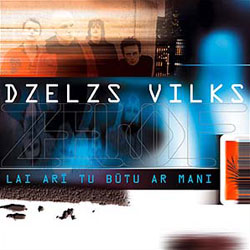
After hearing and liking the song “Ledus” on the Black Friday Vol. IV compilation, I decided to pick up the latest Dzelzs vilks CD. The UPE Recording Co.‘s Web site explained that it is the band’s third album, but only the first to be released on CD. Even though I didn’t like the Fausts recording, my expectations were still high, since this was a different group on the CD, and the songs were the band’s own compositions. However, I found Lai arī Tu būtu ar mani a rather dull affair.

Kaukulis is joined by Armands Butkevičs on bass, Mārcis Judzis on drums and Kaspars Tobis on programming.  Kaukulis also wrote all the music and lyrics for the record.

The music is all in the industrial metal style. That on its own is not why I dislike the album, but it becomes clear from listening to the record that the participants spent a lot of time listening to bands like Nine Inch Nails and other industrial bands. This results the album sounding like a diluted Nine Inch Nails record, on which Dzelzs vilks tries to recreate the sound of a better-known band, but without great success.

It also seems at times that the guitar sound does not change much throughout the album. It remains in the “crunchy” style from beginning to end. This gives the album a repetitive sound and even after multiple listenings I have difficulty distinguishing between many of the songs.

The album starts out well enough with the title track “Lai arī Tu būtu ar mani.” It is a good introduction to the band, with heavy guitars, prominent synthesizers and Kaukulis singing like a soul in torment. The lyrics of this song also present many themes that reoccur throughout the album,  such as the pain of love and how generally miserable existence can be from time to time.

The recording of “Ledus” is slightly different than on the Black Friday compilation, sounding a bit more polished. This remains my favorite song on the album, becaues I think it has a good melody and is not too repetitive.

I also like “Vienas nakts meitene.” The song is quite different than the others on the album, starting off with a very pretty piano and guitar introduction. The track is less aggressive than the others on the album, and it is a good way for the listener to relax (if briefly) before the sonic assault of the rest of the album.

“Saplēstie stikli” has a very eerie piano introduction that is repeated within the song, though the “Whoa-oh” vocals start getting repetitive after a while.

The album ends with a remix of “Ledus” done by Alis P. Though not much different from the original, this remix brings the beat out more with a louder drum track.

Most of the other songs follow the same pattern—starting with a quiet introduction, then the guitars crash in—which is likely why I cant distinguish many of the tracks.

Though many of the songs show promise, this album was not to my taste at all. This is ideally meant for seriously devoted industrial fans (of which I am not one). The production on the album can also be quite muddy, as the crunchy guitars tend to drown everything else out. These guys have talent and have some interesting synthesizer loops,  but there is not too much of interest on this record for me. You could classify the music as hard rock, but its industrial influences make Dzelzs vilks a far different group than, for example, Līvi, so it would not be fair to compare them. Fans of industrial will likely find everything they are looking for here (synthesizer loops, crunchy guitars, angst-filled lyrics), but I must pass on this one.

Details

Lai arī Tu būtu ar mani

Dzelzs vilks

UPE Recording Co.,  2001

Egils Kaljo is an American-born Latvian from the New York area . Kaljo began listening to Latvian music as soon as he was able to put a record on a record player, and still has old Bellacord 78 rpm records lying around somewhere.