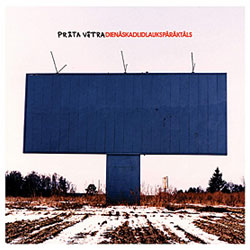
One really never knows what to expect from Prāta Vētra. The band prides itself on doing the unexpected, going against conventional wisdom when recording songs and releasing albums. With its latest compact disc, Dienās, kad lidlauks pārāk tāls, the band surprises again.
The first Prāta Vētra album I bought was the 1999 release Starp divām saulēm, which I really liked. I then got the previous album, Viss ir tieši tā kā tu vēlies, released in 1997. Two of my favorite Prāta Vētra songs are on that album (“Tavas mājas manā azotē” and “Romeo un Džuljeta”), but the rest of the album was truly a head-scratching affair. It really was not at all what I was expecting—truly “alternative” rock.
The next album was the 2001 release Kaķēns, kurš atteicās no jūras skolas, which once again had me scratching my head. This time I was left wondering what happened to the guitars and human drummer. The album was a very slick pop affair, heavy on the keyboards and drum machines, light on the guitar and acoustic drums. Perhaps this should not have been a surprise, considering the big hit and Eurovision contender that the super-poppy, yet pretty, “My Star” was (the song was titled “Īssavienojums” in its Latvian version). Regardless, Kaķēns was yet another excellent album from the band, as the songs were stronger than ever.
So what next to expect from Prāta Vētra? Would the next album be farther down the slick pop trail? Or would the band come back and surprise again?
And the band certainly has surprised me again. Considering the group’s massive success not just in Latvia, but around Europe, I expected a very safe, poppy album that would appeal to the masses and sell lots of records. How surprised I was to hear that the guitar was back in full force, like meeting a dear, old friend whom you have not seen in a long time. Even though years may have gone by, after a few minutes it seems like no time has passed at all. Dienās, kad lidlauks pārāk tāls, though once again departing from the previously established trajectory, has all the necessary ingredients to make for a truly classic album.
Presumably I was not the only one to note the conspicuous absence of guitars on many of the tracks on Kaķēns. On the new album, their return is announced on the first track. “Pa pareizām” is a rocking number that gives the listener a hint of what to expect.
Band members have not changed. Besides Renārs Kaupers on vocals, there is Jānis Jubalts on guitar, Kaspars Roga on drums, Māris Mihelsons on keyboards and Mumiņš (Gundars Mauševics) on bass guitar.
Dienās is actually the Latvian version of the album, while A Day Before Tomorrow is the English version. Starting with Starp divām saulēm, Prāta Vētra has released its albums in two versions, English and Latvian. However, a discouraging trend is that fewer and fewer of the songs on the “Latvian” version are actually in Latvian. On Starp divām saulēm all the songs were in Latvian. On Kaķēns, two of the songs were in English. But on Dienās half of the “Latvian” album (six songs) is in English. Perhaps this should not come as a surprise—it is quite demanding of the listening public to expect an album entirely in English and another album entirely in Latvian! Might as well enjoy it while we can, because if the band’s successes continue, it is entirely possible that English will be Prāta Vētra’s “only” language in the future!
(Dienās also is the first album in Latvia to be guarded by anti-copying software, meaning it’s difficult—but not impossible—to make digital copies of the songs.)
Of the English songs, two stand out. “Colder,” the first single off the album, is not your everyday pop song. In fact, it is a more somber, guitar-driven track. The second stand-out song is “Gala Komma,” probably the most surprising song on the album, as it has an almost African beat and rhythm to it. A lot of the words in the song seem to be made up, but perhaps there is some meaning to them. In any case, it is an infectious song, guaranteed to stick in your head. On the whole, the English lyrics on the album are light years ahead in terms of lyricism than Prāta Vētra’s previous albums.
Of the Latvian songs, my favorite is most likely “Es gribu” (“I Want”). Most all of the great Prāta Vētra songs are those that on the outside are upbeat and pretty, but inside have a tinge of sadness. This song is no exception, and it features some great acoustic guitar work from Jubalts. Another of my favorites in the same vein is “Man kabatā” (“In My Pocket”).
Another standout track is the first Latvian single, “Plaukstas lieluma pavasaris” (“Palm-sized Spring”), featuring drummer Roga playing the accordion!
For those who are specifically looking for the slick poppy stuff, never fear. Linda Leen stops by to sing a duet with Kaupers on the overwrought ballad “Reality Show.” The lyrics here are a bit cliche and I usually skip over this track.
Prāta Vētra enlisted British producers Alex Silva (on “Colder” and “Plaukstas lieluma pavasaris”) and Steve Lyon (producer on everything else), giving the album a truly professional sound, though it thankfully it’s not overly slick. Silva has worked with bands like Suede, while Lyon has produced for Depeche Mode and others.
Prāta Vētra even got well-known photographer Anton Corbijn to shoot the album cover and booklet art. Corbijn has worked with a long list of musical performers, including Travis, Depeche Mode and Paul Oakenfold.
But besides the pictures and credits, the album booklet has lyrics for just one song, “Kristiānijas suņi.”
Hardcore Latvian music fans might be disappointed that there are fewer songs in Latvian this time. However, don’t let that discourage you, as the songs here are some of the best work these guys have done. Hopefully those who might have been turned off by the slick and keyboard-intensive Kaķēns will give this album a listen, as they will be pleasantly surprised by what awaits them.
Details
Dienās, kad lidlauks pārāk tāls
Prāta Vētra
MICREC, 2003
MRCD 252