Tumsa leaves rock roots, chooses pop sound

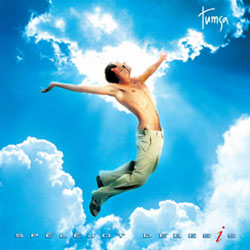
Spēlējot debesis

Mārtiņš Freimanis, lead singer of the band Tumsa, seems dead set on becoming a pop star. Not content with leading his band in a more poppy direction, he is also part of the pop group F.L.Y. (along with Lauris Reiniks and Yana Kay), and F.L.Y. competed earlier this year in the holiest of Europop events, Eurovision 2003.

Perhaps because of his pop inclinations, Tumsa has come a long way since its debut, Putni. Putting that first album side by side with the latest compact disc, Spēlējot debesis, the average listener might be hard to convince that they are by the same band. Becoming slicker with each passing album, Tumsa has left behind its hard rock roots and is courting mass appeal.

Now, this does not mean that Spēlējot debesis is a bad album. On the contrary, I think it is quite good, and perhaps the band’s most consistent album to date. Having had this album for a while now, it still finds its way into my CD player quite often. It may be poppy and it may be slick, but it is still an excellent album.

The lineup remains as before: Freimanis on vocals and acoustic guitar (he’s also the principal songwriter), Jānis Daugalis on bass guitar, Aigars Šmits on keyboards, Haralds Drekslers on guitars and Kaspars Boroduško on drums.

Much like other Latvian bands, Tumsa is at its best when offering up more melancholy songs. Not coincidentally, my favorite songs on the album are the first track “Pēc mums (vēl ilgi zeme skums)” and “Es esmu mazliet don Kihots,” both of which show the band at the peak of its ability.

It’s not all melancholy, though. “Pēc mums” is followed by the far more cheery “Spēlējot debesis,” providing a nice balance to the more heartrending songs on the album.

The song “Logi mākoņos” (a rather sincere anti-drug song) features the Latvian rap group Device often repeating the main theme of the song, “Lūdzu nepadodies” (Don’t give in).

“This is not paradise” is the only song in English and features a saxophone solo by Alex Balinsky, not to mention an appearance by well-known Latvian violinist (and Bet Bet lead singer) Zigfrīds Muktupāvels. This is one of the more poppy songs on the album, practically a dance track.

Tumsa seems to be going for an Elton John feel on the song “Balāde par sirdīm salauztām,” what with piano and a soaring string section, added presumably for dramatic effect.

One of my favorites on the album is “Tu esi tāda viena,” a more up tempo number and probably the catchiest song on the album.

I may have misgivings about Tumsa’s transition to a more pop-oriented sound, but Spēlējot debesis is still a very well-crafted album, full of even more classic Tumsa songs. Also nice is that all the lyrics are included in the CD booklet. Perhaps now that Freimanis has become a bona fide pop star as a member of F.L.Y., he will be able to take out his pop agression there and return revitalized to Tumsa. There is no denying the songwriting talent of Freimanis (his name appears in the songwriting credits for many other artists) and that is why you can always count on Tumsa to put out excellent records, Spēlējot debesis included.

Details

Spēlējot debesis

Tumsa

MICREC,  2002

MRCD 187

On the Web

Tumsa

The group’s official Web site includes background on the band and samples of its music. EN LV
Egils Kaljo is an American-born Latvian from the New York area . Kaljo began listening to Latvian music as soon as he was able to put a record on a record player, and still has old Bellacord 78 rpm records lying around somewhere.

Old Piecīši humor still works sometimes

As part of their live performances, not only do the Čikāgas Piecīši perform satirical songs, but they also do satirical comedy sketches. The sketches poke fun at a wide variety of topics, but the most common motif is the experience of being Latvian while living in the United States.

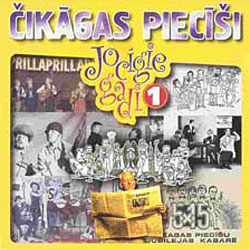
The latest compact disc from the Piecīši, Jocīgie gadi 1, collects a number of these sketches. Many of these sketches were already released on the vinyl recording Vēl jau viss nav pagalam, but this collection also contains other sketches recorded throughout the group’s career. And because this is a comedy album, there are very few actual songs here.

So do jokes from as long ago as the 1960s hold up? Not surprisingly, some of the material doesn’t age well, but some of it can still provoke laughs even today.

The theme of being Latvian in the United States is a rather timeless one, so there the humor is still relevant. One of the funnier sketches on the album is “Jauktā laulība,” which is about the marriage of a Latvian man to an American woman. The woman finds out more than she wants to know about certain Latvian foods, like asins desa (described to her as pig’s intestine filled with fresh blood) and galerts (compared to frozen vomit).

The sketch “Pēc pilsoņu papīriem” details the travails of a Latvian getting his American citizenship, coached by another “helpful” Latvian about how to best answer the questions. “Kokteiļpartija” also has a conversation between a Latvian and American, with the American being bewildered by some of the Latvian customs that are described.

Generational differences are always good for comedy, as shown by “Draudzīgais aicinājums,” which has an older Latvian going on an extended rant about the way the young Latvians dress, with the obligatory comment about “back when I was young…”

But the political humor doesn’t hold up too well. The occasional reference to President Lyndon Johnson dates the humor.

A few “songs” are found on the album, including “Sunītis,” which is a comical attempt at performing “How Much is That Doggie in the Window?” in Latvian.

Most of the texts were written by Piecīši leader Alberts Legzdiņš as well as Uldis Ievāns.

Perhaps some of the recorded humor not working as well as it could is due to sketches having a certain visual aspect. The few photographs that are in the CD booklet show the members of the band dressed up in costumes, which often add to the humor in live performances.

As with most all comedy albums, this CD does not invite repeat listenings. There are more laughs here than I expected, but it is still not a CD I listen to with any kind of regularity. It best serves as an archive of the last 40 years and as a reminder that some humor can be timeless.

Details

Jocīgie gadi 1

Čikāgas Piecīši

Balss,  2002

BACD 067

Egils Kaljo is an American-born Latvian from the New York area . Kaljo began listening to Latvian music as soon as he was able to put a record on a record player, and still has old Bellacord 78 rpm records lying around somewhere.

More songs about ordinary people and things

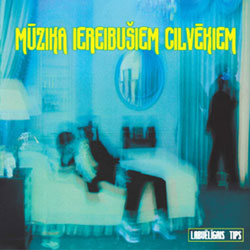
Mūzika iereibušiem cilvēkiem

Labvēlīgais Tips has established itself as one of the premier Latvian rock acts. The group has carved out a niche thanks to its unique blend of accomplished musicianship and sense of humor. But the group’s songs about ordinary people and ordinary things, in my opinion, are mainly what have given Labvēlīgais Tips its longevity and sustained popularity.

In a break from tradition, April 1, 2002, did not see a new Labvēlīgais Tips album. Having released seven recordings over the past years, and always on April 1, for whatever reason the group decided to take a bit more time with its eighth, releasing the album Mūzika iereibušiem cilvēkiem in late 2002.

If that was the case, then I am glad that the group put a bit more time into this one. Mūzika iereibušiem cilvēkiem is a great album, full of classic Tips tunes.

The album starts off with the uptempo “Trakais,” an ode to crazy people and, apparently, a satirical poke at much of the goings on in the Latvian government. Lead singer Andris Freidenfelds intones in his least sincere, nasally best, “Es līdz šim latviešu tautai neko sliktu neesmu izdarījis un turpmāk apsolos arī nedarīt!” (“Until now I haven’t done anything wrong to the Latvian people, and in the future promise not to do anything wrong!”). It’s a very catchy song and an instant Tips classic.

Songs about ordinary things often times have extraordinary results in the world of Labvēlīgais Tips. A perfect example of that is my favorite tune on the compact disc, “Par riekstiem,” a song about, well, nuts! Singing such dreadfully serious lyrics as “Par riekstiem, es dziedu šo dziesmu svarīgo” (“I sing this important song about nuts”) makes the listener burst out laughing. A “hidden” track on the CD is a demo of this song, and Freidenfelds himself starts cracking up halfway through and cannot finish it!

Another favorite is “Gunvaldis un Nataly,” a song about Gunvaldis, who sadly must spend his name day alone. He longs for his neighbor, Nataly, but realizes that unfortunately he will just get drunk and fall asleep by himself.

The song “11.septembris” is not actually about the events of that day, but is more of an “enjoy life while you can” kind of song. My favorite line is, “Ja griesti ir, tad grīda būs” (“If the ceiling is there, then the floor will be there, too”).

As is usual for Labvēlīgais Tips, the packaging of the album is pretty minimal. No lyrics are provided (they would be helpful when trying to decode some of these songs), but you do get a picture of the band members with what look like paper plates on their ears and fake bunny rabbit teeth.

As with most every Labvēlīgais Tips release, many of the songs might be impenetrable to Latvians who not have spent an extended time in Latvia. But don’t let that scare you away. I still really enjoyed this CD, even though I have never lived in Latvia and haven’t the foggiest what some of the songs are about.

Mūzika iereibušiem cilvēkiem is a welcome addition to the Labvēlīgais Tips discography, a return to form by one of Latvia’s most enduring and popular groups. Containing a number of classic songs, this CD shows that the band is still going strong.

Details

Mūzika iereibušiem cilvēkiem

Labvēlīgais Tips

MICREC,  2002

MRCD 190

Egils Kaljo is an American-born Latvian from the New York area . Kaljo began listening to Latvian music as soon as he was able to put a record on a record player, and still has old Bellacord 78 rpm records lying around somewhere.