Igo returns on strong rock album

Igo

One cannot write about Latvian rock music history and not mention Rodrigo Fomins, or, as he is popularly known, Igo. He has one of the most recognizable voices in Latvian music. Igo’s 25-plus-year career has seen him perform with many different Latvian groups as well as in stage musicals.

His latest compact disc, Mirkļa liecinieks (Witness to the Moment), was released in March 2005 on the MICREC label. Considering his near-fatal accident five years ago and the resulting rehabilitation, Igo still sounds as strong as ever and has rebounded from that low point to release a very strong, solid rock album.

Igo was born in 1962 in Liepāja, home to many other famous Latvian musicians. By 1978, he had joined the rock group Corpus, but by 1980 was a member of the popular rock group Līvi. He can be heard singing on many of the band’s early hits, including “Zīlīte,” “Vēju muzikants” and “Zušu dziesma.” His career continued in 1985 when he joined Remix, recording hits such as “…pie laika,” “Meitene kafejnīcā” and “Kā senā dziesmā.”

His singing was not limited to just recordings, as he found success on stage as well. Igo took the role of Lāčplēsis in the Zigmārs Liepiņš rock opera of the same name, as well as Kvazimodo in another Liepiņš rock opera, “Parīzes Dievmātes katedrāle” (Notre Dame Cathedral of Paris). In recent years, he has focused on his solo work, which continued his extraordinary success, including hits like “Bet dzīvē viss ir savādāk.” In 1997, he released a two-disc retrospective called Tas ir Igo, a very thorough overview of his illustrious career.

Though he has accomplished a great amount in the field of music, his life has not been without tragedy. On May 16, 2000, Igo was involved in an extremely serious car crash, which left him with many broken bones and a concussion. It was unknown at that time whether he would even live, much less perform again. Miraculously, his health returned, and he has continued to record albums and perform in concert.

Joining Igo on Mirkļa liecinieks are Ivars Jercums on guitars, Edijs Dukurs on bass guitar, Juris Kristons on keyboards and Ilvars Manfelds on percussion. Igo handles almost all of the lyric writing on the record as well.

A number guest artists appear on the album. A Remix bandmate, guitarist Aivars Hermanis, performs acoustic guitar on “Kas gaida mūs” (Who Waits for Us). Hermanis also co-wrote “Manā istabā” (In My Room) with Igo. Brother Ivo Fomins, from the group Fomins & Kleins, performs a duet with Igo on the song “Krustojumā” (In the Crossing). Former Līvi bandmate Ainars Virga also performs guitar and shares songwriting credit on “Krustojumā” and on the album’s title track.

Probably my favorite song on the album is the first track, “Būsim kā 1” (Let’s Be 1), a straight-ahead rock number that shows Igo still has the ability to belt out a proper rock tune.

“Krustojumā” also is a favorite. Ivo and Igo also both sang in the group Liepājas brāļi, and this song has a small reference to their biggest hit—“Tikai tā.”

Somewhat out of place on the album, due to the song’s completely different style, is the new version of the Remix song “Dzeltenās kurpes” (Yellow Shoes) arranged by the rapper Gustavo. It is very strange to hear rapping in this quintessential 1980s pop tune. I prefer the original, though it is interesting to hear a completely different take on this song.

Packaging for the CD is minimalistic, containing just lyrics for the song “Mirkļa liecinieks” and some photos by Igo himself.

Mirkļa liecinieks is a very strong album and a welcome addition to the large number of Igo’s recordings.

Details

Mirkļa liecinieks

Igo

MICREC,  2005

MRCD 268

Egils Kaljo is an American-born Latvian from the New York area . Kaljo began listening to Latvian music as soon as he was able to put a record on a record player, and still has old Bellacord 78 rpm records lying around somewhere.

Remix retrospective reveals effects of aging

Remix

Although the group has been on extended hiatus for many years, Remix celebrated its 20th anniversary in 2005. In acknowledgement of the anniversary and of the group’s contribution to Latvian popular music, the recording label MICREC reissued three noteworthy Remix albums. The first two are instrumental albums released on one compact disc—Uz veselību and Naktsmājas. The third, Gold, is a compilation of the group’s most popular songs.

Gold was first released on CD in 1995, though it has been out of print for many years now. It is a testament to the popularity of these songs that the CD has been released again.

The group’s name is a bit of a misnomer. The group doesn’t actually “remix” anything. Perhaps the name comes from the fact that the members of the group came from already established groups and were “mixed” together, creating the first Latvian supergroup. Some of the biggest names in Latvian music were members of Remix, most notably keyboardist and composer Uldis Marhilēvičs, guitarist Aivars Hermanis, legendary Latvian rock singer Igo (vocalist Rodrigo Fomins) and drummer Vilnis Krieviņš. The group was also joined on bass at first by Eduards Glotovs and then later, after the departure of Glotovs, by Jevgēņijs Ščapovs.

The music is very obviously from the 1980s. It is very, very slick and polished, with particular emphasis on keyboards and synthesizers, as well as the grandiose vocal stylings of Igo. However, there is a notable difference in styles between the instrumental works and the popular songs with vocals. Two of Remix’s instrumental works are contained on this CD, Cīņa” (Battle) and “Uz veselību” (To Your Health). The brief liner notes (no lyrics, but there is a short history of the group) call the instrumental work “jazz rock,” but I’m not so sure I would agree, because neither of these two instrumentals sounds particularly jazzy. However, I can’t think of a better term, so I’ll just say that they would fit in well on an 1980s movie soundtrack. For those interested in hearing more of this style, listen to the Uz veselību and Naktsmājas re-release, or the Aivars Hermanis solo album Mans laiks.

One timeless song on this album is “Kā senā dziesmā” (Like in the Ancient Song), with music by Raimonds Pauls. Even today, the song remains a popular Latvian anthem. It was performed at the youth choir concert, part of the song festival in Rīga in the summer of 2003. Its unmistakable guitar introduction and chorus of “noskūpstītas lapas no rīta… šai rudenī!” (leaves kissed in the morning…this autumn!) is part of what keeps the song in the hearts of many listeners. It is also a song that shows of the vocal talent of Igo, singing the chorus with more than a little bombast.

Another big hit was “Meitene kafejnīcā” (Girl in a Café), which again has a distinctive guitar intro. Rarely is a drummer also a composer, but Krieviņš is the music’s author. This features yet another beloved refrain, “(S)kumjas acis Jums šovakar…” (You have sad eyes tonight).

Gold isn’t all polished pop songs. “Komunālais blūzs” (Communal Blues) is a blues number, as the title indicates. Hermanis uses his best dirty guitar sound for maximum effect, but I could do without the track’s vocal echo.

The 1980s are in full force on “Dzeltenās kurpes” (Yellow Shoes), which reminds me of some of Prince’s poppy ‘80s output—especially the keyboard, which is the central instrument in practically all of Remix’s songs.

Perhaps Remix’s biggest hit was “…pie laika” (At the Time). The song reached first place in the Mikrofons 88 song competition—with its unabashedly pro-independence lyrics by Igo: “Brīvību tēvzemei – pieprasām!” (Freedom for the fatherland—we demand it!). However, this is not the same version that was on the Mikrofons 88 record (as well as the Tas ir Igo two-disc “best of” compilation.) That is unfortunate, as I think the version on Mikrofons 88 is superior, but it is still interesting to have this slightly different version. The Mikrofons 88 version has a bit more punch to it.

Finishing off the album is yet another hit, “Vienīgai” (Matchless). It’s yet another polished bit of pop, but at more than six minutes, the song starts to drag near the end.

I tend to skip over about half the songs on this CD, because some of them are just a bit too dated, and perhaps a bit too polished, especially with the unmistakable ‘80s keyboard that Marhilēvičs uses at times.

As a group whose active life was only about five years, Remix accomplished much in a very short period of time. Though most of the group’s material has not aged well and is clearly rooted in the 1980s, some of the songs now are classics. Any student of Latvian rock should be familiar with Remix’s work, especially songs like “Kā senā dziesmā,” “Meitene kafejnīcā” and “Dzeltenās kurpes.” To be honest, I’d probably recommend the Tas ir Igo collection over this one, as that contains all the best songs on this CD, as well as a number of others from Igo’s long career. However, that does not mean Gold is not worth picking up. It would certainly appeal to any fan of ‘80s music. Remix was the first Latvian supergroup, and this CD clearly explains why.

Details

Gold

Remix

MICREC,  2005

MRCD 270

Egils Kaljo is an American-born Latvian from the New York area . Kaljo began listening to Latvian music as soon as he was able to put a record on a record player, and still has old Bellacord 78 rpm records lying around somewhere.

Disregard snobby friends and get this Pauls album

Priekšnojauta

Raimonds Pauls, much like comedian Rodney Dangerfield, at times doesn’t get much respect. He is far and away the best known Latvian popular music composer of the second half of the 20th century, with fans not just in Latvia, but in other such countries as Russia and Japan as well. He has performed all over the world, including New York’s Madison Square Garden. He will mark his 70th birthday in 2006. After all that, why is he still given such a hard time, especially when many, many of his songs are beloved by Latvians? Mega-hits of his include “Dāvāja Māriņai,” “Mežrozīte,” “Kā senā dziesmā” and others too innumerable to mention.

From this usually humble reviewer’s perspective, there is quite a lot of Pauls’ repertoire that I quite like. I guess one might compare him to an artist like Prince (a very talented artist, but who probably releases more material than he should) or perhaps like Bruce Springsteen (his best songs are in a class of their own, but his lesser work all starts to sound the same after a while). Pauls certainly could have been more selective about some of the songs that he released. During the 1970s, when he was releasing albums nearly one a year, some lesser songs that otherwise would have been left unreleased got a space on a record. His jazzy style might unnerve some listeners, while some more snooty listeners comment that there might be some active borrowing from jazz pianists like Dave Brubeck in Pauls’ work.

Due to his prolific release schedule, his albums are a hit-and-miss affair. However, one album that bears further attention is 1977’s Priekšnojauta (Premonition). Re-released on compact disc in 2004 by MICREC as part of its “Latviešu populārās mūzikas klasika” series, this is one of Pauls’ records that stands the test of time and reconfirms Pauls’ place as one of the great Latvian popular music composers.

From the opening swell of strings in the song “Par pēdejo lapu” (About the Last Leaf), the listener can immediately recognize this as a Raimonds Pauls work. Perhaps a bit overly dramatic, this song, with lyrics by frequent Pauls collaborator Jānis Peters, is yet another mega-hit, as popular today as it was when it was first released almost 30 years ago. The song features one of the great Latvian female singers, Nora Bumbiere. Prāta Vētra fans will notice the strong resemblance between their song “Lidmašīnas” and this song—so notable that Prata Vētra credits “Par pēdejo lapu” as the basis for its song on CDs that contain “Lidmašīnas.”

Pauls also has a reputation of working with only the best Latvian singers, and this CD includes a number of them. Besides Bumbiere, there is also Mirdza Zīvere, Viktors Lapčenoks and Vladislavs Juhņevičs.

Another beloved song on this disc is the Lapčenoks-sung “Zied ievas Siguldā” (The Cherry Trees are Blooming in Sigulda), with text by A. Smagars. One might consider Lapčenoks one of the first “rock superstars” in Latvian music, because his style was perhaps more appropriate to rock songs rather than the more mid-tempo estrādes style of most of Pauls’ songs. A personal favorite on this CD is “Nīca” (text by V. Brutāne), a duet between Lapčenoks and Bumbiere, a song where Lapčenoks gets the chance to let loose and sing like a rock star—something rather unusual in 1970s Latvian music!

Lapčenoks and Bumbiere join up again to duet on the final song on the album “Tā diena” (That Day), with text by Jānis Peters, a song with a downright Carribean feel to it. Certainly this song and other songs on this album were experiments for Pauls, and I think they worked out quite well. This is probably one of the reasons I enjoy this album so much, as it is much fresher and sharper than a lot of the stagnant, lounge music style albums that came before it.

Of course, there are some clunkers here that I really could have done without, notably “Rudensogle” (Autumn Ember), performed by Zīvere. The song is far too overwrought for my tastes, especially with the overbearing string section.

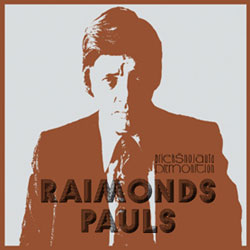
One refreshingly consistent aspect of Pauls’ releases (especially those from the 1970s and 1980s) are the dreadful album covers. Priekšnojauta, with its photo of the composer in brown and gray hues, is no exception.

In a rarity for these CDs in the “Mūzikas klasika” series, all lyrics are included, plus a whole two photographs. Though having the lyrics is a bonus, I still think MICREC could be doing more with these releases, even something as simple as getting Pauls and the other artists to write a few sentences about their thoughts on this album, or any memories of recording it, or anything simply to add value to these re-releases.

When faced with the choice of purchasing one of dozens of Raimonds Pauls releases, it can be difficult to determine what the correct choice might be. Priekšnojauta is one of the best of the bunch. Don’t let your snobby friends tell you that all of Raimonds Pauls’ songs sound the same. This album breaks that stereotype, rather convincingly I say. A bestseller in 1977, it still remains one of his most popular albums.

Details

Priekšnojauta

Raimonds Pauls

MICREC,  2004

MRCD 253

Egils Kaljo is an American-born Latvian from the New York area . Kaljo began listening to Latvian music as soon as he was able to put a record on a record player, and still has old Bellacord 78 rpm records lying around somewhere.