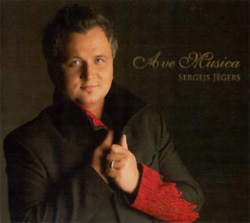
Jēgers hits a high note on first recording

The more I learn about music, the less I realize I know. I used to think that the male voice was generally divided into three groups: tenor, baritone and bass. It turns out I missed an important one—the countertenor, such as Sergejs Jēgers, whose first compact disc Ave Musica was released earlier this year.

The countertenor sings in a register higher than a tenor. I am an average tenor and struggle to hit a high G in my natural voice, but a countertenor easily reaches it, as well as many notes above.

Countertenors are rare. Apart from being popular during the Baroque period of classical music, they haven’t had much opportunity to shine. However, countertenors have recently returned to the spotlight, and one of the leaders of the renaissance is Latvia’s own Jēgers.

I first heard Jēgers sing at a concert in the Small Guild Hall in Rīga. At that point, I had no idea what a countertenor was, or even who Jēgers was. I was rather surprised at the way he sang, in an upper range that far surpassed anything I had heard. To be honest, had I only heard and not seen him, I would have automatically assumed that it was a woman who was singing, such was the upper range. That took a bit of getting used to, but when I did I had a much greater appreciation for the work of Jēgers and countertenors in general, and a greater respect for what he has accomplished in the Latvian classical music scene.

On Ave Musica, Jēgers sings many classic songs from the Baroque period, selected not just because most works for countertenor are from that period of time, but also because the era is especially dear to Jēgers. The songs were recorded in the Rīga Anglican Church. Jēgers is accompanied by the Baroque Orchestra of Latvia, conducted by Andris Veismanis.

Because almost all the works are from the Baroque era, the themes of many of the songs are of a religious nature, including two arias from George Frideric Handel’s “Messiah”:  “But Who May Abide” and “He Was Despised.” Though Baroque music can be considered “simpler” than later music, it is no easy feat to sing it well. The singer also needs to convey the gravity of the text, as these are works of sacred music, and Jēgers is certainly up to the challenge, conveying the somber weight of these Biblical passages.

A great number of arias by Handel are included on this disc. Besides the arias from the “Messiah”, the disc also has arias from the operas “Xerxes,” “Rinaldo” and “Alcina.” The Classical era also is represented, with an early W.A. Mozart piece, Pharnace’s aria “Venga” from the opera “Mitridate.” Also, on the disc you will find two arias from Christoph Gluck’s opera “Orpheus and Euridice.”

The disc closes with one of the most beautiful melodies of the late Renaissance and early Baroque period, Giulio Caccini’s “Ave Maria.” This melody has been performed by many famous singers, including Latvia’s Inese Galante and the internationally renowned Andrea Bocelli. Jēgers joins this elite group with his performance of this sacred song, a fitting entry into the select group who can truly perform this work with the beauty that it requires.

The packaging of the disc is excellent. The liner notes by Orests Silabriedis, which also are translated into English, explain the countertenor (noting that some countertenors sing in falsetto, some in their natural voice, but not actually saying to which group Jēgers belongs!). The notes also contain Jēgers’ biography, as well as song texts for all the arias, and a brief description of each opera or oratorio from which the song is taken. The information is very helpful, and leads to a better understanding of the works and greater enjoyment of Jēgers talents.

It is clear from the recording the immense respect Jēgers has for the music of the Baroque period. It is precise, earnest and spiritual. Certainly, the sound of a countertenor is unusual, but once the listener gets used to it, the realization becomes clearer that Jēgers truly has a unique talent and is an excellent singer. I would recommend Ave Musica for all fans of Baroque music. Even though many of the arias approach 300 years of age, they are still timeless and able to captivate the listener. Jēgers seems poised for bigger and better things, perhaps even on the world stage, and this CD is a great introduction to one of Latvia’s brightest young stars.

Details

Ave Musica

Sergejs Jēgers

Upe tuviem un tāliem,  2006
Egils Kaljo is an American-born Latvian from the New York area . Kaljo began listening to Latvian music as soon as he was able to put a record on a record player, and still has old Bellacord 78 rpm records lying around somewhere.

Zodiaks collection recalls period of reawakening

One of the most amazing statistics in the Latvian music world is the Soviet-era success of composer Jānis Lūsēns. The instrumental ensemble Zodiaks, which he formed in the 1970s, sold a staggering 20 million copies of the 1980 album Disco Alliance in the Soviet Union—an unbelievable amount for that time. To put in perspective, this was a hit on the level of Michael Jackson’s Thriller.

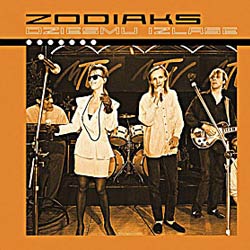
However, this review has nothing to do with the Zodiaks of that period, but with a reimagined Zodiaks—this time with vocalists—and its album Mirušais gadsimts, first released in 1995. The purpose of the statistic was to give an idea of how popular Lūsēns was in those times and how, when he turned to vocal music, his magic touch remained. The new Zodiaks, formed in 1987, had its heyday in the time of Latvian reawakening at the end of the 1980s and beginning of the 1990s—the perfect time for the group and its often patriotic lyrics, which were often taken from classic Latvian poets. Lūsens, besides composing all the music for the group, also played the keyboards.

This is a compact disc I have been waiting for a very, very long time. Many of the bright spots of the Mikrofons records of the late 1980s were Zodiaks songs. For example, Mikrofons 88 had the melancholy ballad “Tautas laiks” (lyrics by Imants Ziedonis), featuring perhaps the most impressive vocal performance of singer (and violinist) Zigfrīds Muktupāvels’ career. There was also “Taisnība” (lyrics by Edvarts Treimanis–Zvārgulis) from Mikrofons 89, with the line “Nāc ārā no metāla zārka” (Come out from the metal coffin)—words that rang true then, at the eve of Latvian independence. Years later, I managed to get hold of the long out-of-print 1990 album Mākoņi, which had a number of other great songs on it.

Thankfully, as part of its extensive republishing of classic Latvian albums and songs, MICREC earlier this year released Mirušais gadsmits, a collection of 17 of the best songs from the vocal era of Zodiaks.

Besides Lūsēns and Muktupāvels, the group included Aivars Gudrais and Dzintars Sāgens on guitar, as well as Maija Lūsēna on vocals. As Lūsens was the composer and keyboardist, many of the songs have a strong keyboard and synthesizer base, but not always. Since Muktupāvels was also a violinist, some of the songs featured his violin work. Perhaps the best example—and one of the stranger songs the group performed—was “Mirušais gadsimts” (lyrics by Klāvs Elsbergs), which features Muktupāvels on violin in the introduction.

As mentioned, many of the songs featured lyrics by classic Latvian poets. These included Vilis Plūdonis (“Manas mīļākās puķes” and a personal favorite, “Bohemiešu dziesma”), Kārlis Skalbe (“Staburags un saulesmeitiņa”), and, of course, Rainis, whose poetry was used for the song “Daugava,” yet another one of my favorites on this album.

Sadly, the group as a vocal and instrumental entity was short lived. After a tour of the United States in 1990, the group broke up. Muktupāvels went on to found the group Bet Bet, which Gudrais also joined for a period of time. Lūsēna still sang some of the songs of Zodiaks with Dāmu pops. Lūsēns himself remains busy with composing. Perhaps his best known work is the rock opera “Kaupēns, mans mīļais,” which remains one of the most popular examples of that genre in Latvia. However, the instrumental version of the group still does periodically perform together.

Packaging, as with many of these releases, is minimal. No lyrics, but there is a short biography of the group, as well as some pictures that I’m sure would look much better if they didn’t have a dreadful orange tint to them.

To say that I am overjoyed at having all these songs finally on CD would be an understatement. There are many classics here, many of which still are popular today. As an example, the a cappella group Cosmos covered “Tautas laiks” on its first CD. Mirušais gadsmits is an essential recording, with many timeless songs, and is highly recommended.

Details

Mirušais gadsimts

Zodiaks

MICREC,  2006

MRCD 305

Egils Kaljo is an American-born Latvian from the New York area . Kaljo began listening to Latvian music as soon as he was able to put a record on a record player, and still has old Bellacord 78 rpm records lying around somewhere.

A trip to the Naukšēnu disko is worth it

For those whose Latvian geography doesn’t go beyond the very basics, Naukšēni is a small town not far from Valmiera in the north of Latvia in Vidzeme. So why did Labvēlīgais Tips title its latest album Naukšēnu disko?

Your guess is as good as mine. The only thing I know about Naukšēni is that they make flaxseed oil there. Perhaps it is simply to say that there are people who like to have a good time in every Latvian town, no matter how large or how small. Labvēlīgais tips perform songs about the most varied kinds of topics, searching for humor in the most unlikely places. The group’s style is also hard to categorize, showing many different kinds of musical influences in its songs.

The group released albums on a yearly basis at the start of its career—beginning in 1995 with Alūminija cūka—but has slowed down in recent years. About two and a half years have passed since the group released its last album, Mūzika iereibušiem cilvēkiem. This allows the group to spend more time on crafting an album, and this shows on Naukšēnu disko. I believe this to be one of the group’s best albums, containing many new hits for the group.

Naukšēnu disko was only released April 1, but many of the songs on the album were already recorded and played on the radio and in concerts. Perhaps one of the biggest hits is “Pīrādziņ’ nāc ārā!,” which could be heard just about everywhere in the summer of 2005. Kids on the tram would be singing the chorus, “Pīrādziņ’ nāc āra, bumbu spēlēt, kvasu padzerties!” Though there are multiple interpretations of the meaning of the song (and looking too deeply into any Labvēlīgais Tips song is probably a waste of time), pīrādziņ’ in this case refers to a person, perhaps a bit pudgy, who is being exhorted by his friends to get out of the house and away from an overbearing mother (first verse) and an overbearing wife (second verse). The song also begins with a death metal like chord progression and screaming, but then segues into a more traditional Labvēlīgais Tips sound.

Another hit prior to the release of the record is “Mazās kalnu ielas samurajs,” a song about a samurai who lives on Mazā kalnu street in Rīga. What a samurai is doing in Rīga is not made clear, and what the samurai is doing in one of the more depressed areas of Rīga is also unclear, but again, don’t look too deeply into the group’s lyrics, because it would spoil the fun. This song, unsurprisingly considering its subject matter, features a Japanese sound to it.

There is also “Laptops,” an ode to people who see a laptop as merely a fashion accessory, as well as those who carry around a laptop everywhere they go in the thought that it makes them look important.

In a very unusual departure for the group, it also has a pseudo-opera song called “Trio no operas ‘Cosi vandas tante’” in which three of the groups members (Normunds Jakušonoks, Andris Ābelīte and Kaspars Tīmanis), collectively know as the “Trīs bemoli” (Three Flats), sing an “opera’ trio bemoaning the difficulties in life when one has a dark-haired bride. Though the guys are clearing hamming it up, they are still excellent singers. If a listener didn’t understand Latvian, they wouldn’t realize that this is supposed to be in jest!

Chock full of new hits, Naukšēnu disko is a triumphant addition to the Labvēligais Tips catalogue. Even in the second decade, the group hasn’t lost its step yet. A more refined sound and craftmanship, not to mention great songs, ensure that this compact will often return to my CD player. A trip to the Naukšēnu disko will be a memorable one.

Details

Naukšēnu disko

Labvēlīgais Tips

MICREC,  2006

MRCD 310

Egils Kaljo is an American-born Latvian from the New York area . Kaljo began listening to Latvian music as soon as he was able to put a record on a record player, and still has old Bellacord 78 rpm records lying around somewhere.