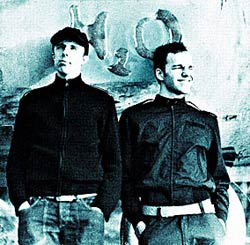
One cannot write about the history of the Latvian-American community, or even the worldwide Latvian diaspora, and not mention the musical group Čikāgas piecīši (The Chicago Five). The group is simply that important and that deeply ingrained in the community that to ignore it would be to ignore one of the most valuable and enduring contributors to diaspora life and culture.
To cover the group’s nearly half century of history is an intimidating task. Čikāgas piecīši has done so much and been so many places that a detailed account of the group’s accomplishments and achievements would require a book. In fact, Piecīši leader and guiding light Alberts Legzdiņš did write a book about the group’s experiences, Čikāgas piecīšu brīnišķigie piedzīvojumi, which serves as the major source for this article and highly recommended to anyone wishing to find out more about the history of the group.
The snobbish may look down upon the songs, some of which were rather simple musically and lyrically, and may dismiss Čikāgas piecīši as “lightweight.” Some may call the group “old timers,” but many Čikāgas piecīši songs are as relevant now as they were when first written, 30 or 40 years ago for some. The group also recognized the immense value of humor in its performances, presenting not just songs, but also short comedy sketches. The group’s achievements—performances all over the world, recording and releasing more than a dozen albums, the ability to draw audience members sometimes from hundreds of miles away—are even more impressive when considering that this was all done starting in the 1960s, a time when it was much more difficult to advertise and promote performances to such a limited audience! Rare was the song festival where the Piecīši did not play to a packed house multiple times. Also impressive is the fact that the group achieved all this even though it was always only a “hobby” and not a full-time career for the members.
Songs such as “Pazudušais dēls,” “Par mani, draudziņ’, nebēdā” and “Vecpiebalga” have become part of the Latvian song canon. Who could have imagined that this group, from its humble beginnings and its first concert more than 40 years ago, would reach such heights?
In fact, our story begins a few years prior. Alberts Legzdiņš, along with friends Modris Avotiņš, Jānis Plūme and Dailis Grauze first performed together in the fall of 1958 in Chicago as the Jamaikas piecīši (the Jamaican Five)—even though there were only four of them, beginning one of the longest running jokes in Piecīši history, because rarely did the group have exactly five members.
The group performed, for example, Harry Belafonte’s “The Banana Boat Song (Day-O),” with, of course, Latvianized lyrics. The performance was for the Chicago Latvian Youth Group (Čikāgas latviešu jaunatnes pulciņš, or ČLJP), which often organized events for young Latvians and had a few hundred members.
For its second performance, the group had already changed their name to Kanādas piecīši (The Canada Five). Afterward, due to decreased interest, the Piecīši stopped performing briefly.
Fate would smile upon the musicians in the fall of 1960, when Legzdiņs and Avotiņš, attending a ČLJP event where musicians and performers from other cities were invited, saw a performance by two young Latvians, Jānis Rinkušs and Uldis Ievāns. Rinkušs and Ievāns, from Kalamazoo, Mich., were performing a comedy sketch and were planning on moving to Chicago very soon. The four joined together, rehearsals began, and the group, after tossing around names such as Jautros kavalierus (The Happy Cavaliers) and Skanīgās disonances (The Resounding Dissonances), finally decided on the name Čikāgas piecīši, even though they were only four at the time. So the group—Legzdiņš (accordion and vocals), Avotiņš (bongo drums), Rinkušs (guitars and vocals) and Ievāns (sketch author and performer)—on Feb. 1, 1961, began what would become one of the integral threads of Latvian diaspora life.
The first concert was March 11, 1961, at the Kalamazoo Latvian Society House. Kalamazoo itself at the time was a major Latvian center. More than 1,000 Latvian immigrants lived there and the community had a choir, theatre and two churches, and it was home for the the editors of the magazine Mēs. As would be the program for future concerts, Čikāgas piecīši performed songs intermixed with comedy sketches. Reviews for the nascent group were generally positive, but one audience member was overheard to say “I’ve seen worse night club acts.”
The group’s first performance in Chicago came on April 15, 1961. By this point, the group had taken on its first female member, Maija Dumpe of Chicago. Legzdiņš, working at department store Montgomery Ward, was able to procure matching outfits for all band members: grey pants, white shirts and red sweaters. The public was responsive and more than 300 attended the concert. The concert began with the group walking on stage from the back of the hall singing the Latvian folk song “Seši mazi bundzenieki” (Six Small Drummer Boys). For the next two hours, Čikāgas piecīši performed Latvian traditional and popular songs, folk songs, American songs translated into Latvian, and even two Legzdiņš originals, the first signs of his impressive song and melody writing talents. At the end of the show, the group sang what would become its closing song at all following concerts, a Latvianized version of “Hey Li Lee Li Lee” by the American group the Limelighters, now called “Hei laili” and including a tribute to women drivers, which got an enthusiastic response from the men in the audience.
The group, well known for its frequent lineup changes, said goodbye to Avotiņš (who returned to work in the Caribbean) and Ievāns (who was drafted into the U.S. Army) and in 1962 welcomed several new members, including accordionist and vocalist Ilmārs Dzenis and vocalist Juris Strautmanis, both of Chicago. Also joining the group was Ruta Kulmane. Another important member of the band joining was Ģirts Puriņš, singer and sketch performer, who became known as the group’s “sex symbol.” Puriņš also was an artist and helped design many of the group’s album sleeves and set decorations.
The first international concert by Čikāgas piecīši took place the same year, but the performance in Toronto was one of the group’s lesser efforts. For this journey, the group members were Rinkušs, Strautmanis, Dzenis, Legzdiņš and Kulmane. Problems began on their travel to Toronto, with a number of members complaining of sore throats and difficulties speaking. Because Kulmane has forgotten her Displaced Persons card (needed to cross the border), the group had to stop and wait for her parents to bring it. At the Canadian border, the group runs into more problems when Kulmane, after being asked by the border guards about their purpose in traveling to Canada, announces that they are “Latvian artists.” The border guards, apparently assuming that the band wanted to get into Canada to make money, ordered everyone to unload their baggage and register their items at customs. In the end, after explaining that they are only out to promote Latvian culture and had no plans for any shady or dubious behavior, the group was let go without having to pay customs tax.
The concert in Toronto was not particularly successful, with only 200 spectators in a 2,000-seat hall. The group’s health problems significantly affected the performance and the audience was reserved as well. Sketches fared no better. In one, Strautmanis came on at the wrong time and then started waving his arms in frustration. Ironically, the first major laughs come at the end of the first act when Legzdiņš, with a large crash, fell over Dzenis’ contrabass case.
With typical Piecīši optimism, the group figured that it could only get better after this.
And better it did get, by leaps and bounds, with performances all over the United States. The group also released a number of recordings through the years. The first album, Čikāgas piecīši sveicina, came out in 1963 and featured many of the trademarks of the group’s live performances: a “latviešu popūrijs” (Latvian potpourri), a medley of popular Latvian songs, as well as an “amerikāņu popūrijs” and a medley of popular American songs with Latvian lyrics, such as a Latvian version of Bobby Vinton’s “Roses are Red.” The record also contained a few Legzdiņš originals: “Noriet saule,” “Bitītes” and “Klusi, klusi.” In its two short years of existence, the group had already performed for more than 7,000 listeners in 17 Latvian centers in the United States and Canada.
The group’s second album, Mēs puisēni jaun’ būdami, came out in 1964 and contained popular songs such as the Latvian folk tune “Es redzēju jūriņā” (as sung by Dzenis) and “Kultūras apmaiņa” (detailing the negative effects on a marriage of the American-Russian cultural exchange in which, after seeing the Bolshoi ballet, a hapless guy’s wife never takes off her boots, not even while in bed). Also notable was “Trīs mednieki,” about three nearsighted hunters who shoot first and ask questions later.
Of the group’s U.S. performances particularly notable was one in Los Angeles in 1964. Among the 300 in attendance was well-known Latvian writer and satirist Anšlavs Eglītis, who provided Čikāgas Piecīši with its first “serious” review and critique. Among his suggestions were to drop the “international” humor and to focus more on the humor of Latvian life in the United States, which the group in fact did with very successful results.
More albums followed: Čikāgas piecīši Amerikā in 1965 and Mēs braucam in 1966. These albums featured the developing songwriting talents of both Legzdiņš and Dzenis, featuring songs like “Supermarketā”” a lament about the unnatural and unappealing products in the local supermarket, “Kuģis Neibāde,” about the fateful Rīga–Saulkrasti ferry Neibāde that sank, and “Sabiedriskā tiesa,” about the eternal conflict between young and old, particularly among Latvians, where the younger generation, as always, is not taking enough interest or participating and is dressing poorly. The song is also interspersed with English words, as well as English words declined as if they were Latvian—“bet vienmēr jūs kompleinējiet” for example.
Humor was one of the main ingredients of the success of the Piecīši, and the lead architects of the between song-sketches were Ievāns and Legzdiņš. The group released a record of just their humorous songs and sketches in 1968, called Vēl jau viss nav pagalam, which was later released on compact disc (with bonus material) as Jocīgie gadi 1 in 2002. Their humor was also at times scathing and biting. Since no two shows were ever the same, no one in the audience ever knew what to expect. Even if disaster struck in the course of a show, the Piecīši were able to ad lib their way out of the mess.
Noteworthy new additions to the Piecīši crew were Janīna Ankipāne and Uldis Streips (both joined in 1967). Ankipāne was from St. Louis and had been performing in a number of nightclubs there. Streips had been the stage director for the Piecīši for a number of years, as well as being a longtime friend of Legzdiņš and Ievāns.
Ankipāne and Legzdiņš would together record two albums, Sanfrancisko–Rīga in 1969 and No Lielupes tilta in 1971. Sanfrancisko–Rīga featured songs like the classic “Vecpiebalga” (words by L. Vāczemnieks, music by Legzdiņš). A controversy remains over the song because, for reasons unexplained, the late Latvian composer Eduards Rozenštrauhs claimed the copyright on the melody in Latvia. Other notable tracks on the album are “Es savai līgavai” (a song about a man with a very large fiancée who falls on top of him, leading to three weeks in the hospital) and “Tautas skaitīšana” (a lament about how few Latvians there are in the world and how Latvians don’t stand out, for example, like the Swiss with their alps and watches). No Lielupes tilta also featured Legzdiņš maturing as a songwriter, particularly the lullaby “Šupuļdziesma,” with its resonating opening words “Saldu dusu visiem latviešu bērniem”—sweet dreams for all Latvian children who are scattered all over the world, but share the same sun and moon. These records were more mellow and serious than the other Piecīši records, but still featured the occasional flash of humor for which the Piecīši were known. Ankipāne’s participation in the group was particularly impressive, as she lived in St. Louis but was still able to regularly practice and perform with the rest of the ensemble in the Chicago area.
As the group’s reputation and fame grew worldwide, it was invited to play even Australia and New Zealand, the first time in 1970. The adventure started ominously, with Legzdiņš experiencing full automotive failure in his Volkswagen. With 25 minutes to spare, he arrived at home to grab his baggage and guitar and, with literally five minutes to flight time, arrived at Chicago’s O’Hare Airport. After concerts in San Francisco and Los Angeles, it was on to New Zealand and Australia. And so, the Piecīši, now composed of Legzdiņš, Rinkušs, Dzenis, Streips and Ankipāne, were on their way. The group performed in New Zealand (Auckland and Christchurch) and Australia (Sydney, Canberra, Brisbane and elsewhere). This being a Čikāgas piecīši tour, there were bound to be amusing episodes, such as in Melbourne, where the police had been warned that a “hippie” group would be performing and that a riot was a certainty, or in New Zealand, where customs authorities suspiciously viewed certain items in the band’s possession such as a Superman costume and a fake “Mexican revolutionary” mustache.
In 1970, Legzdiņš traveled to Rīga for the first time after leaving during World War II. Besides wanting to meet relatives in Latvia, his goal was to investigate whether it would be possible to arrange for the Čikāgas piecīši to perform in Latvia. The initial reaction was encouraging with what seemed to only be technical questions to resolve, but the Piecīši also were asked to speak negatively about the ongoing Vietnam War. Hopes faded when the well-connected and powerful Latvian composer Raimonds Pauls, when asked by Legzdiņš when he thought the Piecīši might be able to perform in Latvia, simply responded, “Never”. No explanation was given, but perhaps the Soviet government thought these performers were a threat to the regime. In the end, it would be almost 20 years before the Piecīši would first be able to perform in Latvia. This was also a time when many American Latvians considered traveling to Soviet Latvia to be practically an act of treason and many heated discussions led to strained relationships within the Latvian community.
But the popularity of the Piecīši continued to grow with more performance in the United States as well as Europe. Dzenis bid farewell to the group in 1972, as he wanted to work more as a solo artist and perform more traditional Latvian songs. Replacing him in 1973 was Armands Birkens, another powerful vocalist. Even as a child, Birkens had been a big fan of the Piecīši. Birkens and his sister would attend as many concerts as they could, and, after a while, were invited both to perform on stage during the pauses between songs and sketches while the group changed clothes. As an adult, Birkens joined the group as a lyrical tenor and has been a focal point of Piecīši sound ever since.
The late 1970s saw the group record some of its best work. The album Čikāgas piecīši koncertā was released in 1975, featuring another classic in the Latvianized version of the Arlo Guthrie song “The City of New Orleans.” Retitled “Pazudušais dēls” (The Prodigal Son), with lyrics by Streips, the song is about a man traveling to Latvia during Soviet times and wondering if there ever will be a time he will be able to return. And lest we forget the group’s paean to procreation, the album also includes “Sekss ir labs” (Sex is Good), a chant “meant for children” to “inspire” them to reverse the low Latvian birth rate. Legzdiņš had now fully established himself as a songwriter par excellence, particularly with songs like “Es redzēju bāleliņu,” a song about young men going to war in foreign lands and their deeds being forever immortalized in folk songs. It is as touching and moving now as it was then, more than 30 years ago. In 1977, the trio of Legzdiņš, Ankipāne and Birkens recorded the album Vakarziņas, featuring the ode to beer, “Man garšo alus,” and the beautiful “Līgo dziesma,” encouraging mothers and fathers to sing midsummer “Līgo” songs to their children so that their children could pass them on to their own children.
The albums of the 1980s saw the group writing songs that often featured more patriotic lyrics, though continuing to detail the lives of Latvians living in America. Some of the members of the group were already parents themselves, so some songs now detailed the trials of raising Latvian children, such as “Piektdienas vakars, sestdienas rīts” (Friday Evening, Saturday Morning) from 1983’s Par mani, draudziņ’, nebēdā!. The song is about the crisis that often erupted Friday evenings in the homes of Latvian families, what with Saturday—the day of Latvian school—looming but very little, if any, homework having been completed. The title track, “Par mani, draudziņ’, nebēdā!,” is a song sung from the point of view of the Freedom Monument in Rīga, telling the listener not to worry, that the three stars that “Milda” holds would keep her warm, no matter how many different armies go marching by. Less than a decade later, the song would prove to be prophetic and still remains one of the group’s most popular songs. Also popular was the ballad “Mūsu mīlestība,” with lyrics by Legzdiņš and sung by Birkens in his distinct tenor, about a love (perhaps between two people, or between a person and Latvia itself) that will withstand the tests of time and distance.
Made in Latvia, released in 1988, was much in the same vein. The title track “Made in Latvia” would also be a big hit. It is about a man whose life is full of international products (electric shaver from Japan, tea from India, kitchen table from Denmark) but his beloved is “made in Latvia” from the ends of her hair to the bottom of her feet. The record also featured new member Lorija Wood, who had joined the group that year. Wood made her mark in a duet with Birkens on “Lai visa pasaule to redz,” a song about a couple that tells the world to gaze in wonder at how great their love is, even though he lives in Chicago and she in Latvia. Wood was very active in the Chicago Latvian music scene, her work included directing the Daugavas Vanagi double quartet, the Chicago men’s choir, as well as the Gaŗezers youth choir, among others.
With the Latvian reawakening of the late 1980s, the invitation to perform in Latvia finally came in 1988, with a letter from the Latvian Cultural Committee. In 1989, Cīkāgas piecīši made its first trip to Latvia. The concert tour consisted of stops in cities like Cēsis, Valka and Ogre, with the final concert on June 26 in Rīga’s Mežaparks. The Piecīši, now composed of Ankipāne, Birkens, newcomer Alnis Cers, Ievāns, Legzdiņš, Streips and Wood, presented an epic performance that highlighted the group’s 30-year history. It was one of the biggest crowds in Mežaparks history, with estimates putting it at between 40,000 and 70,000. A particularly poignant moment in the show was the dedication of the song “Pazudušais dēls” to Vilnis Links, who had written to the group about how he kept the lyrics of this song in his thoughts when, in 1982, he returned to Rīga after a tour of duty in Afghanistan. Another noteworthy aspect of this concert was the fact that all proceeds from the concert stayed within Latvia (as opposed to some percent of the proceeds going to Moscow). This historic performance is documented on the two-cassette set Čikāgas piecīši Mežaparkā.
The group returned to Latvia for additional concert tours in 1991 and 1995, each time closing with an enormous show in Mežaparks. For the 1995 tour, the group consisted of members Legdziņš, Ievāns, Birkens and Cers, with newcomers Ausma Līdace and accompanist Muriel Anderson.
The group’s final studio album of new material was 1994’s Vai debesīs būs Latvija?, the first to be released direct to CD. The songs on this album become more reflective, with themes including the extended families of Latvians (like in “Brālis un māsa,” where the son marries an American and the daughter marries then divorces a Frenchman, but all of their children go to Latvian school), as well as the group’s experiences in Latvia (“1989.gads”) and other thoughts on Latvia (such as “Sprīdītis Rīgā,” in which Latvian folk hero Sprīdītis returns to Rīga to find that much has changed since he was last there). Joining the group on the record was new member Linda Maruta Kronberga of Toronto.
The group’s final performance as a full ensemble was, appropriately, at the Latvian Song Festival on July 19, 2002, in Chicago. Not long after, Ievāns suffered a stroke, leaving very much in doubt whether the group will ever perform in its full lineup again. Legzdiņš and Birkens still sporadically perform together. Legzdiņš also performs periodically with other members of the group, though usually in smaller ensembles. The Legdziņš children have also performed with the group. Son Edgars Legzdiņš has taken part in sketches and played the guitar, and daughter Māra Legzdiņa Svenetecka sings and has been known to convincingly portray Latvian ex-president Vaira Vīķe-Freiberga in sketches. Though the group as a whole has effectively disbanded, almost all of its original work has been released on CD, so that new generations can listen to and enjoy the work of these musicians.
The group’s 50th anniversary would be in 2011, but there are no plans to reform the group or perform.
Legzdiņš has remained active in Latvian music and performance. He has worked with Latvian-American composer Andrejs Jansons, providing some lyrics for the musical “Lolitas brīnumputns.” His best-known recent achievement is the musical “Eslingena,” a collaboration with Andris Ritmanis (on the libretto) and Lolita Ritmane (on the music). The musical’s premiere was in 2004 during the Latvian Song Festival in Canada. “Eslingena” also was performed in 2005 in the National Theater in Rīga.
Streips remains a professor at the University of Louisville School of Medicine (where he has been since 1972). He received the distinguished educator award in 2004 in Microbiology.
Dzenis had a successful solo career after leaving the Piecīši and became one of the most beloved Latvian singers in the United States. He released a number of albums, including Šeit ir Latvija, Ilmārs Dzenis un Florīdieši and Lūdzu, nekāp uz manām varžacīm. Now retired and living in Florida, he remains active in the Latvian community, and still periodically performs, playing the accordion and singing.
Birkens is also still very active in the Chicago Latvian community, singing in the men’s choir and directing the Chicago Latvian Radio, as well as writing reviews of music and theater performances.
Wood (now Cinkusa) lives in Latvia and married conductor Ivars Cinkuss. She is a conductor herself, leading the Ventspils Latvian Society Men’s Choir (Ventspils Latviešu biedrības vīru koris).
Rinkuss lives in Michigan, Strautmanis is currently in Puerto Rico, Kulmane (now Dzelme) has two grandchildren, and Cers lives in Chicago. Ankipāne works as a psychologist with people who have problems with alcohol and other drugs. Puriņš, who left the group in 1972, became the president of the American Latvian Artists Association from 1982 to 1995. He died in 2004 at the age of 66.
By being the lead ambassadors of Latvian popular music from America to Latvia, the songs of the Čikāgas piecīši helped bridge the divide the grew not just between Latvia and the rest of the world during Soviet times, but also between Latvians in North America and elsewhere. Rare is the Latvian who has not heard of the group.
In “Pēc 20 gadiem” (After 20 Years), a song about the possibility that after 20 years in the United States one’s Latvian identity may fade, Legzdiņš exclaims “Pēc divdesmit gadiem, ja es būš’ vēl letiņš, tad tas būs kaut kas!” (After 20 years, if I will still be a Latvian, then that will be something!). Here we are, nearly 50 years later, and thanks in part to the songs and performances of the Čikāgas piecīši, Latvians around the world are still alive and well. And that is quite something indeed.
(Editor’s note: The author thanks Ilze Ievāns, Alberts Legzdiņš and Uldis Streips for their assistance with this article.)
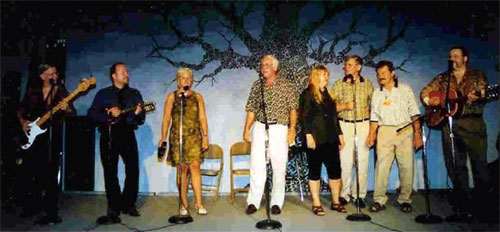
The group Čikāgas piecīši performs at the Latvian Center Gaŗezers near Three Rivers, Mich. From the left are group members Uldis Streips, Alnis Cers, Māra Legzdiņa-Sventecka, Alberts Legzdiņš, Janīna Ankipāne, Uldis Ievāns, Ģirts Puriņš and Armands Birkens. (Photo courtesy of Čikāgas piecīši)
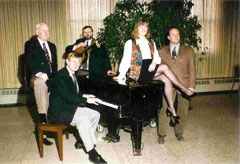
Members of the group pose for a photograph. From left to right are Alberts Legzdiņš, Uldis Ievāns (at piano), Armands Birkens, Ausma Lidace and Alnis Cers. (Photo courtesy of Čikāgas piecīši)