Novel shows promise for Latvian-Canadian writer

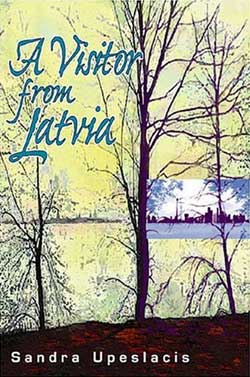
A Visitor from Latvia

How many times have you heard the phrase “the younger generation just doesn’t read Latvian books anymore” said about those now in their 30s, 40s and 50s? It’s true—but why? Is it simply because our Latvian is not as competent as that of the older folks or is the problem subject matter? I would like to think it’s a combination of both.

Latvian books (those written outside Latvia, anyway) are often autobiographical memoirs or novels loosely based on the author’s own experiences. These are informative but difficult to relate to if you have not been through those times yourself. Of course there are also books written by contemporary Latvian authors living in Latvia, but the style of writing is quite different to what people living outside Latvia are used to. The free association and dream sequence-style musings of many modern Latvian writers are all well and good from a creative point of view, but nothing beats a solid story line with believable characters.

Sandra Upeslācis has this and more in her first novel, A Visitor from Latvia. The book is written in English, so no one has the excuse of finding it difficult to read. The plot contains many elements that Latvian readers can relate to. Set in Toronto, many contemporary issues are raised: the ongoing traditions of the Latvian community that still continue today, juxtaposed with the life and career of the next generation in their homeland, Canada. Throw into this setting a visitor from the old “homeland”—the now independent Latvia—and you have the ingredients for an interesting mix of human interaction. This scenario is also easily transposable to any other Latvian setting outside Latvia. The story could just as well be set in Sydney in Australia or Los Angeles in the United States. The intergenerational attitudes and issues, as well as the differences between Latvians from Latvia and those who have lived most of their lives outside Latvia, are similar all over the world.

Other usually taboo subjects in more or less classical Latvian literature such as love, sex and interethnic relationships are also covered, making for quite scintillating reading. The main character, Klāra, is a feisty, independent Latvian-Canadian whose high-powered, career-oriented life is the epitome of what everyone seems to strive for these days. She comes from a traditional Latvian background, where mum is the homemaker and dad the retired breadwinner, and is one of three children in the family. You can probably start seeing the similarities with your own family already. The relative from the homeland, Andrejs, is also the traditional guest from Latvia—everyone has had at least one such over the last 15 years. Glimpses of his life back in Latvia show that he, too, is one of the younger generation with trials and tribulations that await him on his return.

The interaction between the main characters—mainly Klāra with her family, her new love Philippe and her cousin Andrejs—is quite well developed. The racy pace make this book compelling reading. Let’s hope Upeslācis’ creative juices continue to flow and we can look forward to more fresh and perceptive exposes of the lives of Latvians today, wherever the setting may be.

Details

A Visitor from Latvia

Sandra Upeslācis

Toronto:  Town Press,  2004

ISBN 0973660104

Where to buy

Purchase A Visitor from Latvia from Amazon.com.

Note: Latvians Online receives a commission on purchases.

Daina Gross is editor of Latvians Online. An Australian-Latvian she is also a migration researcher at the University of Latvia, PhD from the University of Sussex, formerly a member of the board of the World Federation of Free Latvians, author and translator/ editor/ proofreader from Latvian into English of an eclectic mix of publications of different genres.

Melbourne Latvian awarded Order of Australia

A member of Melbourne’s Latvian community has been awarded the Medal of the Order of Australia (OAM) “(f)or service to the community, particularly through the provision of honorary legal advice to ethnic community members and organisations,” according to the Department of the Prime Minister and Cabinet.

Aleksandrs Gārša was awarded the medal on June 13, the day Queen Elizabeth II’s birthday is celebrated.

Born in Latvia in 1935, Gārša arrived in Australia in 1949. He obtained arts and law degrees from Melbourne University and has worked as a lawyer for the firm of Kahn and Clahr since 1961. He is a public notary in Victoria and frequently commutes between Germany, Latvia and Australia for work-related matters.

Gārša joins a number of other Latvians who have received similar awards over the years. The Order of Australia was created in 1975.

Daina Gross is editor of Latvians Online. An Australian-Latvian she is also a migration researcher at the University of Latvia, PhD from the University of Sussex, formerly a member of the board of the World Federation of Free Latvians, author and translator/ editor/ proofreader from Latvian into English of an eclectic mix of publications of different genres.

Ezīši reach across Baltic borders

Latvians and Estonians have a similar folk music background—logically so, seeing as they are geographical neighbors. Even though they use similar instruments, each nationality has its own interpretation of this musical genre.

Ezīši, an Estonian and Latvian collaboration from the United States, draws on these similarities and has created a very pleasant “easy listening” compact disc. The recording is good for background music for a dinner party, great as a conversation piece to introduce non-Balts to the folk music of the region (this is Baltic, not Balkan music—no balalaikas here!) and can even as an accompaniment to a Latvian or Estonian (or Lithuanian, while we’re at it) dance night.

Ezīši (also known as Siilikesed in Estonian and Hedgehogs in English) is a group of musically talented individuals from Indianapolis, Ind. Most of the members are U.S.-born and only some have Baltic roots. Their common trait is a passion for folk music. They even made some of their instruments themselves and, according to the CD liner notes, their “goals are to help preserve and to spread awareness of the folk music of the immigrant communities from the Eastern Baltic area…our specialty is the presentation of medleys of similar or at least compatible tunes from different nationalities of northeastern Europe.”

Even the name of the group is a glimpse into Baltic heritage. “The name of the group recalls rarely seen but fondly remembered creatures of the old homelands,” the liner notes continue. “These little animals can protect themselves by rolling up into a spiny ball. Thus they aptly symbolize Estonians’ and Latvians’ talent for self-preservation without being aggressive or dangerous to others.”

These folks are masters of their instruments—and not just the kokle. (I’ve heard many a CD of just kokle music, which is most certainly the best lullaby music to date! Kokle songs often all blend into one and the endless plucking of strings can become annoying after a while.) These guys also play the bagpipes (dūdas), shepherd’s horn (ganu rags), wood flute (stabule), accordion, tri-level rattle (trīdeksnis) and many other ancient Baltic percussion instruments. Their rendition of the folk songs is certainly not conducive to sleep! Each instrument appears to have been carefully chosen for each particular tune. No vocals are performed so the focus is purely on the melodies as they are interpreted via the various instruments.

This CD provides a smorgasbord of different types of melodies: some dance tunes, others more contemplative and still others very ancient, soulful melodies that I had never heard before. The liner notes give insight into the similarities of these songs in the region. In some cases the songs have only recently “crossed borders.” The pancake dance (“Pankūkas”) was taught to a group of Lithuanian students by a Czech dance group in the 1970s and a decade later the Lithuanians taught it to their northern neighbors, the Latvians. It would be an interesting topic for a thesis to research the origin of each song and trace it as it was adopted and adapted by folk from neighboring countries.

The music in this recording comes across very pure and clean, probably a combination of sophisticated recording and very precise playing. For instance, the performance of “Sidrabiņa lietiņš lija” (The Silvery Rain) is so sharp it seems the sound cuts the air with a knife.

The dances “Pankūkas” and “Apaļais mēness” (The Round Moon) make your feet want to get up and dance to the music.

For some reason the Balts seem to have mastered the “sad songs.” These more often than not are songs about orphans and their lot in life. Track 26 on this CD provides a medley of hauntingly beautiful “sad songs.”

I have a challenge for you: If you get a chance to listen to this CD, test your knowledge of Baltic folk music and try to discern which song is from which region in the Baltics. I’m sure you’ll learn something new on hearing and reading about each and every song.

The recording may be ordered from Ezīši member Ieva Johnson by contacting her via e-mail at sijats@yahoo.com.

Details

Ezīši

Ezīši

Ezīši,  2005

Daina Gross is editor of Latvians Online. An Australian-Latvian she is also a migration researcher at the University of Latvia, PhD from the University of Sussex, formerly a member of the board of the World Federation of Free Latvians, author and translator/ editor/ proofreader from Latvian into English of an eclectic mix of publications of different genres.