Australia marks 50th annual arts festival

The 50th annual Australian Latvian Arts Festival (Austrālijas latviešu 50. Kultūras dienas), a celebration of Latvian identity in Australia, took place in Melbourne from Dec. 26-31.

The festival included a range of events, from the light to the serious, from the indoor to the outdoor, from those meant for children, to those for youth and adults.

Among musical events was a Dec. 26 spiritual concert in the Lutheran Church of the Holy Cross, the Dec. 27 opening ceremony in Williamstown Town Hall, and the Dec. 28 youth concert in the Latvian House in Elwood, a suburb of Melbourne.

Theatre performances also were a part of the festival. For children, there was “Kraukšķīša piedzīvojumi” (The Adventures of Kraukšķītis), a play based on the story Kraukšķītis by Margarita Stāraste about a gingerbread man. “John’s Night,” meanwhile, took a serious look at issues of cultural maintenance and change over two generations. “Lolitas brīnumputns,” a classic play by Anna Brigadere, also showcased the talents of Latvian-Australian actors.

Other activities included an exhibit of art, photography and crafts. Among artists featured were painter Imants Tillers of Australia and photographer Maija McDougal of England.

A folk dancing performance explored Latvian mythology and featured dancers from seven groups from four Austrlian communities, including Sprigulītis of Canberra, Jautrais pāris of Sydney, Auseklītis of Adelaide, and Sprīdīšu saime, Piektais ritenis and Ritenītis, all of Melbourne, as well as pupils from the Latvian school in Melbourne.

Other events included meetings of various Latvian organizations as well as competition in basketball, darts and novuss.

The Latvian Youth Association of Australia organized a series of gatherings and entertainment to run in conjunction with the festival. The highlight of the youth association’s “Saviesīgie 2004” activities was the Dec. 30 “Triple Bill Extravaganza,” which featured musical performances by modern and traditional groups from Australia and Latvia.

Daina Gross is editor of Latvians Online. An Australian-Latvian she is also a migration researcher at the University of Latvia, PhD from the University of Sussex, formerly a member of the board of the World Federation of Free Latvians, author and translator/ editor/ proofreader from Latvian into English of an eclectic mix of publications of different genres.

Brisbane ensemble explores musical heritage

In the 1970s and 1980s quite a few Latvian families with young children lived in Brisbane, Australia, but these days the Latvian school has closed down and the twenty- and thirtysomethings have moved elsewhere.

However, a group of five women, all still in their twenties and most raised in the community, are deeply interested in exploring their cultural heritage. About a decade ago they formed a kokle ensemble, now named Zigrīda ansamblis after their first kokle teacher, the late Zigrīda Strazds.

The ensemble draws from the wisdom and melodic influences of their ancestors and creates beautiful sounds that leave the listener entranced and teary, taken off to a land far away and a time long gone.

“Our group doesn’t have a leader as such,” said Valda Biezaite, one of the members. “Each member contributes to our group musically each in their own way, at times composing, helping to work on our compact disc or setting up our Web site.”

Other members include Tija Lodiņa, Jasmīne Lācis-Lee, Eliza Grant and Ance Deksne.

“We’ve been friends from childhood,” Biezaite said. “We went to Latvian school together, started learning to play the kokle together.”

Only one member of the group started out as an “outsider.” She was born in Latvia and moved to Brisbane a few years ago, but is very much one of the girls now.

In the group’s performances the primary instrument is the kokle. However it is often combined with other sounds such as voice and percussion. All five women have a musical education under their belt. Some play the piano, others have played the clarinet and flute in orchestras and other musical groups. The talented young artists have been able to successfully translate their more classical musical training to the arranging and composing of hauntingly beautiful and original Latvian folk melodies.

The group’s purpose is not merely to learn and perform well-known folk tunes. They take it one step further. Group members say they want to explore their cultural heritage by bringing something new and unique to the Latvian repository of folk music (tautas pūrs). Each of the women has been to Latvia at various times over the past decade and whenever they go, they seek out folkloric performances and have met with mentors such as Vilnis Salaks, Māra Vanaga and Iveta Tauriņa, all classical kokle composers and experts. They also have met folklorists such as Artūrs Uškāns, Valdis Muktupāvels, the group Iļģi and Jānis Krūmiņš. All of these leaders in the Latvian folk music world have provided inspiration and improved the group’s technical skill.

“We feel we like to push boundaries in our musical arrangements and performances and we are thankful that the Brisbane community has been very supportive,” Biezaite said.

All members of ensemble are of Latvian descent but their language skills range from native speaker to speaking just a few words of Latvian. All of them have spent some time learning the language, though.

“The group prides itself in taking every effort not to allow the language obstacle to hinder the group’s activities,” Biezaite said. “Despite the language barrier that some of us have, each of us has keenly explored what it is to be Latvian as individuals, and are proud to belong to the community in Australia.”

Zigrīda ansamblis doesn’t restrict its performances to the Latvian community. It has also performed at multicultural events in the wider Brisbane community, even at a wedding recently. The size of the group varies, depending on who’s available to play at the time. During the past few years, the ensemble has been discovered by the interstate Latvian-Australian community. Kultūras dienas, the cultural festival in Melbourne at the end of this year, will be another place to again “push boundaries.”
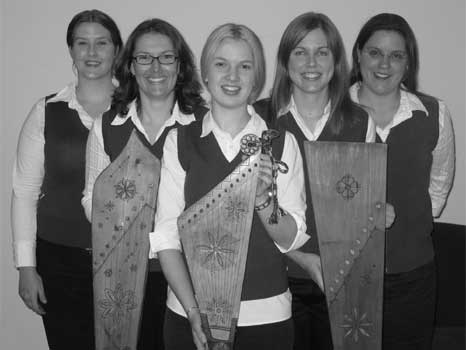
Zigrīda ansamblis

The member of the Brisbane kokle group Zigrīda ansamblis include (from left to right) Tija Lodiņa, Jasmīne Lācis-Lee, Ance Deksne, Eliza Grant and Valda Biezaite. (Photo courtesy of Zigrīda ansamblis)

Daina Gross is editor of Latvians Online. An Australian-Latvian she is also a migration researcher at the University of Latvia, PhD from the University of Sussex, formerly a member of the board of the World Federation of Free Latvians, author and translator/ editor/ proofreader from Latvian into English of an eclectic mix of publications of different genres.

Language is not the only part of our heritage

Language is a crucial element in opening up your children’s Latvian heritage. But there is another part to the process of giving them a sense of Latvian identity: the annual cultural traditions and rituals of the Latvian people.

In my case this process involves food. When I think of Easter, Jāņi (Midsummer), Christmas, New Year’s Eve and even birthday celebrations back in my childhoood, I associate them with the specific foods baked for the occasion and the beautiful smells that wafted from the kitchen.

I can’t imagine Christmas without the smell of pīrāgi, ķimeņmaizes (caraway seed buns), ābolmaizes (apple slice), the traditional cepetis (pork roast) and of course the overpowering scent of piparkūkas (gingerbread) baking in the oven. Birthdays were always celebrated with the traditional kliņģeris. I’ll never forget the exotic scents of the saffron and cardamom being prepared to be mixed in with the other ingredients.

Easter would not be Easter without the eggs dyed in onion skins, as well as paska and a few other yummy Russian ring-ins: kulich (a sweet cake) and kulebyaka (salmon pie). I don’t know why my mother made them. They didn’t even sound Latvian, but they sure tasted heavenly.

And Jāņi would not be the same without Jāņu siers (cheese with caraway seeds) that often crumbled to pieces but always tasted delicious eaten together with the standard fare—pīrāgi.

Needless to say, this was all possible because my mother actually enjoyed cooking. My sister, my father and I were the lucky ones who could enjoy the fruits of mum’s hobby. But was it merely a hobby? Mum worked as well, so the effort she had to put in would have been great. And why? So her family could commend her on her cooking skills over and over again?

I don’t think so. There must have been a reason which I am only beginning to understand now that I have my own children. Come Easter and I will inevitably be out hunting down onion skins at all the local grocery stores (supermarkets are not as helpful in this regard), and in December (even though it’s the middle of summer in Melbourne) you’ll find me slaving over a hot stove baking piparkūkas and pīrāgi in the 40-degree (Celsius) heat.

And the kids love to get involved. They can’t wait to help with the kneading and the glazing and—most fun of all—the tasting! Yes, the process is tedious and exhausting and time-consuming and sometimes I wonder if it’s all been worth it. But when the family sits down for the Easter or Christmas feast and goes ape over the paska or the freshly baked pīrāgi, I know that what they are eating is just another part of their cultural heritage that I hope they will end up passing on to their children.

This aspect of Latvian culture—the preparation of traditional foods on special occasions—is still primarily (even in the liberated Western world) passed on from mother or grandmother to the younger generation of females. It would be rare (although I’m sure it does happen as my son is one example) to see a son or grandson in the kitchen, looking on as his relatives cook and bake. So a logical deduction can be drawn: if the Latvian partner in a relationship is a woman, there is a greater likelihood that there will be some attempt to replicate what her ancestors did before her (providing her relatives had the time, energy and interest in her childhood). There are exceptions, of course – I know of at least one Australian wife of a Latvian friend who makes a mean batch of pīrāgi and a scrumptious kliņģeris.

Cooking is one small part of one’s cultural heritage. In the case of Latvians it all depends on how far you want to take it. During Jāņi you may only be interested in teaching your children how to make a vaiņags (garland) and letting them hear a few songs so they know how they sound. Or you may feel it is important to their upbringing to experience a full-blown Jāņi, complete with jumping over the bonfire in a Latvian national costume and staying up till the wee hours of the morning. To achieve this aim it takes a bit more effort, finding out where these celebrations take place in your part of the world and maybe even getting involved in organizing such. A trip to Latvia around Jāņi is probably the best (and most expensive!) option, but then there’s the problem of finding a venue with authentic Jāņi celebrations.

Language is the most important element that needs to be passed down in order for the next generation to be able to catch a glimpse of the world through the eyes of a Latvian. But traditions add another dimension to this process. Of course it’s possible to show or experience the traditions without understanding the language, but an amalgamation of both creates a three- dimensional picture rather than a two-dimensional one. The traditions, which touch all five senses, will gel into one’s subconscious more readily than language by itself.

Daina Gross is editor of Latvians Online. An Australian-Latvian she is also a migration researcher at the University of Latvia, PhD from the University of Sussex, formerly a member of the board of the World Federation of Free Latvians, author and translator/ editor/ proofreader from Latvian into English of an eclectic mix of publications of different genres.