Irish solicitor disappointed by lack of charges in Saulīte case

The Irish attorney who represented murder victim Baiba Saulīte, the 28-year-old immigrant Latvian mother of two who was gunned down in November 2006, has expressed unhappiness that her suspected killer will not be charged.

John Hennessy, a solicitor in the Dublin suburb of Swords, told Irish newspaper The Herald that he is “bitterly disappointed” the Director of Public Prosecutions will not bring charges. Hennessy represented Saulīte in her custody battle before she was killed.

Saulīte was shot twice on Nov. 19, 2006, as she chatted with friends in the doorway of her home in Swords. Her two sons were in an upstairs bedroom at the time.

According to Irish media reports, police suspected Saulīte was a victim of a murder for hire organized by her estranged husband, Hassan Hassan. At the time of the murder, he was serving a four-year sentence for his role in a stolen car ring.

The murder remains unsolved, despite several individuals having been detained. A year after Saulīte’s death, Irish police issued a renewed appeal for information.

In January, the Director of Public Prosecutions decided not to prosecute a man suspected of arranging the murder, the Irish Examiner reported Jan. 30. However, Irish police have not closed their file, according to the newspaper.

Hennessy was threatened after Saulīte’s murder and his home was firebombed. He continues to receive police protection.

The solicitor has been a vocal critic of the role of criminal gangs in Ireland, the Herald reported Feb. 5.
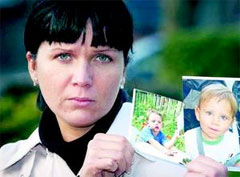
Baiba Saulīte

Latvian immigrant Baiba Saulīte, seen holding photos of her sons, was murdered November 2006 at her home in a Dublin suburb.

Andris Straumanis is a special correspondent for and a co-founder of Latvians Online. From 2000–2012 he was editor of the website.

Translated diary offers teenage boy’s view of life after war

The book has been out for a few months, but now there’s a Web site to support The Journal of Valdis Fomenko, the English translation of a teenage Latvian boy’s diary of life in a liberated Nazi concentration camp at the end of World War II.

The diary was rediscovered by Fomenko, who had immigrated to Canada, about 10 years ago. His written memories were translated into English by his niece, Lyndian Dowling of California.

Fomenko began writing the diary on Sept. 29, 1945, and entries continued until May 1, 1946, according to Astra Moora, editor of Dienvidkalifornijas Latviešu Informācijas Biļetens, who wrote about the book in the newsletter’s November issue.

The Fomenko family lived on Zaķusala in Rīga. They were taken to Germany during the war, spending some time in the Dachau concentration camp and a labor camp near Schongau. As the war came to an end, the family was transferred to a Displaced Persons camp.

The diary includes memories of Latvia, stories about both the dark and bright sides of life in the camps, and musings about the future. The book includes photographs of the family.

For further information, visit thejournalofvaldisfomenko.blogspot.com, where an English translation of Moora’s article is found. The original Latvian version is found in the newsletter’s PDF archive, biletens.com.

The Journal of Valdis Fomenko

The Journal of Valdis Fomenko is a teenage Latvian boy’s view of life in Germany at the end of World War II.

Andris Straumanis is a special correspondent for and a co-founder of Latvians Online. From 2000–2012 he was editor of the website.

Latvia accepts Guantánamo detainee

Latvia has agreed to take in one of the U.S. prisoners now behind bars at the Guantánamo Bay Naval Base, the Ministry of Foreign Affairs has announced.

The person the Latvian government has agreed to take in is considered “clear for release,” meaning the individual is not seen as a threat to society, the ministry announced. The Cabinet of Ministers approved the action Feb. 2.

The decision follows a January 2009 executive order signed by U.S. President Barack Obama calling for the closure of the detention facility at Guantánamo. About 800 individuals had been detained at the base during the past seven years, according to the executive order. Many of the prisoners are being transferred to facilities in the United States, but others are being sent to third countries.

The person being sent to Latvia is from Central Asia, according to the Ministry of Foreign Affairs. The government has received a written application from the person, who has “indicated readiness and interest to be housed in Latvia, as well as to integrate, learn the language and observe Latvia’s laws,” according to the press release.

Latvia’s decision is in line with those of other European Union members who have supported the Obama administration’s decision to close Guantánamo. A number of U.S. and European political leaders had criticized the U.S. prison on the eastern end of Cuba, arguing that detainees were being denied due process under the law.

Andris Straumanis is a special correspondent for and a co-founder of Latvians Online. From 2000–2012 he was editor of the website.