Book about former president raises controversy

A new book about former Latvian President Vaira Vīķe-Freiberga by controversial journalist Lato Lapsa continues to make waves. Va(i)ras virtuve, published Feb. 1 by the Rīga-based Atena, discloses what Lapsa and co-authors Irēna Saatčiane and Kristīne Jančevska claim is evidence of the ex-president’s free-spending time in office.

Vīke-Freiberga, who returned from exile in Canada to become the nation’s second president after Latvia regained independence, served from 1999-2007. Although often seen as a last-minute compromise candidate, Vīķe-Freiberga is presented in the book as a person who clearly wanted to become president.

The 184-page book includes many reproductions of documents as well as a CD-ROM with more details about Vīķe-Freiberga’s years in office.

A Web site in support of the book, www.vairasvirtuve.lv, could not be accessed. However, a site in support of the ex-president, www.rokasnost.com, has called on readers not to buy Lapsa’s book. Registered to Roberts Šulcs in the Czech Republic, the site includes pages applauding an apparent decision by the director of the Jānis Roze bookstore not to sell Lapsa’s book and then criticizing the director for apparently having a change of heart. Jānis Roze’s online store offers the book for LVL 7.95.
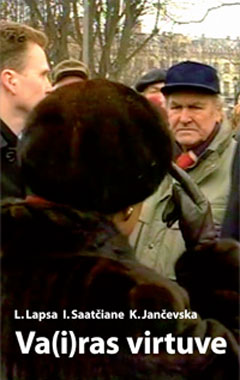
Va(i)ras virtuve

Controversial journalist Lato Lapsa is the lead author of Va(i)ras virtuve.

Andris Straumanis is a special correspondent for and a co-founder of Latvians Online. From 2000–2012 he was editor of the website.

Constitutional Court to review dual citizenship case in April

Latvia’s prohibition against dual citizenship will be reviewed by the nation’s Constitutional Court on April 13 in a case that could have meaning for many Latvians in the diaspora.

The case involves a family in Germany who was told by Latvian officials they would have to first renounce their German citizenship before they could register as citizens of Latvia. The Constitutional Court will have until May 13 to rule on the constitutionality of transitional rules in Latvia’s citizenship law, spokeswoman Līna Kovalevska told Latvians Online in an e-mail.

Baiba Lapiņa-Strunska and Viktors Strunskis and their daughter Rauna argued that they understood they already were Latvian citizens based on passports issued to them by Latvian legations in exile. But when they asked the Office of Citizenship and Migration Affairs (Pilsonības un migrācijas lietu pārvalde) in Rīga for new Latvian passports, they were told that they could not be dual citizens.

After Latvia regained independence in 1991, the government allowed pre-World War II citizens and their descendants to renew their Latvian citizenship without giving up the citizenship of their home countries. However, the offer came with a July 1995 deadline.

Lapiņa-Strunska and Strunskis sued the Latvian government. By last summer, their case had landed in the Supreme Court. That court has yet to rule on the case, but justices in August said the 1995 deadline and the restrictions on dual citizenship, in their opinion, are unconstitutional. The Supreme Court asked the Constitutional Court to look into the matter.

The Constitutional Court had expected to have preparations in the case completed by Dec. 23, but extended its deadline until Feb. 23. The case now is ready, Kovalevska said, and will be reviewed in writing on April 13. Justices will have up to 30 days in which to issue their ruling, or until May 13.

Andris Straumanis is a special correspondent for and a co-founder of Latvians Online. From 2000–2012 he was editor of the website.

ALA protests NBC’s coverage of Latvia in Winter Olympics

The president of the American Latvian Association is urging supporters to join the organization in protesting the failure of the U.S. television network NBC to fully show the Latvian team during the opening ceremony of the Winter Olympics.

In a Feb. 19 e-mail to ALA members and supporters, Juris Mežinskis said protest letters to the network also should point out what he called NBC’s ignorance of Latvia’s history.

Mežinskis, in a letter to NBC Chairman Dick Ebersol, said it was “mildly irritating” when the network in its live telecast of the Feb. 12 opening ceremony cut away to a commercial before the Latvian team was due to enter Olympic Stadium in Vancouver. Shots of the teams from Kyrgyzstan, Latvia and Lebanon were briefly shown when the network returned to live coverage.

But the ALA president used stronger language to criticize the network’s color commentary during the Feb. 16 men’s ice hockey match between Latvia and Russia.

“During the Russia-Latvia hockey game, it was more disturbing to have the commentator try to put Latvia in perspective by describing it as a ‘former Soviet republic,’” Mežinskis wrote. He added that according to the U.S. government, Latvia was an occupied country during World War II and the Americans never recognized its incorporation into the Soviet Union.

“Describing Latvia as a former Soviet republic carries a certain message of civility and legality which is misleading the TV audience,” Mežinskis wrote. “Latvia will have several more hockey games and other competitions where your ‘color commentators’ can either describe Latvia from the occupier’s point of view or that of the Latvian people.”

NBC officials could not be immediately reached for comment.

This was not the first time the Latvian team has not been shown during the live NBC broadcast of an Olympics opening ceremony. However, during the Salt Lake City games in 2002, Latvian fans and NBC affiliate KSL-TV convinced network officials to show the team live.

NBC has exclusive broadcast rights for the Winter Olympics in the U.S. In other countries, including Canada, the Latvian team was shown entering Olympic Stadium without commercial interruption.

Andris Straumanis is a special correspondent for and a co-founder of Latvians Online. From 2000–2012 he was editor of the website.