In a few years, perhaps, a young woman from a small town in Great Britain’s West Midlands might take the stage as Latvia’s representative in the annual Eurovision Song Contest. For now, 12-year-old Karli Ose—the granddaughter of a World War II refugee from Latvia—is keeping busy with schoolwork and a budding musical career.
Karli, who lives in the small town of Bilston about 200 kilometers northwest of London, began singing professionally just two years ago and landed her first public appearance at The Robin 2, a local venue, warming up for a Beatles’ tribute band.
“I have never had to have professional training,” she said in an e-mail interview. “I have always been able to sing, though I do believe my singing voice comes from my Latvian heritage.”
Karli is the daughter of Kārlis and Annette Osis and lives in a full house with three brothers and three sisters.
Unlike other young singers who are ready to emulate today’s music, Karli has chosen to reach back several decades for her repertoire, focusing on popular songs from the 1960s, 1950s and earlier.
“I absolutely love the music of the 1950s and 1960s,” she said. “I have always had this music to listen to as it is the only music my father Kārlis listens to. I love Connie Francis, Helen Shapiro, Cilla Black, Petula Clark and my all time favorite singer Dusty Springfield.”
Karli has covered songs such as “Stupid Cupid” (Connie Francis), “Lipstick on Your Collar” (Connie Francis), “Something Tells Me” (Cilla Black) and “The Loco-Motion” (Little Eva), but also digs into tunes of the World War II era that were especially popular among British soldiers, such as those performed by Vera Lynn and Gracie Fields.
“Vera Lynn was the forces’ sweetheart and Gracie Fields was lovingly referred to as ‘Our Gracie,’” Karli said. “These songs were very popular with the British forces and also helped keep the morale going when things were not so good. The Gracie Fields song, ‘Wish Me Luck As You Wave Me Goodbye,’ is taken from the film Shipyard Sally in which she starred.”
This summer Karli will have a busy schedule of performances around Great Britain. Starting with a June 24 concert in The Spareroom Cafe Bar in Birmingham, Karli will be part of a Michael Jackson tribute show in which she will sing “Ben” and “You Are Not Alone.” The tour runs into October. She also will perform Aug. 8 during V-J Day celebrations in Bilston Town Hall.
Karli has recorded a demo album and some of her covers are available through Amazon and other online stores. Several videos of her performances are available on YouTube.
Although one recording deal fell apart, Karli and her father are pursuing other avenues, including laying down a couple of tracks for Latvia’s largest recording house, Rīga-based MICREC.
“We are planning on recording a couple of songs with her,” MICREC’s Guntars Račs said via e-mail. One will be a cover version of an old American pop song, he said, while another will be a song penned by Karli herself.
“In my opinion she has a fantastic voice and a strong work ethic,” Račs added. “A young girl, but with an intelligent mind.”
In case singing does not pan out as a career, Karli said she has an alternate plan.
“If for some reason I did not make it as a singer, then I would love to be able to work as a nursery nurse looking after young children,” she said. “I really enjoy looking after my baby sister Natalya, taking her out for walks and shopping.” Besides her baby sister, Karli’s siblings include brothers Jēkabs, Jāzeps and Vilhelms, and sisters are Aleksandra and Šarlote.
Karli has never been to Latvia and is still learning the language.
“I have to apologize to all Latvian people, but as yet I know only know a few words in the Latvian language,” she said. Her grandfather never taught the language to her father.
“So now we are both learning together and I hope to learn very quickly so that I will be able to write to my Grandmother Zenta in Tukums,” Karli said.
She is not all that familiar with Latvian popular music, but has heard some songs by Raimonds Pauls. Karli also watched Latvia’s entry in this year’s Eurovision Song Contest, the Guntars Račs and Jānis Lūsēns tune “What For” performed by Aisha. Unfortunately for Latvia, its entry did not make it to the May 29 finals.
“I must say that I was quite surprised by Aisha’s performance,” Karli said. “There was a tremor in her voice and also in the close-up views she seemed very scared and nervous.”
In a few years, Karli might consider representing her ancestral homeland in Eurovision.
“I would like nothing more than to represent the land of my forefathers,” Karli said, “and hopefully I could do them proud and win it for them.”
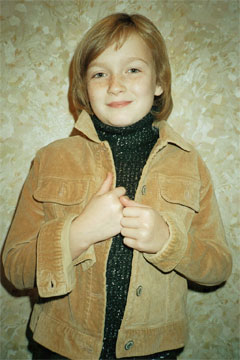
Karli Ose is a 12-year-old singer in Great Britain whose grandfather was a Latvian refugee. (Photo courtesy of Kārlis Osis)
Andris Straumanis is a special correspondent for and a co-founder of Latvians Online. From 2000–2012 he was editor of the website.