Dievturi record album of seasonal songs

Slapping the back of a guitar didn’t sound right. Tapping on the back of a kokle didn’t sound right, either. But pounding on a door was perfect, providing a deep, resounding “boom!” to punctuate the Mārtiņi folksong, “Kas dimd, kas rīb?”

And that’s what listeners may hear when they play a new album of traditional Latvian seasonal songs. The album, supported by the Latvian Church Dievturi and recorded by a group of singers and musicians from the American Midwest, should be ready this autumn.

Dievturi and friends from Illinois, Minnesota and Wisconsin gathered during the Memorial Day weekend May 26-28 for their second recording session in five months at Dievsēta, a Latvian-owned property near the small, rural Wisconsin community of Warrens. Dievturība is a Latvian folk religion that finds its wisdom in the dainas, which are often expressed in song.

“For years the people at Dievsēta have been talking about making a recording of the seasonal songs that we sing at Dievsēta at the different celebrations year-round,” explained project coordinator Zinta Pone of Minneapolis.

Several dozen songs may appear on the album, which is to be available in both compact disc and cassette format. The album initially was meant as a resource for Latvian schools, but its appeal could well be broader.

“People are interested in knowing what songs to sing at different times of the year,” Pone said, “as they are teaching about other traditions for the holidays. The education element is still primary, but we are going to sell the album to the general public. It should be entertaining for everybody.”

About five to 10 songs for each of the traditional seasons are expected to be included in the album, Pone said. “We don’t know yet if it will all fit on one album,” she added.

“Maybe we will divide the year over two albums. There are many people who are not familiar with specific seasonal songs, and we feel it is important to have recordings available so that these songs are not forgotten.” The album is to include printed lyrics and descriptions of the seasonal celebrations.

The singers and musicians who have participated in the two recording sessions number about 20. Songs have been performed solo, by duets and by large groups. Traditional instruments such as kokle, drums, accordian and trīdeksnis—as well as spur-of-the-moment innovations like the door—are used to complement the voices of the singers.

Manning the recording equipment is Atis Freimanis of Washington state, who—along with microphones and a mixer—flew to the Midwest during the winter solstice celebration and again during Memorial Day. Pone and other members of the folk group Lini met Freimanis during a concert trip to the West Coast. “Atis agreed to come to Wisconsin and record these seasonal songs,” Pone said.

Pone’s mother, Elga (leader of the Minneapolis-based folk ensemble Teiksma), and her cousin, Amanda Jātniece (like Zinta Pone, a member of both Teiksma and Lini), helped pick out songs and develop instrumentations and harmonies, she explained. “I did a homemade solo recording of the melodies, which I sent to the participants along with copies of the music and words. That helped them refresh their memories or become familiar with some of the songs before arriving in Dievsēta to record.”

During the recording sessions, the singers and musicians relied on Freimanis to guide them. “He was listening for the best possible sound and advised us of how many takes we should do of each song, played the recording back for our judgment and input and also offered ideas on how to make the songs more diverse and interesting to listen to,” Pone said.

“I think this was a great opportunity for the participants to experience professional recording and to feel an important part in a big project that will be enjoyed by people all around the world,” Pone said. “There is much, much enthusiasm behind the singing.”
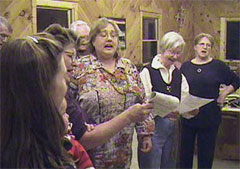
Dievsēta singers

Singers from Illinois, Minnesota and Wisconsin record a Latvian folk song during a recent session at Dievsēta in rural Wisconsin. (Photo by Andris Straumanis)
Andris Straumanis is a special correspondent for and a co-founder of Latvians Online. From 2000–2012 he was editor of the website.

Setting the limits of free expression

Latvians Online censors its discussion forums. And in the past several days, the responsibilities and repercussions of that censorship have hit some of our staff—and several of our readers—hard.

So now we offer you, our readers, an opportunity to determine the degree to which we should limit expression in our discussion forums.

But first some background.

We won’t go into details of the case here, but suffice it to say that as a result of our efforts to remove or prohibit certain objectionable material during two weeks in mid-May, we have had to edit or delete dozens of messages, have had to answer angry notes from irate forum participants and have had to mount a defense against one aggrieved reader’s libelous "anti-defamation campaign" that spread to at least one other online service.

Anyone who uses our forums should know what we mean by objectionable material. Every forum page states, "No foul language, attacks on individual people or companies, or advertising of any kind is permitted (non-profit organizations excluded) in these discussion forums." Since launching Latvians Online, we have edited or deleted messages that contained foul language and that were outright attacks on individuals. We have on several occasions expanded the rules to include attacks on ethnic groups, removing posts that were blatant examples of ethnic or racial prejudice.

But should we? What are the limits of free speech, especially given this still young medium of the Internet? And where do you, our readers, want to draw the line?

The Englishman John Milton, writing in the 17th century, suggested that people should be able to express their opinions in what is now frequently called the "free marketplace of ideas." The theory behind this marketplace is that truth can compete—and rise above—falsehood. This is a notion that has been adopted, in differing degrees, in many Western democracies. It’s a notion, we believe, that should be the standard for political speech.

The marketplace, however, is nothing like what it was in Milton’s day. Global communication technology allows readers of our forums to post messages from Canada, the United States, Australia, the United Kingdom, Latvia and plenty of other locations.

One issue now before legal experts around the world is how to deal with expression on the Internet. Laws about expression that are specific to one territory may find little sway in another.

In the United States, the First Amendment to the Constitution (ratified in 1791) forbids the Congress from making laws that abridge freedom of expression. However, legislative bodies have not always held to that restriction. At times, the courts have stepped in to remind lawmakers about the First Amendment. In the course of two centuries of case law, we now know that the right to free expression is not absolute. Obscenity, for example, is not protected by the First Amendment. Neither is expression that threatens national security.

In Latvia, the Law on the Press and Other Mass Media (adopted in 1990) states that everyone has the right to freely express their opinions. Censorship by the government is forbidden. But Paragraph 7 of that same law outlines what is not allowed to be published. The list includes items such as state secrets; expression that argues for racial, nationalistic or religious superiority, and information about the health of a citizen without that person’s agreement.

If Latvians Online adopted a hands-off policy to expression in its forums, letting every message stand without editing or deletion, we might find ourselves in violation of some law somewhere. And we’re sure that many readers would agree that certain expression should not be allowed, regardless of whether there are laws that forbid it. Child pornography would be the prime example.

As we step away from that extreme, how far should we go before declaring that we’ve reached an acceptable point? Should expressions of ethnic or racial hatred be tolerated? Will Latvians ever come to terms with the Holocaust and with 50 years of Soviet occupation by forbidding online attacks on Jews and Russians? Does denying hatred a channel for its expression do anything to reduce that hatred?

What about foul language? Is a well-placed expletive in a forum message only meant for dramatic effect, or does it encase a political opinion? Should we protect our young readers from foul language, stuff they hear anyway at school, on the playground and at Latvian summer camp?

Is it all right to allow attacks on individuals? If a Kļaviņš accuses an Ozoliņš of being an idiot, should Ozoliņš return the favor or call his attorney? If the former, does it serve any purpose to allow two individuals to sully the forums with personal attacks? If the latter, wouldn’t it make sense for us to step in to avert a possible lawsuit? No one has a right to hurt another individual, and we know that individual readers of our forums have been hurt by verbal attacks. Shouldn’t we police that kind of behavior?

One of our regular forum participants has likened Latvians Online to a house. We’ve invited you in and you are welcome to stay as long as you follow the house rules.

But we want this to also be your house. Over the coming weeks, we invite you to use our Open Forum to discuss what standards Latvians Online should have for the forums. Are our current rules good enough? Too strict? Not strong enough?

Let us know.

Andris Straumanis is a special correspondent for and a co-founder of Latvians Online. From 2000–2012 he was editor of the website.

Ellis Island online records include Latvians

A new online resource promises to aid Latvians searching for ancestors who came to the United States during the late 19th and early 20th centuries.

The American Family Immigration History Center has made available passenger lists of ships entering the port of New York from 1892 to 1924. In all, more than 22 million immigrants, passengers and crew members came to America during this period.

The records became available April 17 at www.ellisislandrecords.org.

Perhaps hundreds of Latvian immigrants passed through New York on their way to new homes throughout America. Family history researchers wanting to review ship passenger lists previously had to travel to New York to view the original documents. Now searching may be done from a home computer, although the popularity of the site may try one’s patience.

Searching is simple, but at least a couple rules must be kept in mind.

First, during the time period covered by the records, many Latvians would have spelled their names using the old Gothic orthography. Thus, Ozols could very well appear in the records as Ohsols. A search for the surname “Ozols” found three individuals, but “Ohsols” returned nothing. The shorter version “Ozol” returned 18 names, while “Ohsol” yielded eight.

Second, Latvian immigrants who arrived in the years immediatedly following the 1905 Revolution may well have traveled with forged documents or under pseudonyms. For example, just because the family name was Kalniņš back in Latvia doesn’t mean that was the name used by a revolutionary trying to find a temporary home in the United States.

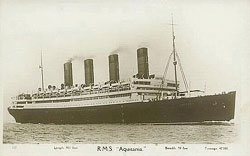
Once a user has completed the free registration with the center, detailed ship records may be viewed. Even these, however, only provide basic information: Nineteen-year-old Juris Ohsol, for example, arrived in New York on Sept. 30, 1922, on the Cunard ship Aquitania, which had set sail from Southampton, England. Additional features include information on the ship and its manifest, so users may learn with whom an ancestor traveled. The online system also allows annotation if users want to add additional information that may be viewed by others.

Search results may be refined, but users searching for Latvian ancestors may face problems here. “Latvian” or “Lettish” are not listed as ethnicities which can be used to tweak results, which is not surprising because for much of the period covered by these records Latvia was a region of the Russian Empire. In additional, “Libau” (Liepāja) is not listed as a port of departure, because for the voyage westward to America many Latvians changed ships at European ports such as Hamburg or Southampton.

Users of these records should keep in mind that they only cover the Ellis Island immigration center and the port of New York. However, immigrants from Latvia also arrived at other ports. For example, among the earliest arrivals in the late 19th century were Jēkabs Zībergs and handful of other Latvians who disembarked at Boston. Others may have first arrived in Canada and only later moved to the United States.

The records were put on line with the help of volunteers from The Church of Jesus Christ of Latter-day Saints. The church has as one of its missions the cataloguing of all people. Others involved in the project are Compaq, FamilyTree Magazine and Hostcentric.

The popularity of the site overwhelmed the history center’s server, according to news reports. Millions of users tried to gain access to the site on its first day of operation. The history center now limits access.

Aquitania postcard

A postcard shows the Cunard Line ship Aquitania, on which many immigrants came to the United States.

Andris Straumanis is a special correspondent for and a co-founder of Latvians Online. From 2000–2012 he was editor of the website.