No easy answers for fears

One of the flight paths from Minneapolis-St. Paul International Airport goes over my neighborhood. Several times this year, as I’ve watched the jetliners stream north-northeast across the Minnesota sky, I’ve wondered where they are headed. Several times this year, I have been on one of those jets, heading to Amsterdam, to Phoenix, to Washington, to Reykjavik (but not, unfortunately, to Rīga).

Perhaps no more than this year, the jet and its vapor trail have for me symbolized the freedom of travel, the opportunity to experience something new, something wonderful.

But no more. Since the Sept. 11 terrorist attacks in New York and Washington, the sound of the jetliners over my neighborhood—now that they’ve been allowed to take to the skies again—makes me nervous. I’ve caught myself thinking: "Please, don’t let it happen again."

And that’s just one of my fears.

The morning the hijacked planes slammed into the World Trade Center and the Pentagon, I was on my daily commute to the university where I teach journalism. Shortly after a radio news report announced that the Federal Aviation Administration had grounded all commercial air traffic, I peeked out my car window and watched as a jetliner made a graceful U-turn back to the Twin Cities airport. As more details emerged of what had happened, my initial reaction was clinical, journalistic. By the time I arrived in the parking lot outside my office, I had amassed several pages of hastily scrawled notes. The events of that morning were all we talked about that day in class.

It was only the following evening, channel-surfing through various television news shows, that a rare emotion came over me: Fear. Here in Middle America, there’s not much to fear. But as I watched stories of victims and their families, of confusion about who was being arrested and why, of the growing rhetoric of war, I was afraid. The last time I had this feeling was years ago when my young daughter convinced me to accompany her and a friend on "The Wave," a ride at an amusement park near the Twin Cities. I wasn’t afraid as the craft into which we were strapped slowly rose up an incline, turned and rose again. But as the craft was tipped over the apex, to be sent speeding downward and splashing into a manmade pond, I felt for a brief moment that I had absolutely no control over my destiny.

That’s the fear that came over me as I watched the TV news.

I fear that America—and many of the other nations that have offered political support—is girding its citizens for a war that may well be unlike anything many of us have only seen in the movies or read about in history books. I fear that talk of a coming "clash of civilizations" is just another way of saying "race war"—and that there are those who would use that talk as an excuse to harm their fellow citizens. I fear that, even while we focus on bringing those responsible for the attacks to justice, we will let one more opportunity slip through our fingers to address the injustices of which all nations are guilty. And I fear that I can’t do anything about it.

The morning after the attacks in New York and Washington, I received an e-mail from a relative in Rīga who was concerned about our family’s whereabouts and well-being. When she heard about what had happened in the United States, she wrote, her first impulse was to think that we should join them in Latvia.

Tempting though it is, I fear that’s too easy an answer. Better yet, I’ll spit three times and get back to work. There’s plenty to do.
Andris Straumanis is a special correspondent for and a co-founder of Latvians Online. From 2000–2012 he was editor of the website.

Iļģi not sure what to expect in America

Iļģi, Latvia’s leading folk music group, mark their 20th anniversary this year with a series of concerts abroad. Fresh from a trip to China, six members of the collective head this month to the United States for a two-week tour of Eastern and Midwestern venues. And, a week after they return to Rīga in early October, the band heads off to Norway, said Gatis Gaujenieks, the group’s bass player.

The U.S. tour will give non-Latvian audiences a chance to hear what “world music” sounds like from the Latvian perspective. Iļģi, who emerged from the early 1980s folk revival movement, have moved far from their roots. While other folk groups have joined Iļģi in seeking out unromanticized versions of Latvian folk songs, it is Iļģi who have pushed furthest into weaving into their repertoire other cultures’ folk influences, along with the sounds of modern rock music.

Founded in 1981 by Ilga Reizniece, Iļģi has seen band members come and go. The group’s early years were focused on retrieving traditional music styles that had been suppressed for many years. The group’s efforts at times were viewed suspiciously by Soviet authorities, who considered the period’s folk revival as unwelcome nationalism.

By the mid-1990s, Iļģi were experimenting with broader musical influences and moving into their “post-folk” period. While Reizniece’s voice and fiddle-playing and Māris Muktupāvels’ handling of the kokle remain integral to the band’s signature, bass, guitar and drums now round out the sound. Group members and the Iļģi sound also at times spilled over into the rock group Jauns Mēness, fronted by Ainars Mielavs, whose UPE record label has released the last two Iļģi albums.

Latvian audiences familiar with the band’s discography should expect to hear material from the last two albums, Saules meita (1998) and Sēju vēju (2000). Some new material also might be heard in the concerts, possibly including something from “Spēlēju, dancoju,” a rock opera based on the work of Latvian poet and writer Jānis Rainis, Gaujenieks said. The rock opera—a collaboration between Lithuania’s Miraklis “visual theatre” group and Latvia’s Jaunā teātra institūts—is scheduled to be performed Sept. 14 at the Daugavgrīva fortress on the outskirts of Rīga as part of the Homo Novus theatre festival. A live Webcast of the performance also is planned.

The band doesn’t know how audiences in the United States will react to the music, Gaujenieks said. In China, he said, Iļģi were generally received positively, except in one concert where the audience seemed apathetic.

Older members of Latvian audiences, Gaujenieks admitted in a telephone interview from Rīga, may not quite like what they hear. He recalled that the last time the band was in North America, playing a concert in Toronto, the reaction of some listeners was cool.

“Yes, we have heavy pieces, but we also have many light pieces,” Gaujenieks said. “But it’s 2001, and if we have a hope of Latvian folk music becoming popular in the world, we have to keep up with what’s happening.”

Among younger listeners in Latvia, Iļģi are the most popular folk artists. It’s important, he noted, that Latvian music maintain a foothold in a time when many radio stations are more focused on broadcasting the European version of the Billboard Top 100.

It’s still too early to tell whether Iļģi will please the ear of a North American producer who might give the band a record deal, but Gaujenieks said the tour will offer the band the rare opportunity to play at a number of folk festivals including Chicago’s World Music Festival, the Detroit Festival of Arts and Lotus Fest in Bloomington, Ind. In Minneapolis, the band will be the warm-up act for a Tuvan throat-singing group performing in the city’s leading world music venue, the Cedar Cultural Centre.

The band also is scheduled to play a number of Latvian community venues, where the full concert program is expected to give way to a more participatory atmosphere, with Iļģi teaching audience members Latvian folk dances and rotaļas (games).

For Gaujenieks, the U.S. tour will be a homecoming of sorts. The bass player was a member of Akacis, a popular early 1980s Latvian-American trimda rock band. Besides playing with Iļģi, he now runs the GEM recording studio in Rīga. Also on the U.S. tour will be fellow ex-Akacis member Jānis Abens who now lives in Sweden and is one of four guitarists who play with Iļģi.

Besides Reizniece (voice and fiddle), Muktupāvels (voice, kokle, bagpipes and accordeon), Gaujenieks (voice, bass and ģīga) and Abens (guitar), the other two band members on this American tour are Mikus Čavarts (percussion) and Vilijs Strods (drums).

The tour begins Sept. 13 with a concert in the Latvian Lutheran church near Washington, D.C., and continues on to New York City; Summit, N.J.; Detroit; Grand Rapids, Mich.; Cleveland; Indianapolis; Bloomington, Ind.; Chicago; Milwaukee; Minneapolis; back to Chicago, ending Sept. 30 in Kalamazoo, Mich.

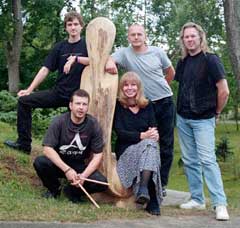
Iļģi

Current band members include (seated in front) Vilijs Strods and Ilga Reizniece, and (standing, from left) Mikus Čavarts, Māris Muktupāvels and Gatis Gaujenieks. The wood sculpture symbolizes any of the four guitarists who regularly perform with Iļģi, said Gaujenieks. On this tour, it’s Jānis Abens from Sweden. (Photo courtesy of Iļģi)

Andris Straumanis is a special correspondent for and a co-founder of Latvians Online. From 2000–2012 he was editor of the website.

Placenames may reveal Latvian ancestry

Thousands of tourists are streaming to the real Rīga this year as Latvia’s capital city celebrates its 800th anniversary. Those who can’t make the trip to Latvia might try searching for the Rīgas, or Rigas (without the diacritical mark), in their backyards.

Several places with the name of Rīga can be found in the United States, not to mention other Latvian-sounding sites such as Livonia or Baltic. And the United States isn’t alone: Similar sites can be found in Canada and Australia.

The Web offers online placename databases for several countries that can be used to find the spots.

Perhaps the best digital resource in the United States is the Geographic Names Information System, run by the U.S. Geological Survey. A search of the database for “Riga” turned up places or geographic objects in Connecticut, Kansas, Michigan, Missouri, New York, North Dakota and Virginia. The database is linked to Microsoft’s TerraServer database, allowing users to see USGS topographic maps and, in many cases, aerial images of places.

The places with Rīga in their name include:

  • A lake, a dam and a mountain in Litchfield County is western Connecticut. The mountain, Mount Riga, also is claimed by New York’s Dutchess County, which also has a Riga Lake.
  • A populated place in Trego County in Kansas.
  • A township, cemetery and a canal in Lenawee County in Michigan.
  • A populated place in Ripley County in Missouri.
  • A township and a school in North Dakota’s McHenry County.
  • A town in Monroe County in New York.
  • And a stream in Virginia’s Orange County.

But the database doesn’t reveal much if anything about the history of these places. While most of the places in North America that have names suggesting some tie to Latvia probably have little connection, a few do.

For example, Riga is a small town in the western New York’s Monroe County, southwest of Rochester. Established in 1808 in the breakup of the larger Town of Northhampton, the community historical committee on its Web site reveals nothing about why Riga was chosen as the name. Even documents such as J.H. French’s 1860 Historical and Statistical Gazetteer of New York State shed little light.

Another Riga, in southeastern Michigan’s Lenawee County, is a lightly populated spot where “For Sale” signs appear frequently. A visit to the community’s cemetery reveals that the town has been home for people of German ethnicity. The town also in 1990 was briefly considered for a low-level radioactive waste disposal facility, but was removed from a list of potential sites after it successfully sued the state of Michigan.

"Riga" placenames also are found in Canada and Australia.

Libau, a community in Canada’s province of Manitoba, does have links to Latvian history. The community, on the south end of Lake Winnipeg, is where a group of Latvian immigrants settled in the early 20th century to take up farming. Libau is the German name for the port city of Liepāja.

To the east of Manitoba’s Libau, on Lac du Bonnet, is Lettonia Bay. The community of Lac du Bonnet, southwest of the lake, was home to Latvian immigrants in the early 20th century.

According to Geomatics Canada, the province of Quebec is home to a Lac Riga and to a Lac de Riga. And in Ontario, near Sudbury, there’s a Riga Lake.

The South Australian State Gazetteer’s online version reports a homestead called Riga Downs.

Livonia is the name of the province that became part of modern Latvia. Quite a few Livonias can be found in the United States in Indiana, Louisiana, Michigan, Minnesota, Missouri, New York and Pennsylvania. But again, the story of why a place was named Livonia isn’t always clear. And when it is, the trail may not point back to Latvian ancestry.

For example, Livonia Township in Minnesota’s Sherburne County, northwest of the Twin Cities metropolitan area, apparently has little to do with the province. It was named instead for the wife of a judge who settled in the area in 1864, according to the Minnesota Historical Society.

The same is true for Baltic. In many cases, the naming of a place as Baltic-something probably has more to do with seafaring or with other lands that touch on the Baltic Sea.

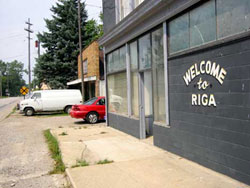
Riga, Michigan

An abandoned building in Riga, a small community in southeastern Michigan, bears a welcoming sign. The town is among the places in the United States with a name that suggests a Latvian connection. (Photo by Andris Straumanis)

Andris Straumanis is a special correspondent for and a co-founder of Latvians Online. From 2000–2012 he was editor of the website.