WAP-py New Year! Latvia in the palm of my hand

New Year’s Eve brought an unusual self-induced bit of boredom. I had nowhere to go, and no desire, either. But instead of moping, I used the quiet around the house to uncover the simple fun of the WAP feature on my mobile phone—and the ability to connect with Latvia while away from a computer.

For those who don’t know, WAP stands for Wireless Application Protocol. It’s a telecommunications standard that allows properly equipped mobile phones to connect to the Internet. Just like Web sites, WAP sites provide news, information, entertainment and e-commerce. But unlike Web sites, what the user usually sees on the small screen of the mobile phone is short bursts of text and few, if any, graphics.

For some readers, particularly those in Europe, the use of WAP is nothing new. In fact, some mobile telecommunications providers have already moved beyond the simple text-based information provided by basic WAP. Eurotel Bratislava, a mobile communications provider in the Slovak Republic, recently unveiled what it says is the first live video feed to a cell phone, using Multimedia Messaging Service (MMS) to send a television news show to its customers.

But that’s way ahead of my phone’s capabilities.

I’d known that my Ericsson R520m could utilize WAP, but I had never tried. In fact, I wasn’t even sure that I could. However, my provider (T-Mobile) clarified that my calling plan includes up to 1 megabyte of data transmissions per month. In the world of WAP, that’s plenty for infrequent use.

After spending half an hour on the Web tracking down information about how to configure my phone to use my provider’s WAP “gateway,” I was set. Within minutes, I was surfing T-Mobile’s site, retrieving generally useless information such as my horoscope and the winning lottery numbers.

Not satisfied with things I can’t control anyway, I began to wonder whether there are any WAP sites in Latvia and whether I might be able to view them on my phone. And, yes, there are some sites in Latvia, and yes, some I could get to through my phone.

My first visit was to Diena, the largest daily newspaper in Latvia. I was pleased to see that my phone readily gained access to the site, even displaying the newspaper’s logotype. The home page of the site allowed two basic choices: today’s and yesterday’s top stories and sports results. Scrolling and “clicking” (by pressing the “Yes” button), I was able to read headlines and the stories behind them.

Cool! This means I can be away from my computer and still read Latvian news on the Internet.

But why stop there? My next visit was to Latvijas Mobīlais telefons (LMT), the larger of the two wireless providers in Latvia. LMT’s WAP portal offers a number of links, but many of them are not Latvian and several didn’t work. However, a fun feature allows a mobile phone user to find out what movies are playing in cinemas around Riga and the rest of the country. The database also provides summaries of the cast and plot. Doubly cool!

My wireless provider when I’m in Latvia, Tele2, also has a WAP site, but its offerings are not as broad as LMT’s—although they are provided in Latvian, English and Russian.

Another stop on my WAP trip to Latvia was at 118, the information service provided by Lattelekom. The horoscope section didn’t work, but at least I could find out the phone numbers for special services in cities around Latvia—in case I need to call the fire department in Saldus, for example. The site also provides a name’s day service for today, tomorrow, the day after tomorrow, and the day after the day after tomorrow (why isn’t there a good word in English like aizparīt?).

These aren’t the only WAP sites in Latvia, but I was surprised that more aren’t available, especially useful ones. The Estonian business newspaper Aripaev, a cousin of Rīga’s Dienas bizness, has a WAP site, but Db doesn’t. Plus I found an interesting English-Estonian WAP dictionary, but nothing like that for Latvian.

The future of WAP is unclear. Two years ago, it was deemed a technology that would slowly catch on, but it seems that it still hasn’t. Surfing the Internet on a screen barely larger than your thumb is one barrier.

But at least it gave me something to do New Year’s Eve.
Andris Straumanis is a special correspondent for and a co-founder of Latvians Online. From 2000–2012 he was editor of the website.

Man charged in killing of fellow Latvian

A 33-year-old man from Latvia is being held in the stabbing death of another Latvian, according to Irish media reports.

The man, identified as Sergy Strautinsh, is to appear Dec. 30 in Dublin District Court. He is charged with assaulting Alexander Timofeyev in the North Dublin home they apparently shared.

Timofeyev died of his wounds Dec. 21 after being taken to Mater Hospital, according to The Irish Examiner newspaper.

Another Eastern European man involved in the incident—apparently a disagreement about rent payments—was taken to the hospital with a head injury.

Strautinsh first appeared in court on Dec. 23, according to Radio Telefis Eireann. An interpreter is to be appointed to help him and he is to receive free legal aid, the court said.

Andris Straumanis is a special correspondent for and a co-founder of Latvians Online. From 2000–2012 he was editor of the website.

NATO invites Latvia to join defense alliance

As the festive mood fades following last week’s historic NATO summit meeting in Prague, politicians and military leaders in Latvia are getting to work preparing the country for eventual admission to the defense alliance.

NATO (the North Atlantic Treaty Organization) last week extended invitations to seven nations to begin accession talks with the defense alliance. Invited were Latvia as well as Bulgaria, Estonia, Lithuania, Romanis, Slovakia and Slovenia.

While the event was laden with symbolism—as if seven more nails were driven into the coffin of communism—NATO Secretary General Lord George Robertson on Nov. 21 underlined the “heavy responsibilities” the candidate nations are taking on. Meanwhile, U.S. President George Bush traveled Nov. 22 from Prague to St. Petersburg to reassure President Vladimir Putin that the West is not out to bury Russia. And then Bush jetted to Vilnius, where on Nov. 23 he was greeted by an enthusiastic Lithuanian crowd chanting, “Ačiu! Ačiu!” (Thank you! Thank you!), according to news reports.

The candidates now have to pass NATO muster for military readiness. In addition, they will have to navigate diplomatic dances to get NATO member states’ legislatures to approve of the expansion—including convincing the U.S. Senate, a job that Baltic lobbyists in America are not considering a fait accompli.

The Prague summit also saw President Bush push NATO members for assurances about their willingness to participate in a possible attack on Iraq should United Nations-sponsored weapons inspections fail to disarm the country of its weapons of mass destruction. NATO members also debated a greater role for the defense alliance that goes beyond merely stepping in should one of its members be attacked. Instead, NATO may see itself involved in the wider “war on terrorism” in areas beyond Europe.

Baltic leaders, lobbyists react

Political leaders in the Baltic countries and lobbyists in the United States reacted favorably to the invitation.

Although the invitation was expected, it nonetheless marked a culmination of several years’ effort. At one point, it appeared only Lithuania might get invited in a first wave of NATO expansion. And looming over all three Baltic countries, but especially over Latvia, has been continued Russian antipathy to enlarging the defense alliance into territory that once was claimed by the Soviet Union.

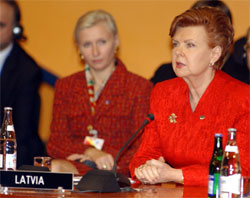
Latvian President Vaira Vīķe-Freiberga, in a statement released by her press office, said the invitation is an historic and joyful event for the nation. “Nothing will ever be the same for Latvia,” she said. NATO membership will offer Latvia security, Vīķe-Freiberga said, but it will also require the nation to work hard to meet NATO standards.

Valdis Pavlovskis, president of the California-based Baltic-American Freedom League, noted in a widely circulated e-mail that “our work is not yet done.” He called on Baltic Americans to thank those politicans who helped push for the NATO invitation.

Implicit in his note is the message that U.S. senators will have to be convinced to vote in favor of NATO expansion. Although Congress has expressed its support for NATO enlargement, actions such as the Oct. 7 adoption of two pro-expansion resolutions have been seen as mostly symbolic.

Latvia’s role in NATO

If accession negotiations are successful, Latvia could become a member of NATO in 2004.

But with a total of only 5,400 personnel on active duty (plus about 14,000 part-time members of the National Guard), according to the Ministry of Defense statistics, what can a small military like Latvia’s offer to NATO?

The answer, in one word, may be specialization. Writing in Time magazine’s Europe edition, James Geary noted that the Baltics’ strategic importance to NATO is BaltNet, a USD 100 million radar system financed by Norway and the United States that is able to peak into Russia’s Kaliningrad enclave.

Latvia’s specific contribution may be in the art of defusing or detonating bombs, according to Roger Boyes, a reporter for The Times of London. In a visit to the Ādaži training ground, Boyes learned that more than 50,000 shells have been exploded there since 1993. Latvian troops are expected to travel to the former Yugoslavia on a bomb-clearing mission.

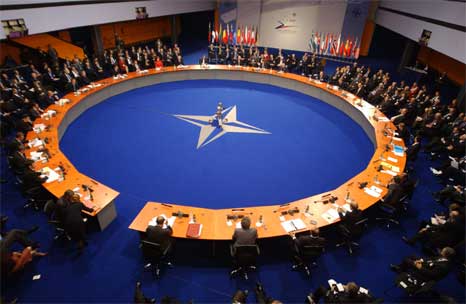
NATO meeting in Prague

NATO leaders and the heads of state of seven candidate countries meet Nov. 21 in Prague. (NATO photo)

Vaira Vīķe-Freiberga

Latvian President Vaira Vīķe-Freiberga speaks during the Nov. 21 NATO summit meeting in Prague. (NATO photo)

Andris Straumanis is a special correspondent for and a co-founder of Latvians Online. From 2000–2012 he was editor of the website.