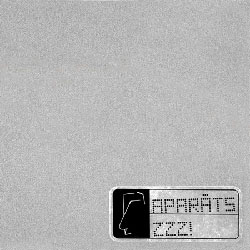
Actually, we’re all Roberts Larionovs

ZZZ

If you take away nothing else from ZZZ, the debut album by the Rīga-based group Aparāts, it’s this simple message: We’re all Roberts Larionovs.

What does it mean? Beats me. Maybe “Roberts Larionovs,” the final track on the album, is a song about a real person. In fact, after hearing the song for the first time I saw an interview on Latvian state television’s Panorāma with someone named Larionovs, but she wasn’t Roberts. Or maybe she was. Maybe Roberts Larionovs is really a sort of twisted Latvian Everyman.

No matter who Roberts Larionovs is, the song is just fun to listen to, as is most everything else on the album.

Describing the musical style of Aparāts isn’t easy. “Eclectic rock” comes to mind, which could fit well considering the group’s participants. The sextet includes a Latvian-singing and guitar-playing Dane named Peter Helms; guitarist Pēteris Sadovskis; bass player Mareks Auziņš; drummer Rihards Fedotovs, and backup singers Santa Pētersone and Ilga Grinpauka. Album credits also list guest singers (such as Alvils Cedriņš, who provides the operatic lead on “Milestības doktors”), as well as several musicians who lend their talents on instruments such as clarinet, flute, saxophone and tuba. The band must be a riot to see live on stage.

Aparāts was formed in 2000 and, by the time ZZZ was released late last year, had become well known in Latvian clubs.

Listen to the music and you’ll hear lots of rock flavored with funk, rap, jazz, the operatic voice or two, and what almost sounds like bits of klezmer thrown in.

ZZZ features 13 tracks, all but two penned by Helms alone. While several had been heard on Latvian airwaves before the album’s release, the song “Galdnieks” made it onto the 2002 Priekšnams compilation featuring music by little-known Latvian groups.

While some of the songs could no doubt be interpreted as having deeper meaning, on their face they are just plain fun. Helms must have enjoyed coming up with some of the rhymes, such as in the chorus for “Miers”: “Es esmu mierīgs, Tik ļoti ļoti miermīlīgs, Es mīlu dzīvniekus, ēdu tikai rīsiņus, Tādus mazus īsinus, Jebkura būtne ir mans draugs” (I am calm, So very very peaceful, I love the animals, Eat only rice, So small and short, Any being is my friend).

“Benedikte,” the loudest song on the album, is an example of why it’s important for some artists to provide the words to songs in album liner notes. Fortunately, Aparāts does, for otherwise “Benedikte” with its screamed lyrics would be unintelligble. Only after reading the lyrics did the song’s anguish and outrage—about a girl named Benedikte who doesn’t love the song’s protagonist—begin to make sense.

ZZZ also is among the newest releases from Baltic Records Group, which has added several new artists to its catalog in the past year in what seems to be an attempt to become a major contender in the Latvian market. The label’s biggest claim to fame is Marija Naumova, winner of last year’s Eurovision Song Contest.

In Aparāts the label appears to have found another success story.

Details

ZZZ

Aparāts

Baltic Records Group,  2002

BRG CD 130
Andris Straumanis is a special correspondent for and a co-founder of Latvians Online. From 2000–2012 he was editor of the website.

Newspaper rekindles merchant marine history

A chapter in the forgotten history of Latvia’s merchant marine is making waves thanks to the Russian-language daily newspaper Chas, even earning rare accolades from the Latvian government.

The Rīga-based newspaper recently published a series of articles about the crews of the eight merchant ships that refused to heed orders to return to Latvia after the Soviet Union occupied the country in 1940. Instead, the ships continued to fly under the flag of an independent Latvia, aiding the allied war effort against Germany.

Latvian Foreign Minister Sandra Kalniete sent a letter March 25 to the newspaper thanking it for illuminating an aspect of history that for years had been hidden from Latvians. While Latvians in the West had known about the ships, Soviet authorities kept the history hidden.

Six of the ships were lost after being attacked by German submarines, according to the series, which has been retold by the Associated Press.

The first of the Latvian ships to be attacked was the Ciltvaira.

Just weeks after Japanese attack on Pearl Harbor, Germany unleashed a series of attacks on merchant vessels sailing off the eastern coast of the United States. The 3,779-ton cargo ship Ciltvaira was sunk Jan. 19, 1942, by the German submarine U-123 near the Outer Banks region of North Carolina. It was one of three merchant vessels attacked by the submarine that day.

The existence of the Ciltvaira wreck is known to some people along the North Carolina coast. At least one Web site shows photographs of the sunken ship, also known locally as the Green Buoy Wreck. According to the Web site of the Outer Banks Dive Center (www.obxdive.com) in Nags Head, the Ciltvaira wreck is found in 120 feet of water and is covered with marine life that is popular with underwater photographers.

The community of Nags Head has a street named after the Ciltvaira.

According to media reports, city leaders in Rīga are considering renaming streets for the eight merchant ships.

In addition to crew members aboard Latvian ships who were lost during the war, several Latvians serving on American merchant ships also lost their lives, according to information posted on the Web site of the U.S. Maritime Service Veterans (www.ummc.org).

The sailors included John Alost of the West Ivis, killed Jan. 26, 1942; Sergei Burmeister of the Pan New York, killed Oct. 29, 1942; William Karklin and Jānis Krastiņš of the Equipoise, who died March 26, 1942; Victor Frank Liskovs of the LaSalle, who died Nov. 7, 1942; and an unknown Latvian who died in October 1942 when the El Lago was attacked.

Andris Straumanis is a special correspondent for and a co-founder of Latvians Online. From 2000–2012 he was editor of the website.

Tobago gathering postponed until 2004

The uncertainty of world events as well as potential scheduling conflicts have forced organizers of the 13th Latvian gathering in Tobago to postpone the event until June 2004.

News of the change came in an e-mail forwarded to Latvian media by the World Federation of Free Latvians in Rīga.

In the mid-1600s, Tobago was briefly a colony of the Duchy of Courland, an area that included what today is the Kurzeme region of Latvia. Tobago is the smaller of the two main islands that make up the Caribbean nation of Trinidad and Tobago.

The 2004 gathering would begin June 17 with participants arriving in Port-of-Spain on Trinidad, according to the e-mail from Guntars Gedulis, a Latvian living in Venezuela. Participants would travel to Tobago on June 19 and would stay at least through a Midsummer, or Jāņi, celebration. The gathering is scheduled to end June 26.

Uncertainty about world events tied to the crisis over Iraq, as well as concerns that organizing a visit to the island at the same time that the major song festival is planned in Latvia, convinced organizers to move the event to next year, according to Gedulis.

On Tobago, participants would visit locations where Courlanders settled as well as view the Latvian section of a local museum. Other excursions to view the island’s habitat also are planned.

Further information about the gathering is available from Gedulis via g@etheron.net or telephone, +58 212 575-2874. Some Latvian tourist bureaus also should have information about the gathering.

Tobago gathering

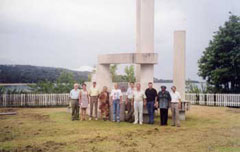
Participants in 12th Tobago gathering in 2001 pose in front of a monument to the Courlanders erected in 1978 in Plymouth, Tobago. (Photo courtesy of Guntars Gedulis)

Andris Straumanis is a special correspondent for and a co-founder of Latvians Online. From 2000–2012 he was editor of the website.