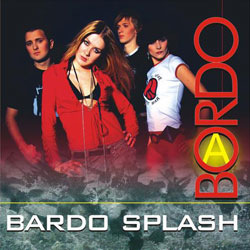
Influences of others show on Bardo Splash debut

Bordo

When I first heard Bordo, Bardo Splash’s debut album, I was at different points reminded of another Latvian group. But I couldn’t quite place it. Prāta Vētra? Jumprava? RamaDance? A bit of research revealed that at least the latter two are related.

Bordo, released late last year, was produced by Aigars Grāvers, one of the four members of the long-standing Jumprava and leader of the exciting Rama Dance project. And, it turns out, Bardo Splash’s lead singer, 21-year-old Rudīte Būmane, performed on Rama Dance’s second album, Extravagance.

Bardo Splash is relatively new to Latvia’s music scene, growing out of the now-defunct group Zupski Rubin. Bardo Splash has performed since 2001 in a variety of venues, including the noted Liepājas Dzintars and Sinepes un Medus festivals, as well as traveling around Latvia with the 2001 Priekšnams tour organized by Radio SWH. Attempts by media to pigeon-hole the group into a particular genre have mentioned modern rock, atmospheric rock, pop and other labels. On Bordo the group crosses and melds genres as needed. One track, “Māras avots,” in the liner notes is even described as postfeiklora, which, I suppose, can in turn be described as contemporary songs that sound like traditional Latvian folk songs but aren’t.

At the time the album was recorded, the group’s members numbered five: Rudīte Būmane on lead vocals and synthesizer; her brother, Renars Būmanis, on drums, programming and synthesizer; Aleksandrs Ruģēns (a.k.a. Sniegs) on vocals, acoustic guitar, Jew’s harp and programming; Edgars Dambis on electric and acoustic guitars, and Ieva Rudzīte on bass and acoustic guitar. Ruģēns was largely responsible for all music and lyrics on the album.

Since last summer, Dambis and Rudzīte no longer are with Bardo Splash, according to Baltic Records Group. A new guitarist and a new bassist are now working with the group in preparation for concerts. Ruģēns, meanwhile, is reported to be abroad, earning money to support his family.

I hope the departures, permanent or temporary, don’t hurt the group, because this is one band I’d like to see hang together for a while. How many rock or pop bands are there in Latvia today with a female lead singer? For Būmane’s potential as a role model alone, the band should survive.

Bordo also is just a good debut album, with an interesting mix of sounds and thoughtful lyrics. Anyone who has heard RamaDance’s Sāga or Extravagance will recognize similar electronica and folkloric elements in some of Bardo Splash’s work, especially on tunes such as “Māras avots” and “Spoku kamanas” (although for the latter the band cites influence from “post-folkore” group Iļģi).

But don’t expect that to be a constant on this album. The lead track, “Kad sajūtas mānās,” for example, is clearly a pop song, although the lyrics describe emotions encountered during a strange tusiņš.

The sweetest song on the album also is the shortest. At one minute and 12 seconds, “Kad straume projam iet” describes a simple philosophy about humankind’s relationship to the recurring forces of nature. Eight layers of Būmane’s vocals are accompanied just by an acoustic guitar. According to the liner notes, an earlier version of the song almost became the title track for the album.

Five of the album’s 14 tracks are in English, including one of the band’s better-known tunes, “Force majeure.” As with many other Latvian groups, Bardo Splash’s Latvian songs generally are better than their English material, although Būmane’s vocals and Ruģēns lyrics make for a nice combination. And, just as other groups lately have done, Bardo Splash offers Latvian and English versions of the some songs: “Glory Nights” is at least musically the same as “Kad sajūtas mānās,” “Four Fingers” is a relative of “Četri,” and “Initiation” is the anglicized “Māras avots.”

As we often lament in our reviews, the liner notes here are spartan. Lyrics are not provided. They would especially be helpful for the English-language tracks, where meaning sometimes is obscured by unpolished pronunciation.

Flaws aside, if you’re looking for something new from Latvia’s popular music scene, Bordo is worth seeking out.

Details

Bordo

Bardo Splash

Baltic Records Group,  2003

BRG CD 178

Andris Straumanis is a special correspondent for and a co-founder of Latvians Online. From 2000–2012 he was editor of the website.

Finnish plan would limit Latvian workers

Latvians and citizens of seven other new European Union countries would still be treated as non-EU workers for the next two years under a proposal being considered by the Finnish government.

The proposal, which is scheduled to be taken up by the parliament next week, would require workers from the new EU member states to get the Finnish employment office’s approval that there are no workers in Finland who can perform the job, the daily newspaper Helsingin Sanomat reported. The government accepted the proposed legislation Jan. 15.

The two-year transition period could be extended based on the findings of a report the government would have to submit to the parliament, according to the Finnish government’s Web site.

One principle of the European Union is the free movement of people across borders, although many member states have restrictions in place.

The Finnish proposal would affect new workers from eight of the 10 countries scheduled to join the EU in May: Latvia, Estonia, Lithuania, the Czech Republic, Hungary, Poland, Slovakia and Slovenia. Only workers from Malta and Cyprus would be exempt from the rule.

Finland joined the EU in 1994.

In 2002, according to Finnish Ministry of Labour statistics, a total of 21,807 work permits were issued to foreigners. More than two-thirds of those went to workers from Estonia and Russia. A total of 483 permits were issued to Latvians, half of them for garden workers.

Andris Straumanis is a special correspondent for and a co-founder of Latvians Online. From 2000–2012 he was editor of the website.

RFERL broadcasts to continue into January

Latvian broadcasts from the U.S. government-funded Radio Free Europe and Radio Liberty will not end Dec. 31 after all, but will continue into January, a spokesman in Washington, D.C., has told Latvians Online.

Before recessing Dec. 9 for the holiday season, the U.S. Senate failed to take action on a USD 820 billion omnibus appropriations bill that includes funding for the Broadcasting Board of Governors, which oversees RFERL, the Voice of America and other radio stations. Congress has instead approved a continuing resolution to keep the U.S. government operating.

That means Latvian broadcasts, as well as transmissions in six other Central and Eastern European languages, will remain on the air into January, said Mārtiņš Zvaners, associate director of communications for RFERL.

However, the broadcasts will be “sharply reduced,” Zvaners said. The Latvian, Estonian and Lithuanian broadcasts on Jan. 1 will decrease to 15 minutes Monday through Friday, while the hour-long weekend programs will be dropped from the schedule. In addition, the RFERL bureaus in each country will close.

What happens after that depends on what happens with the omnibus appropriations bill.

In proposing its fiscal 2004 budget, the Bush Administration pushed for ending RFERL and Voice of America broadcasts to nations that are set next year to join the NATO defense alliance and the European Union. The money saved would be diverted to radio broadcasts targeted to the Mideast.

Apparently anticipating the appropriations bill would be passed, RFERL Director Thomas Dine on Nov. 28 announced to his staff in the station’s Czech Republic headquarters that broadcasts to Latvia, Estonia, Lithuania, Bulgaria, Croatia, Romania and Slovakia would cease Dec. 31.

The government’s fiscal 2004 began Oct. 1. Because appropriations for a number of departments have not been passed, Congress has had to approve a continuing resolution to allow the government to continue operations at last year’s funding level.

The Senate is expected to take up the omnibus appropriations bill on Jan. 20, but some senators are saying the legislation may be tough to pass because of growing concerns over “pork,” or funding of programs that benefit legislators’ home districts.

The House of Representatives passed the bill Dec. 8.

Andris Straumanis is a special correspondent for and a co-founder of Latvians Online. From 2000–2012 he was editor of the website.