


Nearly a quarter of voters in Latvia said in mid-August that they did not know for which one of 19 parties to cast their ballot come the Oct. 7 parliamentary election, according to the Rīga-based survey research firm SKDS.
Another 12 percent said they had no intention to vote. If they are looking for a voice, Eso Antons Benjamiņš might be their man.
Benjamiņš, grandson of the famous Latvian newspaper publisher Antons Benjamiņš (1860-1939), recently began a blog called Change for Latvia in which he calls on voters to ignore the ballot box on Oct. 7. Instead, he suggests that a low turnout might force the Saeima to rewrite the constitution to provide for more representative government.
“As my blog indicates,” Benjamiņš writes in his blog’s profile, “I observe a cynical political elite, without perspective, all status quo and empty rhetoric, all defused by Big Brother sitting in Brussels giving out enough euros to keep their mouths shut and stultify their increasingly orthodox thought.”
Benjamiņš was born in Latvia, but spent most of his life in exile in the United States. He returned to Latvia 12 years ago and now lives near Valmiera.
In an e-mail exchange, Benjamiņš answered questions about his blog and his ideas.
What encouraged you to create the blog Change for Latvia?
It is not possible to live in Latvia and not be aware of the overall poverty of the people, the lack of education about the nature of the modern world, and government corruption. I mention government corruption last, because that appears to be the fate of all modern governments. For sure, corruption in high places is not a new phenomenon, except that in our times, it comes when the problems that beset the world (an unsustainable population, pollution of the environment, a water crisis, climate change, deforestation, desertification, poverty, informal employment, slums, energy crisis—you name it) bring a more than usual awareness of the role of government in the creation of same. The Latvian government attracts special attention, because it was created by the people when they broke away from the Soviet Union and voted their will by gathering “on the barricades” in Riga in 1991. Ever since, the government has done what it can to exploit that trust, first by taking payoffs (kukuļus and, in the end, like most modern capitalist countries, becoming subject to business interests. In 1993, Adolfs Bučis protested against corruption in government and killed himself in an act of extreme protest and self-sacrifice at the foot of the Freedom Monument in Riga. He was ignored as a man who had lost his mind. Today we have (from what I read and hear in the Latvian media) nearly 700 millionaires and no less than 700,000 poor. It makes one take notice, especially because the 700,000 are part of the body on behalf of which an independent Latvia came, ostensibly, into being.
To answer your answer specifically, however, recently I finished writing a book that took me a number of years to do. My time is freed up for a while, and as they say: “If nothing is happening, just wait a while.” I am concerned over the loss of authority that 17 years of corruption have brought the Latvian government. At the top, government appears to have become subject to business interests; at a lower end, the people cuss it helplessly because all political parties are subject to the same corrupting influences and there seems no way out. At the level of the precinct (pagasts) where I have my summer domicile, I was signatory to a letter asking for an investigation regarding money that seems to have disappeared following the harvesting of several local government forest properties. Letters were written and an investigation by the authorities was launched, but more than a year later little has happened. The investigation does not seem to go forward, and one is tempted to conclude that this is not by accident.
The theme of your blog is that one should not vote in the election of 9th Saeima. Will you perhaps vote, nevertheless?
I will not vote for the 9th Saeima, because my objective is not to encourage not voting, but because a no vote can constitute political action. Alas, the philosopher kings in and out of government do not see it that way. Latvians Online, for example, has a poll question that asks what party the site visitor will vote for, but no space for the customary “other” of most questionnaires. My absence from the ballot box is precisely because such an “other” is not available for those who do not care to choose from any of the parties. Of course, were such provisions available, I would visit the polling station.
If your vote were to be the one that decides which party comes to power, would you not vote then as well?
My personal sympathies are with people who vote for what is known in central and western Europe as the Greens—the Green Party. A long time ago, in the 1970s, I was an active participant in the protests in New England (in the United States) against the building of nuclear power stations. But I see no such energy in the Greens of Latvia. I cannot imagine any leader of the Green Party climbing a tree to protest on behalf of saving the beachfront in Jūrmala. I cannot imagine myself voting for the Greens (standing in the election as part of the Union of Greens and Farmers, or Zaļo un Zemnieku Savienība) even though my personal sentiment tends in their direction.
It is not clear to me how by not voting the voters of Latvia will create a situation that will force the lawmakers to write a new Constitution. Will you explain in greater detail how, according to you, this might happen?
I am asking for a massive no vote, one that approaches 70 percent of the electorate. If in the previous election over 70 percent of the electorate voted, I believe that an obvious reversal in voter sentiment will send a signal to the authorities that their charisma and authority is at a most critical level, but can be likely corrected by writing a new constitution (satversme). The overall political situation in Europe, what with the defeat of the constitution of the European Union, also encourages attention to the voices coming from the periphery. I believe that Latvia can be in the political limelight of Europe if the public were to make a dramatic reversal in its voting pattern. This may encourage a change in the political education of Latvians and perhaps elsewhere in Europe, albeit the process will necessarily take a few years. It is likely to encourage the airing of such arguments as could result in a new constitution.
Contrary to your arguments, President Vaira Vīķe-Freiberga recently said in an interview on Latvian State Radio that compulsory participation in elections should be adopted in Latvia (as, for example, in Belgium). What do you say concerning the suggestion?
I am sympathetic to the president’s suggestion, provided the “other,” the vote for “none of the above,” is included. An active life in politics is to be encouraged, but only when balloting is fair to all perceptions of reality.
Why did you choose a blog to publicize your opinions? Will there be other opportunities, for example, a letter to a newspaper, a public protest, and so on?
The blog and the Internet in general expand democracy. In the democracy of the 20th century (as in Latvia to this day), the news media had a high degree of control over what was reported in the news and, thus, what was to be the opinion of the world. Today the Internet makes democracy available (theoretically at least), to everyone with a computer logged in on the Web. This is why I chose to speak through the medium of the blog. It allows me to ask Latvians Online to include in its voting preference questionnaire a window for voting “none of the above,” “a write-in suggestion” and “a new constitution.”
Would you want to be a candidate for the Saeima yourself sometime in the future?
I wonder if I would then have time left for writing and reading, work that is not only a lifelong habit for me, but brings pleasure and often a better perspective of what is really happening and why.
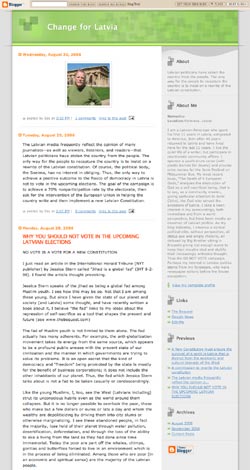
Eso Antons Benjamiņš has begun a blog, Change for Latvia, to push for political change in his homeland.
