If you are tired of firing up the computer when you want to listen to a Latvian radio station over the Internet, a device like the Acoustic Energy WiFi Internet Radio should be on your shopping list.
For Internet users who have a broadband connection and a wireless system in place, the Acoustic Energy radio solves a number of problems. Your computer is freed to do other things—or can even be turned off. Thanks to how the unit taps into an online database of thousands of Internet broadcasters, searching for a station is a breeze. And it is a delight to be able to program the radio’s clock to wake you to the sounds of your favorite station, no matter if it’s across town or on the other side of the globe.
Acoustic Energy Ltd., a United Kingdom-based company, claims its Internet radio is the first one capable of receiving more than 99 percent of the world’s broadcasters. While that sounds like puffery, what is true is that the unit has software built in allowing it to play Windows Media, RealMedia and MP3 audio streams.
I was thrilled to learn of the radio and quickly placed an order. I have been waiting for something like this since learning about the ill-fated Kerbango radio marketed by 3Com Corp., a product that died in 2001 when its parent ran into financial trouble.
The genius of the Acoustic Energy unit is that it is tied to a database of stations maintained by Reciva Ltd., a British company designing and building Internet radio modules. Reciva’s database is used by a number of Internet radio manufacturers, including Acoustic Energy, BT (once known as British Telecom), MagicBox and others.
When I first got my unit, the Reciva Web site (and an Acoustic Energy salesman) boasted the radio could receive 15 stations from Latvia. If true, that would be almost all of the 17 over-the-air stations currently streaming their signals online, or three-fourths if you count all of Latvian State Radio’s four programs, and Radio SWH’s three programs, separately.
Unfortunately, Reciva’s claim quickly crumbled. Of the 15 stations, two were Internet-only broadcasters, and one of those was dead. Of the rest, Reciva listed Latvijas Radio 2 three times (once as Latvijas Radio P2, once as Radio Latvia 2 and once as Radio Latvia Two). It repeated the 1st Program once. Radio NABA had two listings, as did Radio SWH+ and Radio SWH Rock. The result: Reciva’s database really only listed seven distinct over-the-air broadcasters from Latvia, or just under a third of what’s available.
To add to the disappointment, the genre listings for some stations were confusing. In one instance, the format for Latvijas Radio 2 was shown as oldies, in another as varied and in yet another as folk. It’s all those, plus more, and really should be put in the public broadcaster category, the heading that most accurately describes what kind of station it is. Radio NABA was listed as having both dance and electronica formats. The station does occasionally play those formats, but it’s really a college station, run by the University of Latvia.
In an effort to increase the number of Latvian stations in Reciva’s database, I registered on the company’s site and submitted information on half a dozen more stations. Reciva promptly acknowledged receiving each entry, but weeks later I was still waiting for them to appear in the database.
Even now, months later, Reciva claims its database holds 19 Latvian stations, but five of those are duplicates. And, of course, it’s also 19 “stations” because Latvijas Radio has four programs, while Radio SWH has three.
The Acoustic Energy radio is great. I have it on all the time now, listening mostly to that handful of stations from Latvia and a few times exploring some other favorites from around the world.
But I could do without Reciva’s database of 5,400 stations and the inaccuracies therein. I don’t plan to listen to all those stations. I want to listen to my favorites.
What I need is a way to transfer my computer’s bookmarks into the AE Radio. That would be a top feature and a “missing link” that would move the radio from an already excellent product into the “must have” category. If Reciva doesn’t do it, I’m sure once the radio reaches a certain saturation level in the market some computing genius will create a hack.
Reciva does offer a partial solution: a “My Streams” option that allows a user with an account on Reciva’s site to input a list of stations and addresses. It’s what I use to store all Latvian stations in one place. My only issue is that it is stored on Reciva’s site. What if Reciva were to disappear, or stop supporting the feature?
To be fair, Reciva appears to be going strong. The fact that a number of Internet radio manufacturers are using its database suggests consumers need not worry.
Despite my concerns about Reciva’s database, I’m happy with the radio. Acoustically it’s not the greatest, what with one speaker. However, a listener may easily attach external speakers, but that’s only worth doing if you plan to listen to a stereo audio stream. The price may put off some consumers, too. The unit has a suggested retail price of GPB 199.95 (USD 299.95), but keep in mind this is really a simple computer in a little box.
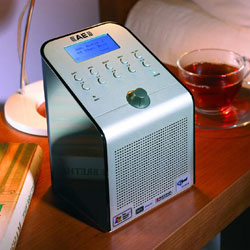
The Acoustic Energy WiFi Internet Radio offers ready access to thousands of stations, including many from Latvia. (Photo courtesy of Acoustic Energy Ltd.)
Andris Straumanis is a special correspondent for and a co-founder of Latvians Online. From 2000–2012 he was editor of the website.


