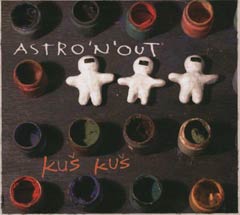
The closing months of 2006 brought to the forefront a young group, Astro’n’out, that turned out one of the more exciting Latvian rock albums of the year. The recording, Kuš kuš, even earned the title of best rock album during the Latvian Music Awards last month.
Some fans, however, may now be wondering if that’s the end of the road. Rapid stardom seemed to be replaced quickly by rumors of Astro’n’out spinning out of orbit. One article in the Latvian press noted the young lead singer Māra Upmane’s turn to photography as a creative outlet, while the band’s MySpace page curiously focuses only on her and none of the original bandmates.
However, the band’s management said in an e-mail that Astro’n’out still exists and that rumors of its demise are just that. Changes have been made to the lineup and a new single, “Apple Green,” can be heard on the MySpace page.
That makes me happy, because Astro’n’out—and especially Upmane—is worth listening to.
The band was founded in January 2003 and saw growing appeal in airplay and concerts. A big boost came when Astro’n’out released the single “Daļa Rīgas” (Part of Rīga). The song, which in 2005 won a contest sponsored by the youth-oriented nongovernmental organization Avantis, speaks about Maskavas forštate, often viewed as a tough neighborhood just south of the Old City district of Rīga.
With dozens of concerts on the band’s résumé, the airplay success of “Daļa Rīgas” and other achievements, the release of Astro’n’out’s debut album was long awaited.
Kuš kuš starts out with one of the group’s hits, “Nē gravitātei” (No to Gravity), a song about flying or reaching for the skies. It is a good piece that showcases Upmane’s songwriting talent and her unusual voice. My daughter compared Upmane’s voice to that of Alanis Morisette’s. A similarity in timbre can be heard, but what matters is that on the Latvian music scene Upmane’s voice is distinctive.
My favorite track on the album is the second, “Ķieģeļi” (Bricks), a metaphorical song about a person in love who is building a wall of bricks that ultimately shuts out everyone dear to them. It is followed by “Monsters,” sung in English, and another radio hit, “Tanki” (Tanks), which may be wrongly perceived as an antiwar song.
“Vien (neguli neguli)” perhaps does the best in characterizing how the band has defined its style—astrorock. But the track so far has done little to move me.
However, the next track, “Baidos,” is my second favorite. In musical style it comes close to a repressed emo. I enjoy both the lyrics as well as how Upmane belts them out. “Baidos” starts out with acoustic guitar, drums and bass join in, and then Upmane’s strong voice arrives to carry the song. Listening to her makes me wonder what she would be like singing in the “white voice” style popular with some Latvian folk ensembles.
The standout hit “Daļa Rīgas” is next. If you have ever heard anything bad about Maskavas forštate—and if you have heard anything, it probably has been bad—listen to Upmane describe her neighborhood. It is a place of hardship, clearly, but Upmane turns an anthropological eye to the district to make the point that it is a rich, complex and wonderful place as well.
Kuš kuš loses some of its strength over the next five tracks. “Mās’” (Sister) is an appeal to a sibling to learn to see the world differently and “Funny How” is about how we often are not true to ourselves. “Tievā diegā” (On a Fine Thread), “Enigmatic” and the oddly titled “La-La-Lauring” are all about relationships.
The album concludes with the title track, “Kuš kuš,” a restrained and unsettling song. It is the best of Upmane’s English-language compositions on the album. Upmane’s vocals and the sparse instrumentation create a soundscape that makes one wonder if the subject of the song, who tells herself “kuš kuš” to calm down, isn’t really about to explode from the “little earthquakes” that bedevil her.
The band’s lineup on the album include Upmane on vocals and guitar, Rihards Streiķis on percussion, Mikus Zaķis on bass and guitar, Uldis Beitiņš on guitar and Rūdolfs Budze on keyboards. The compact disc comes with liner notes that include all lyrics.
I for one will have an eye on Astro’n’out’s MySpace page, waiting for news of the band’s next album.
Details
Kuš kuš
Astro’n’out
Avantis, 2006
On the Web
The band’s official Web site. LV
The band’s page on the Latvian social network draugiem.lv allows fans to comment and provides information on concerts. LV
Current information on the band, including the song “Apple Green,” are available on Astro’n’out’s MySpace page. EN
Where to buy
Purchase Kuš kuš from BalticShop.
Note: Latvians Online receives a commission on purchases.
Andris Straumanis is a special correspondent for and a co-founder of Latvians Online. From 2000–2012 he was editor of the website.