Kastēns urges broader dual citizenship discussion

A work group studying how dual citizenship could be used to foster closer ties with the Latvian homeland should broaden its discussions to include World War II refugees and Soviet-era deportees, says Oskars Kastēns, special assignments minister for social integration affairs.

Kastēns announced Oct. 15 that he has sent a letter to Prime Minister Aigars Kalvītis asking that the work group’s duties be expanded. The letter also asks that membership in the work group be increased to include representatives from the World Federation of Free Latvians and the state Office of the Ombudsman.

The work group was formed after Kastēns’ office in August submitted a report to the Cabinet of Ministers outlining measures that could be taken to encourage repatriation to Latvia among the tens of thousands of citizens who in recent years have moved to Ireland, the United Kingdom and other Western European countries. One suggestion was that children born to Latvian parents abroad be allowed to hold dual citizenship, which under current law is not possible.

“However,” Kastēns said in his letter to Kalvītis, “I consider that it is necessary to deal not just with questions related to children born abroad, but also with refugees and deportees from the time of Latvia’s occupation, as well as with children who have been left without the care of parents.”

The World Federation of Free Latvians completely supports Kastēns’ recommendation, Jānis Andersons, head of the federation’s office in Rīga, told Latvians Online in an e-mail. Many political refugees and their descendants were unable to register for Latvian citizenship before July 1995, when the window closed on a Latvian government offer of dual citizenship for exiles.

A total of 30,793 Latvian citizens hold dual citizenship, according to the Office of Citizenship and Migration Affairs. Of those, 12,473 are in the United States, 4,283 in Australia, 3,788 in Canada, 2,759 in the United Kingdom and 1,615 in Germany.

In a Sept. 27 letter to the work group, the World Federation of Free Latvians urged consideration for political refugees and deportees—and their descendants—who left Latvia during the Nazi and Soviet occupations between June 17, 1940, and May 4, 1990. The first date is when the Soviet Union entered Latvia and the latter date is when the Latvian Supreme Soviet declared the restoration of the country’s independence.

The federation also argued for allowing dual citizenship for Latvian descendants in Brazil who never had Latvian citizenship because their forebears emigrated before Latvia declared independence in 1918.

The integration minister’s work group has until Dec. 10 to submit its recommendations to the Cabinet of Ministers.
Andris Straumanis is a special correspondent for and a co-founder of Latvians Online. From 2000–2012 he was editor of the website.

Radisson, Grand Palace earn travel awards

The Radisson SAS Daugava Hotel and the Grand Palace Hotel, both in Rīga, have been named Latvia’s leading hotels in this year’s World Travel Awards.

The awards were announced Oct. 9 during a ceremony in England. Winners were determined by a vote of travel agents in more than 190 countries.

The Radisson, situated along the Daugava River across from Old Rīga, was named Latvia’s leading business hotel. Also nominated in the category were Hotel Bergs, the OK Park Hotel, the Reval Hotel Rīdzene and Rocco Forte’s Hotel de Rome.

The Grand Palace Hotel, located on Pils Street on the edge of the Old City, was named Latvia’s leading hotel. Also nominated were Ainavas, the Baltic Beach Hotel, the Grand Palace Hotel, the Radisson SAS Daugava Hotel, the Reval Hotel Rīdzene, the Reval Hotel Latvija and Rocco Forte’s Hotel de Rome.

Andris Straumanis is a special correspondent for and a co-founder of Latvians Online. From 2000–2012 he was editor of the website.

Latvian production wins top tourism film prize

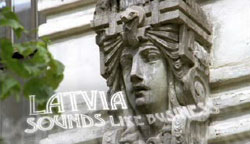
The Latvian Institute’s promotional video “Sounds Like Latvia” has won the grand prize at the 40th Annual Tourfilm Festival in Karlovy Vary, Czech Republic. The video, produced by Rīga-based Style Master Studios, was judged the best country promotional film of 2007.

The film was chosen from a record number of 775 entries representing 138 countries, Tourfilm organizers said in a press release. Slovenia won the prize last year.

The jury singled out the Latvian Institute video for its originality, creative direction, humor and storyline, Ojārs Kalniņš, director of the Latvian Institute, told Latvians Online. Especially noted were the “talking Jugenheads” (animated version of the heads often seen in the Art Nouveau architecture in Rīga), which have become a popular symbol for the city of Rīga. Kalniņš attended the event Oct. 3-4 and accepted the award on behalf of the institute.

The Latvian victory was one of several surprises in the competition, given that its entries had not fared well in the past, Tourfilm said.

Kalniņš, who served as executive producer of the film, praised director Ivo Kalpenieks, art director Eriks Bozis and music composer Girts Biss for offering an original idea that managed to stand out in a crowded and highly competitive field.

“Ironically, the LI’s video was not created to just promote tourism,” Kalniņš said. “We decided to expand on Latvia’s existing tourism slogan (“The Land that Sings”) and explored the country through its many distinctive sounds.”

Kalniņš said use of “talking Jugenheads” in the film was not necessarily an original concept, but simply a natural creative evolution of an idea that had been developing in Rīga in recent years. Advertising executive Ēriks Stendzenieks had toyed with the idea before his Zoom agency adopted the “Talking Stones” installation for the “Surprising Latvia” project in France. Pop group Prāta Vētra considered using singing “Jugenheads” for a music video.

“To me, the fact that so many people were thinking in the same direction indicated that this idea had a life of its own, and we simply needed to develop it further,” Kalniņš said.

The Latvian Insitute has recommended to the Rīga City Council that it adopt the “talking Jugenheads” has part of its marketing plan.

The 6-minute, 30-second film may viewed or downloaded through the Latvian Institute’s Web site, www.li.lv.

Jugenhead

A scene from “Sounds Like Latvia” features a “Jugenhead.” The film won the grand prize of the 2007 Tourfilm competition.

Andris Straumanis is a special correspondent for and a co-founder of Latvians Online. From 2000–2012 he was editor of the website.