Latvia condemns Russian attack on Georgia

Latvia has condemned Russia’s military offensive against strategic targets in Georgia, which quickly moved beyond the breakaway region of South Ossetia, the Latvian Ministry of Foreign Affairs and President Valdis Zatlers’ press office announced Aug. 9.

Russian forces began attacking targets in South Ossetia on Aug. 8 in response to a Georgian military operation intent on regaining the central government’s control over the autonomous region. Russia said it is defending Russian citizens in South Ossetia. By Aug. 9, Russian airplanes also had bombed Tbilisi, the capital of Georgia. Reports say hundreds have died in the attacks at the hands of both Russian and Georgian forces.

However, by Aug. 10 media reports said Georgian troops had moved out of South Ossetia. Georgia’s foreign ministry announced a ceasefire and called on the Russians to negotiate.

South Ossetia is situated in northern Georgia on the border with Russia. Ethnic conflict there and in neighboring Abkhazia has continued for years since Georgia regained its independence after the breakup of the Soviet Union in 1991. South Ossetia is de facto autonomous and has been supported by Russia, which since the 1990s has deployed a peacekeeping force there.

Latvian Foreign Minister Māris Riekstiņš had asked the NATO to discuss the effect the conflict may have on the defense alliance and the security of NATO member states. He also asked Russia to stop its military operations because they could further destablize the region.

President Zatlers, attending the Beijing Olympics, joined with the presidents of Estonia, Lithuania and Poland in condeming Russia’s offensive and in questioning whether Russia can be seen as adequate strategic partner with the European Union. It makes no sense, the presidents added, for the EU to continue negotiations about easing visa requirements with Russia.

“What happened in Georgia is a litmus test on the EU’s and NATO’s ability to solve conflicts in the nearby border regions,” the presidents’ statement said, “and it will show all EU and NATO members states, candidate states and other democratic partners whether it is worth being these organizations’ members and partners.”

The Latvian foreign ministry also warned that travel to Georgia at this time should be carefully evaluated.

A small community of Latvians lives in Georgia, mostly in the Tbilisi area, and Latvia has an embassy in the capital.
Andris Straumanis is a special correspondent for and a co-founder of Latvians Online. From 2000–2012 he was editor of the website.

‘World famous’ Rezgale to perform in Vecpiebalga

Reading on Notikumi.lv about the Aug. 9 festival “Satiksmies Piebalgā” in Vecpiebalga, this line jumped off the page: “Šogad mūzikas festivāla īpašais viesis būs pasaules slavenā dziedātāja Endija Rezgale no Dienvidāfrikas.” A world-famous singer from South Africa named Endija Rezgale? Gee, never heard of her. Or, rather, I had heard of her, but in a different context.

Rezgale—known as Endia in places like Cape Town, Durban, Johannesburg and Pretoria—is somewhat famous in South Africa and perhaps folks remember her back in Kansas, too. At Wichita State University she was destined to be a stand-out cross country runner, until an injury slowed her down (she did make All-Conference in 2001).

Born in Salacgrīva, Latvia, Rezgale met her future husband (and so now she’s Endija Rezgale-Strydom) while at Wichita. He is from South Africa, which explains why she is living so far away from her homeland. In South Africa, her singing talent blossomed. A nice article about her appeared in a July 2006 edition of Republika.lv. If you read Afrikaans, here’s a 2006 article from Die Burger.

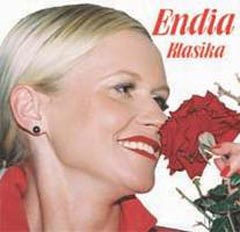
The soprano has had good reviews in the South African press, including one for her 2003 performance in the stage production “G String.” Rezgale released a solo album, titled Klasika on compact disc in 2006.

Rezgale has a spartan Web site, www.endia.co.za, but at least visitors can learn how to order her CD.

Endia

Endia (Endija Rezgale-Strydom) released the compact disc Klasika in 2006.

Andris Straumanis is a special correspondent for and a co-founder of Latvians Online. From 2000–2012 he was editor of the website.

Dublin earns No. 1 in voter turnout abroad

Voters failed Aug. 2 to pass a referendum on constitutional amendments that would have allowed citizens to initiate a recall of the Latvian parliament. However, some politicians appear rattled enough by the results that they themselves are now calling for changes, according to media reports.

Latvians in Ireland, who in the past have been criticized for their seeming lack of political involvement, pushed Dublin to the No. 1 spot in terms of turnout among the 47 polling stations abroad.

Supporters of the referendum fell almost 10 percentage points short of their goal. Half of Latvia’s more than 1.5 million eligible voters had to vote in favor of the referendum for it to become law. Provisional results reported Aug. 3 by the Central Election Commission in Rīga showed turnout at 41.5 percent, with those voting in favor representing 40.16 percent of all eligible voters.

Among those voting, however, the result was overwhelmingly in favor of the amendments, suggesting a deep dissatisfaction with the government. Overall, 96.75 percent voted “yes” on the referendum.

Aigars Kalvītis, former prime minister and leader of the People’s Party (Tautas partija), told the newspaper Diena that his and other ruling coalition parties now will have to work with opposition parties to find a compromise on constitutional changes.

Meanwhile, the opposition party New Era (Jaunais laiks) urged President Valdis Zatlers to call for a dismissal of parliament, according to media reports. Under current constitutional language, that would put into motion a national referendum. If such a referendum succeeds, the Saeima is considered dissolved and new elections are scheduled. But if it fails, the president has to step down.

The constitutional amendments would have added language allowing for a citizen initiative to call for the parliament’s recall, thus sparing the president of the risk.

Zatlers, in an Aug. 3 press conference in Rīga, said he will not call for the dismissal of the Saeima. But he will call a special session of the parliament and will present draft legislation to amend the constitution to give citizens the right to initiate recall of the Saeima.

The vote abroad

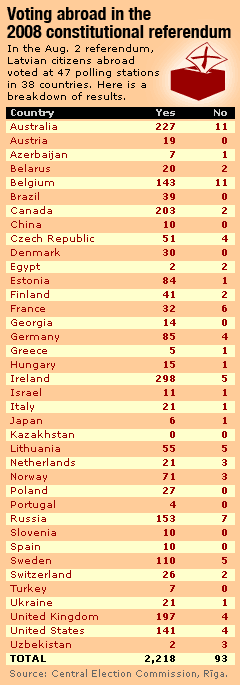
Provisional results from polling stations outside Latvia showed turnout, by mail and in person, at 2,315 voters.

The most active polling station abroad was the Latvian embassy in Dublin, Ireland, with a total of 303 ballots cast, according to the Central Election Commission. London was second with 202 voters and Toronto, with 161, was third. Brussels, Stockholm, Melbourne, Tallinn, Moscow, Adelaide and Washington, D.C., rounded out the Top 10.

Australia, Belarus, Canada, Germany, Russia and the United States each had more than one polling station, but did not necessarily translate into more voter activity. Ireland still proved to have the greatest number of valid ballots. Australia, with a total of 227 valid ballots from polling stations in Adelaide, Melbourne and Sydney, was second. Canada had 203 valid ballots from polling stations in Ottawa and Toronto. The United Kingdom ranked fourth. And Russia was fifth with 153 valid ballots recorded at polling stations in Kaliningrad, Moscow, Pskov and St. Petersburg.

Voters in the United States cast 78 valid ballots in Washington, D.C., and 67 in New York.

Voters in Germany cast 71 valid ballots in Berlin and 18 in Bonn.

In Belarus, a total of 19 valid ballots were cast in Minsk, but just 3 were recorded in Vitebsk.

Many polling stations reported just a handful of voters. The polling station at Astana, Kazakhstan, recorded zero votes.

As with the overall results, voting abroad showed strong support for the referendum. Only the five voters in Tashkent, Uzbekistan, turned the tables, splitting 3-2 against the constitutional amendments. The four voters in Cairo, Egypt, evened out at 2-2.

(Updated with final provisional results.)

Referendum results abroad

Andris Straumanis is a special correspondent for and a co-founder of Latvians Online. From 2000–2012 he was editor of the website.