Latvijas Radio, LTV face financial disaster

Latvijas Radio is on the verge of bankruptcy and the state-run television service is in tough shape, too. Users of both media should expect that the next several months will bring drastic changes to the scope and quality of programming.

Although both services have been saddled with financial troubles and political controversies during the past years, the government’s decision late last year to slash 25 percent of their financing forced both radio and TV managers to lay out some unpopular choices.

Latvijas Televīzija, for example, said it would cancel its participation in the Eurovision Song Contest and end production of the popular homemade soap opera, “Neprāta cena.” The radio service, meanwhile, suggested that it would have to trim programs and cut back on the range of its signal, especially to rural areas.

For Latvijas Radio, at least, things have very quickly gone from bad to worse.

Listeners no doubt have heard the frequent announcements—some of them a bit hyperbolic—warning that a cutback in programming threatens the ability of the public to be informed. As if to underscore the point, the radio service on Jan. 20 was called before the National Radio and Television Council (Nacionālā radio un televīzijas padome) to offer a plan that could prevent its bankruptcy in the face of at least LVL 700,000 in debt. On the same day, Aigars Semēvics, director general of the radio service, appeared to fall on his sword and announced his resignation.

Latvijas Radio and Latvijas Televīzija both receive financing from the government budget. They augment that by selling advertising time. The trouble with cutting state financing is that the difference cannot be made up by selling more advertising. In times of economic hardship, one of the first things businesses look at trimming is their advertising budgets—and that’s already happening.

Among ideas floated to stop the bleeding at Latvijas Radio are ending the Radio NABA service, dropping the Latvian Radio Choir and limiting the signals for Radio 3 and Radio 4 to just the Rīga area.

Just what and who will get the ax will be a decision left to Dzintris Kolāts, who was named Jan. 21 to take over from Semēvics. Kolāts has been head of Latvian State Radio’s news department. The National Radio and Television Council approved Kolāts on a 5-0 vote with three members, including chairman Ābrams Kleckins, abstaining. (For reasons not entirely clear but unsettling nonetheless, the council also briefly considered the controversial Edvīns Inkēns for the job. Inkēns, some readers might remember, once was a member of the Saeima and, at the same time, a television journalist—an ethical dilemma that did not seem to bother him. Among his accomplishments was “uncovering” the dubious pedophilia scandal of eight years ago that brought down a number of politicians.) The conservative opposition party New Era (Jaunais laiks) on Jan. 22 submitted a bill to the Saeima demanding the removal of Kleckins from the council, blaming him for not keeping tabs on the financial condition of Latvijas Radio. The party also wants LVL 500,000 to be transferred to Latvijas Radio from the LVL 28 million reportedly held by the Latvian State Radio And Television Centre, the state-run company that controls the country’s radio and TV transmitting facilities.

I would not want to be in Kolāts’ shoes right now. According to a report on Latvijas Radio, among options he is considering to save the service is laying off about 100 staff. The popular Radio 2 service also faces the possibility of a weaker signal.

Some of these decisions probably should have been made many months ago. Knowing it was going to face a tough year, why didn’t Latvijas Radio look at eliminating or collapsing some of its services? In a country of 2.3 million people, is it really necessary for state-run radio to provide four different national channels? If you have lost count, they are the news and public affairs oriented Radio 1; the all-Latvian music service Radio 2; the classical music service Radio 3; and the Russian-language Radio 4. Latvijas Radio also transmits Radio NABA, a college music service owned by the University of Latvia.

Between the two of them, Radio 1 and Radio 2 claim more than 30 percent of the listening audience in Latvia, according to Baltic Media Facts data. Radio 3 and Radio 4 claim about 5-6 percent. Couldn’t Latvijas Radio get by with perhaps just two channels?

Latvijas Televīzija also faces financial challenges, but not as bad as the radio service. Among its most dramatic moves—no doubt playing to the emotions of viewers—was announcing that Latvia would not participate in the Eurovision Song Contest and that production of “Neprāta cena” would come to an end.

However, fans of both shows have some hope. By not participating in Eurovision, LTV would have saved about LVL 120,000. But last week the European Broadcasting Union, which organizes Eurovision, decided to help out Latvia with a reduced participation fee, while Latvijas Krājbanka and the convenience store chain Narvesen announced they would come up with the money. The song contest will take place in May in Moscow. Only a few months ago, some commentators in Latvia were suggesting the country should not participate in Eurovision as a protest against Russia’s invasion of Georgia.

The producer of “Neprāta cena,” a soap opera set in a Latvian hotel and starring such personalities as actor Uldis Dumpis and singer Mārtiņš Freimanis, earlier this month turned to fans for financial help. The show costs about LVL 3,000 per episode to produce, Latvijas Televīzija spokesperson Ieviņa Ancena told Latvians Online. The producer is asking fans to donate one lat each in an effort to raise LVL 160,000 by the end of the month so that filming of the show may continue.

Among other measures, LTV also said it would cancel the Russian-language news program “Strana LV” and pull its correspondents from Brussels and Moscow.

This is not the first time Latvia’s two public broadcasters have been under the gun, but this is clearly the worst we have seen. Commercial broadcasters (and, in several cases, their foreign owners) would love to see the state-run media disappear so that they can divide up what’s left of the pie. A number of politicians also wouldn’t mind exerting more pressure over public broadcasters. I have lost count on how many times the heads of Latvijas Radio and LTV have changed over the years.

Latvia’s public broadcasters are a vital public service. Unlike the country’s commercial broadcasters, they are charged with telling Latvia’s story to Latvia. Sure, they could do a better job, but slashing their funding will not improve them.
Andris Straumanis is a special correspondent for and a co-founder of Latvians Online. From 2000–2012 he was editor of the website.

Rīga officials deny permit for anti-government march

Rīga city officials have denied a permit for a demonstration planned just four days after a small riot in the city’s Old Town district near the parliament building.

The demonstration’s organizers, the Action Party (Rīcības party, formerly known as the Eiroskeptiķi), announced on their Web site that they will appeal the Jan. 15 decision of the Rīga City Council’s commission in charge of meetings, parades and pickets.

The permit was denied based on suggestions from law enforcement officials, according to a press release from the city council. Organizers were asked to reschedule the demonstration by a few weeks, but they declined.

Following a peaceful Jan. 13 demonstration in the Dome Square attended by an estimated 10,000 protesters, unrest broke out by the nearby Saeima building and then spread to Smilšu Street. Windows in several businesses and government buildings were smashed by rioters, a liquor store was looted and several police vehicles were damaged. More than 100 people were arrested and several dozen injured.

The large-scale demonstration had been called by the political party Sabiedrība citai politikai to demand that President Valdis Zatlers dismiss the parliament.

The Action Party wanted to organize a Jan. 17 demonstration at the Saeima and then march to the Castle of Rīga, the president’s official residence. The party is calling on the government of Prime Minister Ivars Godmanis to step down.

The Rīga city commission also reviewed an application for a Jan. 22 assembly at the Saeima building planned by the Latvian Student Association (Latvijas Studentu apvienība), but the association withdrew its application after meeting with city officials, according to the press release.

Meanwhile, the anticorruption watchdog group Delna, the European Movement-Latvia and other organizations plan to stage a Jan. 16 action by the Freedom Monument in downtown Rīga to condemn the vandalism of Jan. 13 but to press for basic democratic values. Participants are asked to wear white ribbons to symbolize empathy for the action, which is titled “Ieklausies! Es esmu Latvija” (Listen up! I am Latvia!), according to a press release from Delna.

Andris Straumanis is a special correspondent for and a co-founder of Latvians Online. From 2000–2012 he was editor of the website.

President to Saeima: Amend constitution or else

In the aftermath of the Jan. 13 riot in the heart of Rīga, President Valdis Zatlers has issued an ultimatum to the parliament: Pass a constitutional amendment allowing for the popular recall of the Saeima, or he will call for its dissolution.

Zatlers, in a Jan. 14 press conference, gave the Saeima until March 31.

The president’s response to the previous night’s unrest in Rīga’s Old Town district came after his return from a European Parliament meeting in France and after consultations with Latvian government and police officials.

While he condemned the unrest, Zatlers also said it is evidence of how low the public’s confidence in the government has sunk.

“Both the Saeima and the Cabinet of Ministers have lost contact with the voters,” he said during the press conference. “I have already several times pointed out that trust can only be regained with specific actions.” Among those, he added, are amending the constitution to allow for the popular recall, work on an economic stimulus plan and government reform.

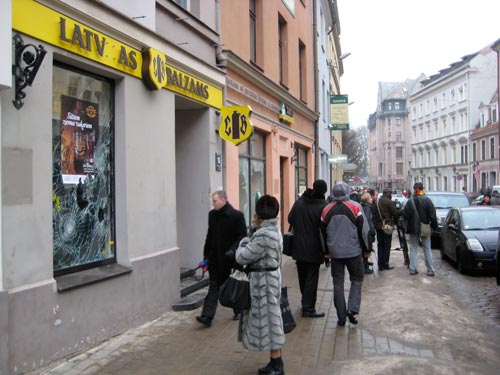
By midday Jan. 14 much of the damage from the riot had been cleaned up, Latvians Online observed. Businesses and government offices along Smilšu Street were particularly hard hit, including a Latvijas Balzams liquor store that was looted.

Along Jēkaba Street, a work crew was busy repairing windows at the Latvian National Library’s Letonika Division. The building was closed to patrons, a sign in Latvian and English telling visitors that windows and computers were damaged by rioters.

The Saeima building by midday showed little outward damage. Broken window panes had been replaced, but pockmarks from bricks thrown at the building the night before were still visible. Local and military police patrolled the area on foot.

The rioting began about 7 p.m. Jan. 13 after the close of a peaceful demonstration that drew an estimated 10,000 protesters to the Dome Square. The demonstration was organized by the political party Sabiedrība citai politikai to call on the president to release the Saeima.

Under the Latvian constitution, the president can initiate dismissal of the parliament. A national referendum then must be held. If it passes, the Saeima is dissolved and an election for a new parliament is organized. But if the referendum fails, the president must step down and the parliament chooses a new chief of state.

In his Jan. 14 press conference, Zatlers gave the parliament and the government three assignments:

  • Pass amendments to the constitution that allow for the popular recall of the Saeima. He said he would present a bill to the Saeima within a week.
  • Change the election law to address two specific problems. First, because Latvians can vote for just one party’s list of candidates, the “locomotive problem” allows a few well-known politicians to pull into parliament deputies who are not known by voters. Second, 10 percent of the Saeima’s 100 deputies are no longer members of the parties from which they were elected, resulting in parties being represented that did not stand in the last election.
  • The Saeima as quickly as possible must create a board to oversee Latvia’s economic development plan and the EUR 7.5 billion in loans the country is getting from the International Monetary Fund, the World Bank and others.

Zatlers said he also wants the Cabinet of Ministers to present a clear government reorganization plan in one to two weeks.

“Only with these specific assignments can we calm the public and give it a little bit of hope that the process in the country is headed in the right direction,” the president said. “This time I am clearly stating a deadline for completion of these assignments. It is one thing to work, but something completely different to work effectively with results—to work with results demanded by the public, results that serve the public. This time the deadline is March 31.”

Meanwhile, the leader of Rīcības partija (formerly known as Eiroskeptiķi) announced his group is planning a demonstration at noon Jan. 17 at the Saeima, follwed by a march to the Castle of Rīga, which is the president’s official residence. Normunds Grostiņš, in a message on the party’s Web site, called for the government of Prime Minister Ivars Godmanis to step down.

Latvijas Balzams

Passers-by and journalists inspect the Latvijas Balzams store on Smilšu Street in Rīga’s Old Town district. The store had its windows smashed and was looted by rioters Jan. 13. (Photo by Andris Straumanis)

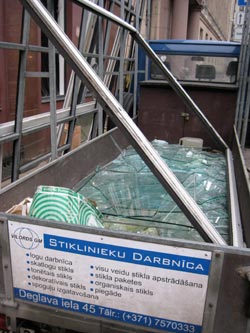
Stikli

A window repair company’s truck was filled with broken glass from the State Treasury building on Smilšu Street. (Photo by Andris Straumanis)

Andris Straumanis is a special correspondent for and a co-founder of Latvians Online. From 2000–2012 he was editor of the website.