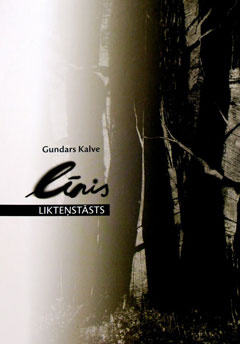
Story of deportation draws on relatives’ memories

Gundars Kalve’s first novel, Līnis, tells the story of a young mother, Līva Lūse, and her daughter, Liene, who are deported from Latvia on June 14, 1941, to the Ural mountain region of the Soviet Union. Although the story is fictional, it is based on Kalve’s memories of stories about his relatives, especially the fate of his grandmother’s sister.

Kalve told the Jēkabpils regional newspaper Jaunais Vēstnesis that he was driven to write the story in part because of the inner turmoil he felt about what has happened to the Latvian people through various waves of repression, and in part because of the knowledge he has gained from his parents and grandparents about historical events.

The title, Līnis, is a term of endearment for Liene.

The book was released in June by the publishing arm of the Rīga-based Valters un Rapa booksellers.

Kalve is known in the Jēkabpils region for his fisheries work, a business he has been involved with for 10 years, according to the newspaper Brīvā Daugava.

Līnis

Gundars Kalve’s first novel is Līnis.

Andris Straumanis is a special correspondent for and a co-founder of Latvians Online. From 2000–2012 he was editor of the website.

News staff of The Baltic Times quits, but weekly to continue

The entire editorial staff of The Baltic Times, a weekly English-language newspaper published in Rīga, has resigned this week, according to an e-mail circulated to various government and civic leaders in Latvia and abroad.

The e-mail claims staff members have not been paid their salaries for up to four months and “repeated attempts to receive any information on a future payment plan has been repeatedly refused by management.”

However, the newspaper’s managing director said the publication will continue.

“We had a disagreement with Rīga staff journalists,” Sergey Alekseyev told Latvians Online in an e-mail. “As you can assume from the e-mail you received the aim is to (break) The Baltic Times’ reputation. The current issue of The Baltic Times was available for readers this Thursday as usual and will be available in future.”

The e-mail from the editorial staff was dated July 24 and was sent from an account listed for staff member Kate McIntosh, but the message was signed by the paper’s “news team.”

“As the sole English-language publication, The Baltic Times has prided itself on retaining editorial integrity and independence,” according to the e-mail. “However, in recent months staff have come under increased pressure to write favourable articles for advertising incentives.

“While we appreciate that these are hard times economically for business and companies, we felt that it was no longer possible to continue to produce a professional product under such circumstances.”

The e-mail continues that most of the former editorial staff members plan to stay in the Baltics and pursue independent media projects.

The Baltic Times is distributed throughout Estonia, Latvia and Lithuania, and subscribers are found throughout Europe and beyond in the Baltic diaspora, among business people and government officials. The newspaper has a circulation of 12,000, according to Alekseyev. The paper claims about 150,000 readers between its print and online versions, according to its Web site.

The weekly was created in 1996 with the merger of two other English-language newspapers, The Baltic Independent and The Baltic Observer.

Andris Straumanis is a special correspondent for and a co-founder of Latvians Online. From 2000–2012 he was editor of the website.

Vīķe-Freiberga joins in letter asking Obama to not forget Eastern Europe

Former Latvian President Vaira Vīķe-Freiberga has joined other Central and Eastern European leaders in raising concern about what they see as waning U.S. interest in the region.

In a July 16 open letter to President Barack Obama, 22 intellectuals and former policymakers asked the U.S. administration to reconnect with the region “around a new and forward-looking agenda.”

They wrote that the region “is one part of the world that Americans have largely stopped worrying about” and that U.S. policy appears to assume all is well.

“That view is premature,” they continued. “All is not well either in our region or in the transatlantic relationship. Central and Eastern Europe is at a political crossroads and today there is a growing sense of nervousness in the region. The global economic crisis is impacting on our region and, as elsewhere, runs the risk that our societies will look inward and be less engaged with the outside world. At the same time, storm clouds are starting to gather on the foreign policy horizon.”

The role of the NATO is in doubt and the defense alliance needs to be strengthened, they wrote.

The letter writers also pointed to Russia as a problem for security in the region.

“Our hopes that relations with Russia would improve and that Moscow would finally fully accept our complete sovereignty and independence after joining NATO and the (European Union) have not been fulfilled,” they said. “Instead, Russia is back as a revisionist power pursuing a 19th-century agenda with 21st-century tactics and methods.”

The White House did not immediately respond to the letter, which was made public a week after Obama met with Russian officials in a Moscow summit.

The Joint Baltic American National Committee shares many of the same concerns expressed in the letter, Managing Director Karl Altau said in an e-mail.

“Particularly worrisome from the Baltic perspective is the Kremlin’s increased whitewashing of the historical record and the recent creation of a commission to glorify and legitimize the Soviet narrative of World War II,” Altau wrote. “That narrative deliberately disregards other narratives, and proven facts of how the Baltic countries were occupied and annexed by the USSR.”

The letter from the 22 Central and Eastern European leaders called on the Obama Administration to follow six steps to improve relations with Europe:

  • Reaffirm America’s role as a European power, while Europe must adopt a more global perspective and “be prepared to shoulder more responsibility in partnership with the United States.”
  • Work for “a renaissance of NATO as the most important security link between the United States and Europe.”
  • Determine the future of the planned American missile defense installations in coordination with European allies, not based on “unfounded” Russian opposition.
  • Creation of a strategic partnership between the U.S. and the European Union.
  • Lend its political support to improving Europe’s energy security.
  • Open the U.S. Visa Waiver Program to Poland and Romania, “arguably the two biggest and most pro-American states” in the region.

Besides Vīķe-Freiberga, signers of the letter included such leaders as Valdas Adamkus, former Lithuanian president; Lech Walesa, former Polish president; Mart Laar, former Estonian prime minister; and Sandra Kalniete, a former Latvian foreign minister.

Andris Straumanis is a special correspondent for and a co-founder of Latvians Online. From 2000–2012 he was editor of the website.