
Absurdist film overloads on strangeness

Scene from Medības

Guna Zariņa as Renāte and Rolands Zagorskis as the policeman Krasts are among the actors in the Andis Mizišs film Medības. (Publicity photo)

Emir Kusturica is a world-renowned Serb filmmaker who makes great surreal and absurdist films. Time of the Gypsies and Arizona Dream come to mind. Medības tries to traverse the same terrain, but unfortunately Andis Mizišs, the director of the film, is no Kusturica.

The elements are there, but somehow they never really come together into a cohesive story in which we care about either the characters or the outcome of their actions.

The film opens with a scene of two men making and bottling juice in a rundown former train station. A train pulls up. It’s the owner of the bottling operation stopping by to check on the progress. The train also serves as a home for unwed mothers and the bottling operation owner seems to be their matron. The men hadn’t been paid in a while and ask as to their wages. The owner gives them the runaround and instead presses them to finish the latest shipment. The train pulls away, one of the bottlers goes back in and out of spite adds some poison to a few of the bottles. The entire shipment is then delivered to a small country bar.

Elsewhere a trio of orienteering competitors gets lost in the woods; a hunting party, also on rails, sets out for their annual hunting party; a famous architect and his highly strung lover are working out some issues; and a local policeman is trying to keep his young partner awake at a railroad crossing.

Keeping track? All of these characters and stories of course will be intertwined and then stuff will happen or, as a friend of my commented, “and then it gets weird.”

Medības is not all bad. There are some good performances (Guna Zariņa’s Renāte the best among them) and the stories have potential, but it’s just that it never really comes together. It’s just a lot of exposition about really strange situations and the sometimes strange people who get trapped in them.

The title itself seems to be an allusion to the personal and emotional hunts we all engage in our daily lives. But there’s just too much of the strange here that is never really explained. It’s a strangeness overload and we are far too busy making up our own back stories for the characters to have any time to actually relate to them. Just starting with the train, is it really that easy and simple to operate your own train, maintain your own track? Doesn’t it cost money to operate a train and why put a home for unwed mothers on it and who would ever send or willingly find themselves on this one?

(Editor’s note: This review originally appeared on the author’s blog, Not Really a Blog, and is republished with permission.)

Details

Medības

Andis Mizišs, director

Ego Media,  2009

Notes: In Latvian. Drama, color, 80 minutes. Screenplay: Elvita Ruka and Kaspars Odiņš; camera: Agris Birzulis; art director: Jurģis Krāsons; composer: Kārlis Auzāns; editors: Igors Verenieks and Dāvis Sīmanis; principal cast: Guna Zariņa, Rolands Zagorskis, Andris Keišs, Jana Sekste, Indra Burkovska, Santa Didžus, Beata Grickeviča, Kaspars Znotiņš, Artuss Kaimiņš and Juris Lisners.
‘Tumšie briežie’ follows tradition of doom, gloom

Tumšie brieži

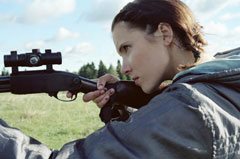
Kristīne Krūze plays Ria in the Viesturs Kairišs film Tumšie brieži, based on a play by Inga Ābele.

If you were to judge the Latvians by their films you would have to arrive at the conclusion that the Latvians are a very, very unhappy people. Viesturs Kairišs’ Tumšie brieži (The Dark Deer), based on a play of the same name by Inga Ābele, follows in that rich tradition of doom and gloom where things start out bad and then they get worse.

Latvian filmmakers seem to be primarily interested in making two types of film, the depressing or the tragic.

The characters’ entire lives are spent in a cycle of manic depression punctuated by brief spells of exhausted catatonia. Few are the films offering escapist fare and simple entertainment. If a Latvian filmmaker were to make It’s a Wonderful Life, George Bailey would jump off that bridge, Clarence would not get his wings and be relegated to the depths of hell, and Mary would become Mr. Potter’s unwilling mistress. And those would be the cheerful parts.

Tumšie brieži follows the lives of Aija (Elita Kļaviņa), Alfs (Kaspars Dimiters) and Augusts (Juris Žagars). The film opens with the three riding in a car. A pregnant Aija sits in the back, Alfs in the passenger seat and Augusts at the wheel. The relationships between the three aren’t clear, but it’s evident that they are intimately close. They’re returning from an evening at the theater when the car runs into a deer and crashes. The next scene picks up 17 years later. Aija is now a semi-catatonic recluse tended to by Alf and his new wife Nadine (Maija Doveika), Aija’s former nurse. They all live on a game farm and hunting lodge managed by Alfs and his father Opis (Pēteris Martinsons). Times are evidently hard, but a group of German hunters, among them Augusts who is now a successful businessman in Germany, has just arrived and the money they’ll spend just might save the day.

There’s just one problem. Ria (Kristīne Krūze), Aija’s and Alfs’ daughter, has grown up with and loves the deer. She will do everything in her power to disrupt the hunt and save them.

Kairišs is a talented filmmaker with a very strong feel for pacing, composition and mood. His 2001 Pa ceļam aizejot (Leaving By the Way) was a lyrical and mystical film despite some uneven performances. In Tumšie brieži we have the opposite. Despite some very strong performances from his cast, the film never really engages us. The characters somehow never really connect. We never seem to care about any of them. The motivation of the actors is never clearly explained.

While Aija is certainly a very attractive woman, we are never really sure why the two men would be so attracted to her or she to them. Why is Aija in the state she’s currently in? An accident can certainly be a traumatic experience, but is that enough to drive Aija to madness? Why does Alfs not just run away from his crazy family and why does Nadine put up with any of it? Why did Augusts leave? And why did he come back? Obviously there’s a lot of missing backstory. The film hints at its presence, but most of it doesn’t find its way to the screen. Ultimately, the answer to all of these questions seems to be that it’s in the script and that’s the way the actors play it.

It’s not that Tumšie brieži is necessarily a bad film. It has a definite feel to it and Kairišs’ strong visual sense and feel for mood and pacing are evident. The acting, with the possible exception of Krūze, is strong. Both Dimiters and Žagars bring a presence to their roles which goes beyond just their lines of dialogue. Kļaviņa does the best with what the limited script offers her. Krūze, unfortunately, brings the least to the table. Her Ria seems to alternate between petulance and cliché teenage rebellion. It’s Ria’s role that has to be the focal point of the film. All the action flows through or from her. How much of that is the fault of Krūze and how much is the fault of the script is debatable, but it never really seems to come together on the screen.

Details

Tumšie brieži

Viesturs Kairišs, director

Kaupo Filma,  2006

Notes: In Latvian. Feature, 85 minutes, in color. Screenplay by Viesturs Kairišs, based on a play by Inga Ābele; cast: Kaspars Dimiters, Maija Doveika, Elita Kļaviņa, Kristīne Krūze, Pēteris Martinsons, and Juris Žagars; producer: Guntis Trekteris; director of photography: Gints Bērziņš; music: Artūrs Maskats. DVD offers original Latvian and Russian dubbing, as well as English subtitles.

Director’s feature debut captures Latvia’s zeitgeist

Monotonija

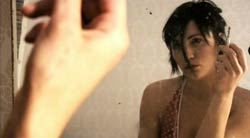
Having failed her audition, Ilze (Iveta Pole) stares into a mirror and considers her future.

Juris Poškus’ debut full-length feature film Monotonija (Monotony), the Perspectives Award winner for first- and second-time filmmakers at the 29th Moscow International Film Festival, and a nominee for best full length feature film in this years Lielais Kristaps, can be best described as a Latvian Dogme film as done by the English director Mike Leigh.

The focus of the Dogme film movement, headed by Lars von Trier and Thomas Vinterberg in the mid-1990s, was to return to a more naturalistic style of filmmaking, one free of special effects, artistic flourishes or genre. It produced such diverse and notable films as Søren Kragh-Jacobsens Mifune, Lone Scherfig’s Italian for Beginners and Thomas Vinterberg’s The Celebration. Leigh, the director of respected films as Secrets and Lies, Naked and Life is Sweet, is known for an improvisational style that relies heavily on his actors to create character, improvise dialogue and develop the plot. While Monotonija doesn’t exactly reach the lofty standards set by the aforementioned films, it comes close and, if nothing else, establishes Poškus as a talent to watch on the Latvian film scene.

The film is an improvised collaboration between Poškus, director of the 2003 Lielais Kristaps winner for best documentary for Bet stunda nāk (But the Hour is Near), and actors from Jaunais Rīgas Teātris (the New Rīga Theater). They started out with only one precondition. Each character in the film needed to have a dream. “We wanted to make a movie about everyday banality where there is no big story. We just wanted to show (a) small guy story that usually (is) not being shot in movies,” Poškus said at the Moscow festival. What results is the story of a woman from a small Latvian village who leaves the routine monotony of small town life for what eventually turns out to be the routine monotony of the big city.

As the film opens Ilze (Iveta Pole) is part of a crew of cannery workers who still use old fashioned methods to catch fish. As we follow Ilze through her daily routine we are introduced to a village where life and time seems to have stood still. It’s a place where people still chop wood by hand and have to use that wood to heat their houses. It’s a place where people still get their milk straight for the cow and rely on horses as their beasts of burden. It’s a drab and grey dead-end place with little future or promise for the young.

Ilze comes across a newspaper advertisement for an open audition for a film shooting in Rīga. After mulling it over with her boyfriend Ojārs (Varis Piņķis), Ilze leaves him and her village behind for a shot at the big time in the big city. Arriving in Rīga she moves in with her cousin Linda (Madara Melberga), fails the audition, has a fling with Archie (Artuss Kaimiņš), reconciles with Ojārs, breaks up with Ojārs, finds a new job and, in short, falls into the routine monotony of big city life.

Monotonija‘s greatest strength is in capturing the zeitgeist of Latvia as it continues emerging from the shadow of the Soviet Union and into independence and the present of the European Union. It’s a place where the young often find themselves with few options and where the future always seems to lie elsewhere. For those growing up in the rural areas it’s in the big cities. For those who are already in the big cities it’s in Ireland, and Germany, and the United States. It’s a country whose people seem to be trapped in a vicious cycle where they are always searching for that greener grass and that greener grass is always just slightly out of reach.

Poškus’ documentarian’s eye serves him well and allows the actors to disappear into their characters. When it works, like during the opening sequence when we are introduced to life in Ilze’s village with virtually no dialogue, we are treated to moments of movie magic where the line between fiction and reality blurs. When it doesn’t work, like during Archie’s exercise at self-absorbed and bad joke telling, it feels forced, artificial and, well, self-absorbed. Overall, Monotonija is an interesting film filled with talented, if sometimes spotty, performances that gives us a glimpse into the present day lives and experiences of Latvian youth.

Details

Monotonija

Juris Poškus, director

Fa Filma,  2007

Notes: In Latvian with English subtitles. Feature, 93 minutes, in color. Cast: Iveta Pole, Varis Piņķis, Artuss Kaimiņš, Andis Strods and Madara Melberga; camera: Andrejs Rudzāts, Stefans Doičmans and Juris Poškus; sound: Ernests Ansons; set designer: Ilva Kļaviņa; costumes: Ginta Vasermane; editors: Liene Bāliņa and Uģis Grīnbergs.