The Making of a Dziesmu Svētki, Part 4: Venue Selection

As soon as I heard we might be hosting a Latvian song festival on the East Coast, the flashbacks hit. “Well,” I thought with a laugh, “It’s a good thing that we just had all that practice with venue selections.”

It had only been half a year since Washington, D.C. had hosted the traveling annual multi-sport tournament ALA Meistarsacīkstes. Several of us who had helped organize Meistarsacīkstes were now working on the song festival, and the memories came rushing back: All day every day for several months we had been glued to our phones, attempting (and repeatedly failing at) what should have been a simple task: booking some venues. It’s the type of thing that seems straightforward and easy until you try it; you call and ask for availability and wave some cash, the venue says yes or no, and boom, you’re booked. Simple, right? Oh no, not even close. Where event venues are concerned, nothing is ever simple.

Before I go any further, I want to make clear that the organizing committee could not be more thrilled with the festival’s venues, from the grand hotels that provide impressive views of Baltimore Harbor to the intimate Baltimore Soundstage, just a six-minute walk away and host of the festival’s first party. Indeed, one of the main reasons we selected Baltimore as the host city was because we knew it has excellent theaters, arenas, clubs, hotels, churches, and restaurants, and we’re confident that you’ll agree once you experience them. But that doesn’t mean that getting all of the pieces aligned has been easy.

The very first challenge regarding pinning down event venues was timing. Arguably the single greatest obstacle we’ve faced as an organizing committee has been having just 20 months to plan the entire festival. That may seem like a long time, but many venues get booked much earlier. One major theater was already reserved for a touring Broadway show. A hotel that we had visited and seemed promising as the festival’s home base got snagged by another group in the couple weeks between our first and second visits. Even earlier, when we were considering in which city to host the festival, towns like Boston were immediately scrapped due to venue unavailability (see Part 2 in this series).

Ironically, the surprisingly more common timing dilemma was that venues often wouldn’t know their availability that far in advance, and we found ourselves making inquiries too early rather than too late. The issue mostly came up as we searched for locations for smaller events, like the play (Ceļā uz mājām, presented by the Latvian National Theatre Company) and smaller concerts. Baltimore has a handful of very cool little theaters, which seemed promising at first, but at the time when we approached them, most didn’t yet know their rental availability for 2017. In many cases their own company’s season needed to be set. Or construction projects got in the way. A world-renowned music conservatory with a plethora of potential stages told us to check back at the start of the school year, which we did, only to be met with: “Turns out we’re renovating. Check back in the spring.” Considering that we were hoping to start selling tickets in the fall and were budgeting for and expecting thousands of attendees, checking back was not an option. And so it continued. Each venue had a different sweet spot in terms of timeline; catching them at just the right time proved to be difficult.

The second major challenge regarding pinning down venues for our shows was budget constraints. Letting our imaginations run wild and disregarding financial limitations, we explored all sorts of inventive scenarios, from a dance party among the dinosaurs of the science museum to jaundejas at the open-air pavilion on the waterfront. But these wish-list ideas ran up against one hard truth: Our largest events require seating for a couple thousand people and stage space for several hundred. This audience-performer ratio is not too common, and it most certainly does not come cheap. The only two ways we could have made these larger events break even on their own would have been to double their ticket prices (don’t worry, we wouldn’t do that to you folks) or to double our audience size (please bring friends!). And so, with the larger venues uncompromisingly eating up big chunks of the festival budget, finding affordable options for the other events so that they could help subsidize the main events was crucial. Unfortunately, the search for modestly priced smaller venues turned up less-than-ideal solutions, as nearby options (such as local high schools) failed to meet the professional standard of the event, and more appropriate options were too far away.

Luckily, we were saved by two perfect sources that served as financially responsible options. First, our trusty hotels came to the rescue, offering up fantastic spaces for most of the evening events, the art and fashion exhibits, and even the theater performance. And a local Latvian led us to a hidden gem of a church so beautiful and ideal that we probably would have jammed every event into it if we could have (in the end, we went with just two concerts).

Timeline and budget are obviously the main factors in venue selection, and in theory, the story should end right there. But even once you are on a venue’s calendar, things can go wrong. You can never really rest until the contract is signed and countersigned. And waiting on the finalization of the contract can be frustrating, since even in today’s modern world communication is rarely instant. Our seemingly monumental festival is small potatoes to our largest and priciest venue, and so while we got a base price estimate right away, getting a final estimate that included correct audio/video and staffing costs (which had the potential to more than quadruple our expenses) took weeks. Considering that this venue’s rent and all of its non-negotiable ancillary costs constitute the festival’s single greatest expense, we were understandably anxious to receive an estimate so that we could figure out if the rest of the festival was financially possible. It was the very epitome of catch-22 timing: we had to book right away to reserve our slot, but wouldn’t know for months whether or not we could afford it. We also needed to advertise the festival far in advance so that potential attendees would keep their busy summer schedules open, but we wouldn’t know if the festival was financially viable until after we had announced that it was taking place.

Our single greatest venue-booking frustration came in June, mere weeks before hotel and flight reservations would become available: one of our venues went MIA. A major one. One that had been on the books as a safe bet from the very beginning. All that remained was to sign the contract and send our deposit. But no contract came. Several members of our team called and emailed repeatedly over a several-week period. Nothing. Radio silence. To this day, we still have not received an explanation, though we gather that, despite assurances in the winter that logistics would not be an issue, they likely backed out due to the headache of assembling choral risers with a short turnaround time.

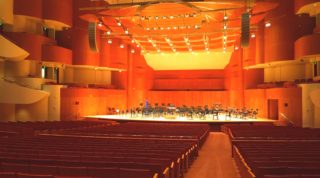
Thankfully, we found a solution when we discovered that one of the city’s most beautiful large concert halls was available — and not only available, but, as it turned out, perfect for its intended event. While some (myself included) might initially envision a doomsday scenario when such potential setbacks reveal themselves, this situation proves that, with careful attention and planning, you can find a solution or workaround for virtually anything.

And now, I end with a confession: this article was originally intended to come out months ago, because we had fully expected to have all of our venues, big and small, completely finalized by the end of the summer. Alas, though we almost made it — we opened the ticket store in October– one venue-less orphan event was responsible for the delay.

That event, surprisingly, was the chamber music concert. At first glance it should have been easy to procure a location: musicians can set up pretty much anywhere, right? Baltimore’s own symphony orchestra recently performed a pop-up concert at nearby Penn Station. And audience capacity shouldn’t have been an obstacle: we only needed seating for a couple hundred (instead of the couple thousand expected for larger events). Dozens of venues in Baltimore fit the bill, but almost all had issues with scheduling or were too far from the hotels. But the real obstacle was the flīģelis (a word I’d never heard before and had to repeatedly look up because I thought our music director had pulled it from a Dr. Seuss book just to mess with me). Few places (including our otherwise-convenient church venue) have a grand piano nowadays, and there are considerable additional costs associated with bringing one in from the outside. With all traditional venues crossed off the list, our quest for a grand piano, or for a nearby space where we could afford to bring in a grand piano, forced us to look outside the box again.

We fell in love with one of these unconventional spaces as soon as we saw it: a whiskey warehouse turned outsider-art gallery, the American Visionary Art Museum is walkable, affordable, and just plain cool. But could we manage the cost and logistics of bringing in a flīģelis? It turns our we didn’t need to worry about it. “Well, sure – we could probably get a grand piano up to the third floor by tilting it on its side in the elevator,” explained the rental manager, “but…  we can also use the baby grand that’s already on that floor.” Sometimes providence truly saves the best for last.

For full descriptions, photos, and maps of festival sites, check out the festival website’s “Event Venues” and “Location” pages. And, of course, you’ll have the opportunity to experience all these amazing venues for yourself this summer in Baltimore.

“The Making of a Dziesmu Svētki” is an ongoing series documenting the behind-the-scenes process of organizing a Latvian song and dance festival.

The XIV Latvian-American Song and Dance Festival will take place in Baltimore, Maryland, from June 29 to July 3, 2017. For more information, please visit www.latviansongfest2017.com or write to info@latviansongfest2017.com.
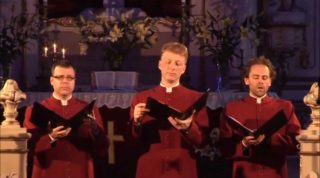
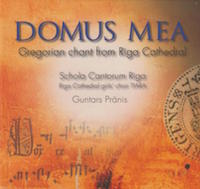
Gregorian chants feature on CD by Riga ancient music ensemble

Schola Cantorum Riga: Domus Mea

Skani, LMIC/SKANI 046, 2016

One of the earliest manuscripts that references music in Riga is the Missale Rigensis (or Riga Missal), a 15th century document that describes church and liturgical life at the Riga Cathedral. The Missal provides an overview of the celebration of Mass throughout the calendar year, and, among instructions and texts, there is also music – the Gregorian chants that were performed during Mass. This can be considered the first evidence of written musical history in Latvia.

Recognizing the importance and uniqueness of this document and the music contained within it, the Gregorian and ancient music ensemble Schola Cantorum Riga, led by Guntars Prānis, have recorded an album of some of the music in the Missal, entitled Domus Mea. As these songs were originally performed in the Riga Cathedral in the 15th century, it is appropriate that this CD was recorded at the same Riga Cathedral, but almost 600 years later. The album was released by the Latvian national record label Skani, which has released many excellent CDs and has raised awareness of talented Latvian artists and composers worldwide.

Schola Cantorum was founded in 1995, and the ensemble mainly focuses on medieval era repertoire, but also performs modern works. The group members on this recording were Jānis Moors, Aigars Reinis, Jānis Kurševs, Dainis Geidmanis, Ansis Klucis, Kaspars Milaševičs, Mārtiņš Moors and Jānis Rožkalns.

The CD contains two cycles of works, the first being the 13 part Missa in Dedicatione Ecclesiae and the second the five part Varia in Assumptione Beatae Mariae Virginis & In Dedicatione Ecclesiae. Missa in Dedicatione Ecclesiae is a mass for the celebration of the dedication of a new church, and it combines both elements from the Riga Missal as well as other chants of that era.

Though Gregorian singing is, by its very nature, relatively simple and plain (that is, these spiritual works are not meant to be flashy), there is an art to making this kind of music. Its simple nature still contains many different emotions and thoughts – worship, faith, praise, even fear. Schola Cantorum Riga bring out the many facets of these chants that are more than half a millennia old – making them as vital and as vivid as they were 600 years ago.

The Riga Cathedral Girls’ Choir Tiara, conducted by Aira Birziņa, joins the ensemble on two of the recordings, and the Gregorian singing is balanced by the girls’ choir, revealing additional layers in the sacred texts and making for a particularly unique performance.

Prānis also adds an extra dimension to some of the performances by adding the hurdy-gurdy – a medieval era crank-turned string instrument that was originally intended as a tool to teach monks to sing. Its single voiced sound adds a haunting and somber element to the music in the chants such as ‘Agnus Dei cum tropo’ and ‘Fundata est’.

The CD booklet contains extensive notes on the works and Gregorian singing by Prānis (who is also a PhD in Gregorian singing), as well as notes on the performers, in Latvian and English. The booklet also has all the texts to the chants, with the original Latin texts translated into Latvian and English. Still, the English translation has inconsistent translations for ‘Rīgas doms’, the correct ‘Riga Cathedral’ appears, but also the incorrect ‘Dome Cathedral’ (which is incorrect, if only because the cathedral doesn’t actually have a dome).

Schola Cantorum Riga reconfirm that they are one of the premiere early music ensembles with the release of Domus Mea, a release that is not just of high quality, but of historic value, as it contains some of the earliest music written in Latvia. It is an authentic and faithful recreation of the music of that era, and the recording in the Riga Cathedral gives the music an added spirituality and sacredness, confirming that this music, comparatively simple chanting, is eternal and always relevant. Director Guntars Prānis has establishes himself as an extremely talented and knowledgeable Gregorian music interpreter, and, together with the exceptional singers in Schola Cantorum Riga, has made a memorable record of early sacred music in Latvia.

For further information, please visit the Schola Cantorum Riga website.

schola-cantorum-riga-domus-mea-001


Egils Kaljo is an American-born Latvian from the New York area . Kaljo began listening to Latvian music as soon as he was able to put a record on a record player, and still has old Bellacord 78 rpm records lying around somewhere.

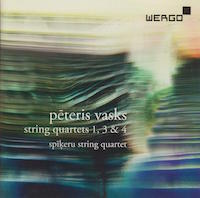
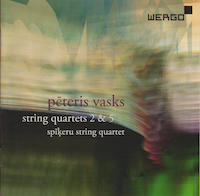
Vasks’ five string quartets now available on 2 CDs

In celebration of composer Pēteris Vasks’ 70th birthday in 2016, many recording projects were undertaken, and among the many such projects, perhaps the most ambitious is the recording of Vasks five (to date) string quartets by the Spīķeru String Quartet.

Released separately on two CDs (the first CD, containing string quartets Nos. 2 and 5 was released in 2015, then the second CD, containing string quartets Nos. 1, 3, and 4 was released in 2016), the works were recorded at the recently built Rēzekne concert hall GORS in the Latgale region of Latvia in 2014.

The Spīķeru String Quartet, who have been performing as a group since 2011, is made up of Marta Spārniņa (violin), Antti Kortelainen (violin), Ineta Abakuka (viola) and Ēriks Kiršfelds (cello). The name of the quartet comes from the fact that their base is the Spīķeri Concert Hall in Riga. The quartet also focuses on the music of Latvian composers in their repertoire, so they were a natural fit to take on the monumental task of recording all of Vasks’ string quartets for the German record label Wergo (who have released many of Vasks’ works on CD).

One of the many aspects that makes recording Vasks’ string quartets such a challenging endeavor is the scope of the works – they were composed over a nearly 30 year period – String Quartet No. 1 was composed in 1977 (though revised in 1997), and String Quartet No. 5 was composed in 2004, and feature many different compositional techniques and approaches. Vasks, whose music is often harsh and is meant to depict suffering, still imbues his compositions with hope, and his string quartets are often intimate and personal, balancing elements of nature, spirituality, and the Latvian spirit. Gathered together, his string quartets are an essential aspect of not just his body of work, but in all of Latvian music, and to perform them requires a group of musicians who are not only talented, but able to convey all of the emotions expressed in his music – and the Spīķeri String Quartet is such an ensemble.

The first string quartet, as it was written in the late 1970s, is perhaps the harshest of all of the quartets, and even though it was written in the period of the Soviet occupation of Latvia, it still has Vasks expressing his view of society at that time (in, of course, as oblique and abstract a way as possible, considering the severe censorship at the time). One might even consider the second movement (Sonata), with its rising tension, to be a kind of counter to the stagnant and oppressive Soviet environment of that era.

Vasks’ String Quartet No. 2 was composed in 1984, and this work displays the themes of nature that so often appear in his works. The quartet is entitled ‘Vasaras dziedājumi’ (Summer Tunes), and the work traces, in musical form, the summer from beginning to end. The first movement is entitled ‘Izplaukšana’ (Coming into Bloom), and its slow, deliberate development presents a picture of blooming nature after a long winter. The Spīķeru String Quartet provides an enthralling interpretation of this work, captivating the listener with their performance of this picturesque movement. The blooming is then followed by the movement simply entitled ‘Putni’ (Birds), where the musicians present the sounds and songs of a wide variety of birds. The sorrowful third movement – ‘Elēģija’ (Elegy), heralds the approaching autumn, and the accompanying sadness at the departure of summer.

More than a decade passed before the appearance of the third string quartet, which was composed in 1995. According to the liner notes of the CD, the theme of this string quartet is Christmas. From the soft and tender touches of the first movement, perhaps reminding the listener of a calm winter night, with candles flickering in the darkness, the sudden burst of energy in the second movement, a kind of celebratory dance, provides a stark contrast. The abrupt end of the second movement then leads to the dramatic third movement, reminding listeners that even during Christmas, one of the most joyous times of the year, there is still much suffering and unhappiness in the world, but this somber note is tempered with the concluding fourth movement, which does resolve this string quartet on a note of hope (and bird sounds again), indicating that all is not lost. The Spīķeru String Quartet takes this work with its many contrasts, and reveals all the many subtleties and nuances throughout.

At more than half an hour in length, Vasks’ String Quartet No. 4, composed in 1999, is the longest of the quartets. The work and its five moments were dedicated to the composer’s mother, who was celebrating her 90th birthday, which inspired the composer to contemplate the entire 20th century in this work. Perhaps due to that dedication, the work has, at times, a sentimental feel to it, a sense of eras that have long passed, particularly the slightly nostalgic first movement ‘Elegy’, which, according to the notes, is meant to convey a view of Latvia in the early 20th century. The concluding movement – ‘Meditation’, one of the most striking sections of all the string quartets, is woven together by the melancholy violin performance, which, as Vasks himself described, is meant to convey the flight of an angel, who views the world with both sadness and hope.

The most recent string quartet – composed in 2004 – is in two parts, with a theme of presence and absence. The first part, entitled ‘Klātbūtne’ (Being Present), is a direct and sharp work, and the Spīķeru String Quartet maintain this turbulence and tension for the entire thirteen minutes of the piece – bringing forth the energy and emotion until the conclusion. The second movement, as in many of Vasks’ works, is an immediate contrast, somber and deliberate. Entitled ‘Tālu prom … tik tuvu’ (So distant … yet near), it is another work that is full of longing and a quiet despair, emotionally rich and textured. As the movement concludes, the strings present a mood of departure, as the music fades, conveying a sense of deep loss.

The CDs come with extensive notes on the composer, the Spīķeru String Quartet, as well as detailed notes and analysis of the works, written by Latvian composer Jānis Petraskēvičs. The notes are presented in both German and English. The label Wergo, which is a division of the Schott Music Publishing company, has produced yet another commendable CD of Vasks’ music.

Recording all five of Vasks’ string quartets, with their varying styles, broad range of themes and emotions, from pure joy to the depths of despair, would be an ambitious and daunting challenge for any string quartet, but the Spīķeru String Quartet has proven themselves not only up to the task, but has presented what might even be considered the definitive performances of these quartets. As the quartets trace the evolution of Vasks’ compositional style throughout the decades, they are perhaps the cornerstone of his body of work, and an essential aspect of Latvian classical music as a whole. These two CDs are not only a testament to Vasks’ stature as one of the greatest Latvian composers, but also to the talent of the Spīķeru String Quartet.

vasks-quartets-1-3-4-001vasks-quartets-2-5-001

Pēteris Vasks String Quartets No. 1 – 5

Wergo WER 7329 2 (Quartets 2, 5), 2015
Wergo WER 7330 2 (Quartets 1, 3, 4), 2016


Egils Kaljo is an American-born Latvian from the New York area . Kaljo began listening to Latvian music as soon as he was able to put a record on a record player, and still has old Bellacord 78 rpm records lying around somewhere.