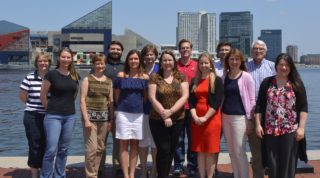
Nineteen months ago, a small group of D.C. area Latvians nervously met up at Lost Dog Cafe, a local pizza and sandwich joint in northern Virginia, and listened to their friend Marisa Gudrā pitch a crazy idea; we should host dziesmu svētki. One week ago, a similarly-sized group gathered around a table at Captain Larry’s, a Latvian-owned bar and restaurant in Baltimore’s Federal Hill neighborhood. We were unwinding after what had been a particularly productive meeting focused on final gametime logistics. It is amazing to think how much has happened in this short time.
I view our journey thus far as being divided into three fuzzy, uneven sections: preliminary planning, initial public involvement, and crunch time. The majority of this series has thus far addressed initial planning, with some forays into initial public involvement. We worked hard to select a city, to find capable personnel to lead projects, to find venues and set a schedule and plan a budget. This period lasted from roughly November through last summer. Once the stars were aligned, we pushed our boulder off the cliff and watched what happened, and things became real as we opened the festival up to the public. For the overall-logistics-based organizing committee, this meant opening up hotel blocks, ticket sales, and fundraising avenues to gauge interest and numbers. For the music committee and folk dancing show organizers it meant opening up choir and dance troupe registration and sending out materials so that the performers could begin a year’s worth of preparations for the big shows. Other organizers who we haven’t discussed yet in this series got their balls rolling, too. Philadelphia’s Inta Grunde and llze Rēķis Bērziņa opened up registration and collected payments from Latvian craftspeople and vendors for the festival marketplace. ALA Office of Cultural Affairs director Līga Ejupe sent out calls for submissions to the festival’s art exhibit. And Boston-based Karmena Ziediņa, director of the festival’s new choreography contest, sent out contest rules and deadlines and waited for the competitors to work on their creations.
With the arrival of 2017, each project’s crunch times began. Vendor sign-up ended for the marketplace, and Grunde and Rēķis Bērziņa turned to the complex tetris game of figuring out how to best pack in the large number of merchant tables. Artist submissions came as a slow trickle for the first few months, then flooded in right before the springtime deadline, and Ejupe got to work planning out logistics of artwork spacing and transportation, and planning for an opening reception. With the first couple months of early ticket sales complete, ticket coordinator Inga Bebris began the gargantuan and often thankless task of mailing paper tickets out to hundreds of individuals. She enlisted the help of her parents, Lolita and Jānis, and especially of their spacious dining room table, and every other weekend the family sat down together for an evening of family bonding and envelope stuffing.
January brought the deadline for new choreography contest submissions. At that point submitted videos and apraksti (step by step dance instructions) were collected into a secret online location and then released back to the competing choreographers and dance troupes, who then were given a set amount of time in which to rate their competitors based on a handful of specific criteria. This score, decided months before dancers step foot in Baltimore, makes up the majority of any dance’s score, with the live show’s small panel of expert judges (whose identity remains a well-kept secret until showtime to ensure no improper influence) only contributing a smaller percentage. Here in these final days of crunch time, Ziediņa is focusing mainly on gametime logistics; meeting with Lyric Opera House staff, finalizing decorations (provided by Broadway set guru Andris Krūmkalns), and working out a detailed day-of rehearsal schedule that allows each dance exactly ten minutes onstage.
Crunch time is also an excellent time to test out our own resiliency. Did early planning make us surefooted enough to roll with punches instead of crumbling? The most dramatic and public test revolves around our theater production. We were understandably nervous when, shortly after deciding to accept the Latvian National Theater with their dark comedy “Ceļā uz Mājām,” we heard news that a different Latvian theater had just had their performance visas denied and had to cancel a U.S. tour. With a determined gulp, Iveta Grava, Aivars Osvalds, and Dace Aperāne committed countless hours and cramped fingers to dotting every i and crossing every t on a mountain of visa application paperwork, yet after splurging on expedited shipping, we received the disappointing news that our actors’ visas were denied. Not giving up, Grava, our theater coordinator, set to work both preparing materials for an appeal, and searching for an emergency backup plan. She found one in Northern California, where the San Francisco Theater Workshop was in the midst of a well-received family-friendly musical “Emīls un Berlīnes Zēni.” When our appeal was denied in the spring, we hit the ground running and announced the program change, bracing for impact from any fallout from angry audience members. No fallout came; most people chose to keep their tickets despite the wildly different shows, and some of the few who did return tickets even instructed us to keep their money instead of issuing a refund. Storm survived! Until we sailed right into a hurricane; the news media in Latvia had caught wind of the visa denial, and suddenly all eyes in Latvia were looking at us in Baltimore. Higher powers intervened, and suddenly the visa denial was reversed. We found ourselves with two separate theater shows in an already packed festival schedule. I wish we could say that we never for a second considered dropping either show, because the more the merrier, but the truth is that we would be irresponsible organizers if we had not stopped to consider the impact of such a boomeranging change on our budget and/or credibility. Still, after extensive group discussions and planning, we managed to keep both shows, and if ticket sales are any indicator, then it appears that our audiences are happy with our decision.
The vast majority of credit involved in navigating this revolving theater situation goes to Grava, but the ripple effect impacted several other aspects of the festival and its organizers. Bebris has had to be extra diligent in working out ticket calculations, and the same goes for treasurer Juris Mohseni (who amazingly happened to be on an off-the-grid vacation in Africa when these events unfolded and returned to find that all hell had broken loose). Marketing team members agonized over how to most clearly present this complicated situation to the public. And other festival events had to be altered, none more so than the Children’s Activities. Originally intended to be three days worth of free drop-in activities for youngsters, the addition of kid-friendly “Emīls un Berlīnes Zēni,” combined with a kid-friendly musical presentation by Latvian folk group Iļģi, cut our three days of playtime to one. Jolanta Stoops, our children’s program director, shows no sign of being bothered, beginning her updates at each committee meeting with, “I’m ready for anything, even if that anything ends up being nothing!”
In case you think Stoops is bored now that her kids’ program has been slimmed down, have no fear. Stoops is also in charge of both Thursday evening’s Pub Night with AKRA, and recently also took on leadership of the PRINTFUL Stage program. In these final weeks leading up to Baltimore, Stoops is busy recruiting performers to sign up for the informal open mic style performances which will take place in the Renaissance hotel’s atrium. Also still recruiting in these final weeks is Volunteer coordinator Aija Moeller. During Phase One Moeller worked out a plan and timeline. During Phase Two all other organizers were instructed to figure out the exact number of volunteers that they might need for each of their events, a number that in many cases keeps fluctuating based on evolving circumstances. Now in crunch time, Moeller has opened up a fantastic online tool, SignUp Genius, and is inviting everyone to donate a couple hours to help make everything run smoothly.
One of the most unfortunately crunched Crunch Time tasks is finalizing the Vadonis (official festival guidebook). During Phase Two, requests went out to hundreds of individuals requesting information for the guidebook in both Latvian and English. These requests included bios and descriptions for festival participants (including not just dance troupes and choirs, but also choreographers, composers, and others), finalized programs for every festival show, formal letters from various community leaders, and various informative articles, not to mention administrative information such as festival schedules, lists of donors and organizers, and a hearty selection of advertisements. Each word of this material needs to be proofread, and while efforts were made to get as much information as early as possible, the reality is that for many folks this information either hasn’t been fully known until recently, or it is frankly the sort of task that falls through the cracks. For weeks, content editor Aija Celms-Evans and layout editor Silvija Ozols have been poring over every page and word to prepare the 170-page long booklet in time for publication. In addition to the Vadonis, organizers are also preparing a Pavadonis (brochure-sized mini guidebook), as well as concert programs, all of which are now due for printing.
It seems impossible to count the remaining odds and ends of tasks that creep up in these final weeks and days. There are final arrangements with hotels, attempts to nail down final participant lists for various venues and events, final details being etched out regarding potential transportation, final organizer schedules to work out, final- well- final “everything,” really. But the amazing thing that it is difficult to wrap our brains around is the fact that these things we are still working on, they are actually the final things, the things that are supposed to be happening at this point, and while we are as busy as ever, we are by no means scrambling. And in just three weeks, we will be past final. We will be done. Seeya in Baltimore.
“The Making of a Dziesmu Svētki” is an ongoing series documenting the behind-the-scenes process of organizing a Latvian song and dance festival.
The XIV Latvian-American Song and Dance Festival will take place in Baltimore, Maryland, from June 29 to July 3, 2017. For more information, please visit www.latviansongfest2017.com or write to info@latviansongfest2017.com.