Līgo collection sounds a tad too contemporary

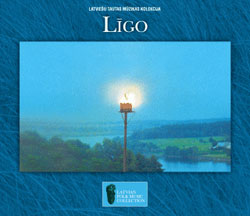
Līgo, the latest compact disc in UPE Recording Co.‘s Latvian Folk Music Collection doesn’t sound like the Jāņi celebration I was at earlier this summer. Of course, the basic songs and the “līgo” refrains would have fit in. But this recording is more of an exercise in musical arrangement, more of an “art recording” by former Iļģi member Zane Šmite, Ilze Grunte and Mārtiņš Tauriņš.

Jāņi is the Latvian summer solstice celebration—the longest day and shortest night of the year—and “līgo” is the typical refrain of the summer solstice songs. “Līgo” means a type of swinging or swaying, also in the sense that in early summer everything in nature, as well as human activity, is “in full swing.” Jāņi tends to be a boisterous and exuberant celebration. But there is also a mystical side to Jāņi that often goes unnoticed: the quiet miracle of nature in full bloom and a yearning to become a part of it. It seems that this CD has tried to capture some of that mysticism, by way of modern arrangements of ancient folk tunes.

The CD begins with birds chirping and softly sung verses proclaiming that Jāņi is the holiest day of the year. This reverie is interrupted by a horn announcing the arrival of the loud neighbors and jāņabērni (Jāņi celebrators). The second and third songs are again quieter. Grunts and overtone singing make the fourth song, “Jāņu nakti nepazinu,” very masculine, almost macho. The next song, “Uz avotu līgot gāju,” has an easy-listening sound to it, while “Teku, teku” makes beautiful use of echoes. (Or is it a round? It’s hard to tell, but the result is entrancing.). Whispers and heavy breathing give “Sijāju uguni” a slightly disjointed sound. It is followed by an unruly version of the song-game “Dimdaru, damdaru.”

Līgo ends with one of my favorite Jāņi melodies. Against a background of static-like rain and with understandable tiredness in her voice—because it is a tradition to stay awake all night at Jāņi—the singer sings a farewell to Jānis, the namesake of the celebration, and tells him that everyone will be awaiting his return next year.

Mostly guitar, bass and nature sounds accompany the stylized songs of Līgo. If they are all, in fact, traditional melodies, then some of them are well hidden in the arrangements. As always in the Latvian Folk Music Collection, the liner notes provide the full text and translation for every song.

With nature at its fullest and all of the festivities taking place outdoors, Ive always felt like singing loudly at Jāņi. That’s why at first the mostly reserved manner of Līgo seems kind of out of place. That said, the CD does have that mystical feeling and is pleasant to listen to, although some may wonder whether it’s a bit too contemporary to be included in a collection of folk music.

Details

Līgo

Latviešu tautas mūzikas kolekcija

UPE Recording Co.,  2003

UPE CD 047
Skandinieki recording is very infectious

Skandinieki

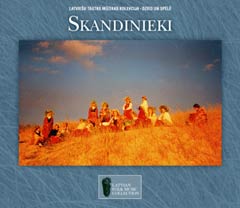
I was flying back to the United States from Latvia for Christmas, and wanted to pick up some gifts for my parents. I saw the new Skandinieki compact disc, Dzied un spēle Skandinieki, and bought a copy. Although I enjoy a good folk song every now and then, overall I am not a fan of the genre. I wasn’t expecting much from this CD, but since I had a long flight, I gave it a listen. I must have liked it, because as soon as I got back to Latvia, I bought a copy for myself. Though it is in the traditional folklore vein, there is enough good stuff on this CD for me to strongly recommend it to anyone, even those outside of the folklore connoisseur set.

Skandinieki is a collective of singers and instrumentalists (a total of 23 are credited on this recording) that marked its 27th anniversary last November. The core of Skandinieki is the Stalts family. Dāvis, Helmi, Julgī, Marga and Ričards Stalts perform on this CD. Of note is that the Stalts are of Liv descent. Though their numbers have fallen through the years, the Livs are still alive and well in Latvia. The 30 songs contained on this CD cover all aspects of folklore, with beautiful singing and melodies, some of them in Livonian.

Most of the songs are sung a capella, but there is occasional musical accompaniment. Unfortunately, the liner notes don’t detail who plays what, or even what kind of instrument is being played.

Favorites on the album include the opening song, “Gauži raud saulīte,” which is about the sun crying its eyes out over a golden apple falling from an apple tree—among other things. The singer tells the sun not to worry about it, as God will make another one. It’s a truly beautiful way to begin the recording and, I’m not sure why, but this song gets me all weepy whenever I hear it.

Another beautiful song is “Kam, muomeņ, tu audzēji,” in which the narrator chastises her mother for growing a birch tree in the yard, because a potential suitor caught her napping by it in the middle of a day.

I also liked “Skaļi dziedu, gavilēju.” It reminds me of one of my favorite songs from when I was in the London Latvian Choir, “Aurēdama vēju māte.” Both songs have similar melodies and each verse begins with the “teicējs” singing the first line with the chorus joining in afterwards.

Skandinieki sing in Livonian on “Sūr rīnda.” It is interesting that in the liner notes this song is not just translated into English, as is every other song, but into Latvian as well, though it appears that only the first verse is translated. The song is about a girl who apparently has low self-esteem. She asks her mother what to do: all the pretty girls are standing in a line, but where should she stand, being “unattractive.” Unfortunately, because the second verse is not translated, I don’t know how the story ends. I especially enjoyed the interesting instrumentation on this one, with what sounds like an accordion, some kind of guitar, and a recorder-like instrument.

And fear not, droning fans, there is some droning for you here, too. For example, on “Tumsināja,” for those of you who can’t sing, you can drone that “ēēēēēē” to your heart’s content! The occasional droning song does not decrease my enjoyment of this CD, as it helps provide a more “complete” folklore picture.

Skandinieki has done an admirable job of bringing these songs to life, and keeping alive not just Latvian folk songs, but Livonian as well. This CD truly captures the simple joy of singing, and it is very infectious.

Details

Dzied un spēlē Skandinieki

Skandinieki

UPE Recording Co.,  2003

UPE CD 049

Where to buy

Purchase Dzied un spēlē Skandinieki from BalticShop.

Note: Latvians Online receives a commission on purchases.

Egils Kaljo is an American-born Latvian from the New York area . Kaljo began listening to Latvian music as soon as he was able to put a record on a record player, and still has old Bellacord 78 rpm records lying around somewhere.

Nicol’s vocals soar, no matter the musical style

Melns un balts

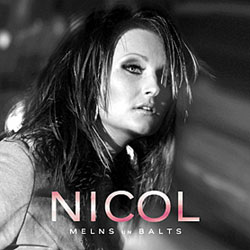
Once upon a time I was used to the idea that the Latvian music world would take a while to get the hang of more mainstream popular music genres. Then, while in Latvia in December, I heard Nicol’s “Melns un balts” play on the radio. The song immediately caught my attention, and I wondered: since when did Latvian R&B exist? How did it come off sounding so good? Who is this singer? I personally don’t listen to R&B artists that often, much less favor them. I was even a bit embarrassed to admit that I liked “Melns un balts.” Since then I’ve listened to her album countless times and have overcome my embarrassment to the point that, when I’m sure no one else is around, I sing along.

Nicol just recently made her debut as a professional singer. Before releasing her newest album Melns un balts in November 2003 (her first Latvian album, preceded in August by a three-song “single” and a full-length album, both mostly in Russian) she sang in clubs, won an award in a new artists’ competition in 2000 in Belarus, and was a finalist in Latvia’s 2002 Eirodziesma competition with her self-written “One More Dance,” according to MICREC’s Web site.

It turns out the album Melns un balts isn’t an R&B album, but rather a mixture of R&B, pop, dance and sometimes a hint of 1980s rock. For me, the first time listening to the compact disc was spent complaining. Eventually I did become used to the overall feel of the album—after the 30th or so time playing it, the music seemed totally normal. Why had I been complaining?

The beginning of the first track on the album, “Noktirne,” reminds me of any song from Vivo, a 2001 album of works composed by Uldis Marhilevičs (released by UPE Recording Co.): footsteps on a gravel path and distant-sounding, airy music. Definitely not R&B. But it’s not a bad sound, either, so I kept away from the “skip track” button and continued listening. The second track, “Ja būsim kopā,” isn’t too bad, either. The lyrics to this song are written by Nicol. Actually, out of the 26 songs on her three albums, Nicol has written the lyrics for 12. This, as far as I know, is also rather atypical of an R&B artist. It’s admirable.

Realization sets in quickly: Nicol, point blank, can sing. I can understand, for the first time, why she has been called “Latvia’s Christina Aguilera.” Nicol’s vocals soar (she took opera lessons in high school), no matter the style of music she’s singing. She easily adapts to the genre of the individual song: soothing ballad, upbeat pop, and offbeat or syncopated R&B. There are neither harsh breaks in her voice as she belts out lyrics in the more intense tracks, nor are there overly sugary stretches in the calmer melodies. It’s a balance that’s refreshing to hear.

The third track is the popular “Melns un balts.” R&B all the way, it’s a very catchy “in your face” song about a failed relationship and finding independence. This track and I had a bumpy beginning. At first I liked it. Then I was frustrated at how much more striking it would have been had there been a heavier bass beat and less synthesizer. The beginnings of a truly captivating R&B song were there, but I still felt empty after listening to it. Now we’re friends again, and the lyrics often stay in my mind: “…Un tad Tu man teici, ka viss būs savādāk / bez pārsteigumiem / bez baltiem ielūgumiem / bez kompromīziem un velns / nav nemaz tik ļauns un melns…”

Go ahead, hit the “back” button, listen to the song again. As lame as it may sound, it’s fun to hear Latvian lyrics set to R&B music.

Later on the album hits some tough spots. While listening to track six, “Pieskaries man,” all I could think of was Sweden’s disco-pop group Ace of Base.

The final track is “One More Dance.” The lyrics sound rushed, but the music and vocals somewhat make up for what ends up being a choppy, grammatically sinful song. The lyrics are choppy, the spelling in the insert appears to be incorrect, and if you pay attention too much, the song makes little sense: “…put your hands around me / ‘couse it feels so right / I wanna be surrounded / with your love tonight / if that’s for one night stand / you’re moving fast / don’t forse me make an and / and turn this dance into last…”

Word for word, from the insert. I see Nicol as another artist who should either stay away from singing in English, or have a text editor who knows what he or she is doing. The Latvian lyrics make sense, of course.

One of my favorite tracks other than “Melns un balts” is track four, “Aiziet vieglāk,” which is a beautiful and soulful song, but doesn’t hold back any of Nicol’s amazing vocals. She manages to work a few belt-outs in there. Another favorite is track 10, “Dzīvoš’ ilgi, ne tik ilgi.” It’s a Latvian folk song put to modern music. The overall effect is kind of eerie, quite unlike the folk song remakes of such artists as the girl group 4.elements and the long-gone techno-inspired Saule.

All in all, I’m surprised and pleased at what Nicol has to offer, and I look forward to her future projects.

Details

Melns un balts

Nicol

MICREC,  2003

MRCD 232