The Latvian American group Čikāgas piecīši, throughout their career lasting more than half a century, are one of the most recognizable and significant Latvian ensembles in history. Their songs and performances were popular not only with exile and diaspora audiences, but they also resonated with listeners in Latvia during the Soviet occupation. Their enduring popularity shows no sign of fading, even as the group is no longer as active as in the past.
The group’s core member is founder, vocalist, guitarist and songwriter Alberts Legzdiņš, who has steered the group throughout its more than fifty year career. Legzdiņš has also written a book about his experiences with the Piecīši, and that book – Čikāgas piecīšu brīnišķīgie piedzīvojumi – originally released in 1993 by SIA NC – was re-released in 2014 with a few small updates.
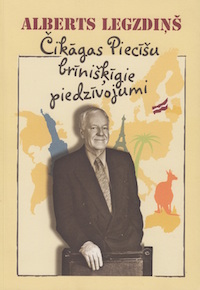
The book chronicles the group’s founding in Chicago in 1961 and their experiences on major tours of the United States, Australia, and Europe, and concludes with their triumphant tours of Latvia in 1989 and 1991. Along the way there are many anecdotes and amusing stories about the various successes and mishaps along the way.
Among the many reasons for it being notable, the book could also be considered a chronicle of what some might consider to be the ‘golden age’ of the Latvian exile community – the 1960s – in that during those years just about every city of at least a medium size had an active Latvian community. Their first major American/Canadian tour in 1963 brought them to Chicago, Denver, Los Angeles, San Francisco, Portland, Seattle, Vancouver and Winnipeg – difficult to arrange for an ‘amateur’ group who had to juggle tours with the demands of full time jobs. Reading this book today it seems almost inconceivable the level of activity and interest, considering how small the diaspora Latvian community has become in the subsequent decades.
Also fascinating is Legzdiņš’ 1970 visit to occupied Latvia to meet with relatives and determine the possibility of arranging a Čikāgas piecīši concert in Latvia. Understandably, no one wants to talk to him on the phone, and there is also his attempt to call his wife in the United States, telling the operator that he ‘wants to talk to America’ and the response is ‘Don’t we all?’ and gets hung up on. Unfortunately, for various reasons, it still is almost two decades before the Piecīši can perform in Latvia. The book also delves into the controversy surrounding visits to Latvia by exiled Latvians in the 1970s, and the frequent harsh assaults on those that did.
From reading the book, a particularly amusing aspect is that Legzdiņš made sure to note just about every meal he had along the way! Smoked salmon in Seattle, oversized meatballs in Melbourne, and smoked eelpout (lucīši) at the Latvian National Theater (which only Legzdiņš could bring himself to eat), to mention but a few.
The book is a breezy read, full of the typical Piecīši wry humor. Mishaps abound, with other strange and interesting events occurring – the time spent in Fiji on their way to Australia, the shark warning in Bondi, Legzdiņš tripping over Ilmārs Dzenis’ double bass during a show in Toronto, and many other comic events. The occasional typo notwithstanding (the inconsistent ‘Latvianization’ of names – Jack Benny does not change, but then Red Skelton becomes ‘Red Skeltony’ and Milton Berle ‘Milton Berli’), the language flows easily and the stories are always engrossing .
Still, to call this an ‘updated’ edition is a bit of a stretch. The updates are new introductions by journalists Ina Eglīte and Ēriks Hānbergs and new afterword by Legzdiņš, altogether less than ten pages. In fact, this rereleased version is almost 100 pages shorter than the original version! The original release had a number of newspaper and magazine articles, interviews, commentaries by other group members, as well as quite a lot of other information that supplemented Legzdiņš’ story. Granted, the extra material made the narrative somewhat disjointed in the original release, but the extra information made for a more comprehensive read and provided a better understanding of why exactly the Čikāgas piecīši became such legends not just in North America, but in Latvia and the rest of the world as well. This large deletion of material is unfortunate.
Along those same lines, from reading the book, the impression is that the group has not really done anything of note in the last twenty years (the narrative stops with their 1991 tour of Latvia) – barely any mention of further tours of Latvia and elsewhere, the success of the musical play Eslingena (where Legzdiņš provided the music), and their 50th anniversary tour in 2011 (though, granted, this was covered by the documentary film Par mani, draudziņ, nebēdā, available on DVD). Even though it can be argued that the pinnacle of the career of the Piecīši came with their 1989 and 1991 tours of Latvia, it still would have been interesting to hear a bit more about those subsequent years. For those who already have the original release, there is not much new here, but it is still certainly worth reading for anyone that missed the first edition of the book.
In addition to the re-release of Čikāgas piecīšu brīnišķīgie piedzīvojumi , a songbook entitled Hei lailī un citas Čikāgas piecīšu dziesmas 1961 – 2013 (Musica Baltica, ISMN 979-0-69795-286-7) has also been published, and contains more than 100 of their songs, including many obscure and unreleased songs as well. Each song has music and lyrics, including more than twenty different verses of their traditional closing song ‘Hei lailī’ that have been written throughout the years. The book also includes many photographs, band member profiles, and some brief notes on many of the songs.
Čikāgas piecīšu brīnišķīgie piedzīvojumi is a unique and valuable, not to mention often hilarious, story of the best known Latvian diaspora ensemble. It is not just a story about a band, but also a story about the worldwide Latvian exile community. In their travels throughout the world, the Piecīši met with both success and setbacks. Featuring Alberts Legzdiņš’ trademark dry and self-deprecating humor, it is a treat to have this book back in circulation.