In celebration of composer Pēteris Vasks’ 70th birthday in 2016, many recording projects were undertaken, and among the many such projects, perhaps the most ambitious is the recording of Vasks five (to date) string quartets by the Spīķeru String Quartet.
Released separately on two CDs (the first CD, containing string quartets Nos. 2 and 5 was released in 2015, then the second CD, containing string quartets Nos. 1, 3, and 4 was released in 2016), the works were recorded at the recently built Rēzekne concert hall GORS in the Latgale region of Latvia in 2014.
The Spīķeru String Quartet, who have been performing as a group since 2011, is made up of Marta Spārniņa (violin), Antti Kortelainen (violin), Ineta Abakuka (viola) and Ēriks Kiršfelds (cello). The name of the quartet comes from the fact that their base is the Spīķeri Concert Hall in Riga. The quartet also focuses on the music of Latvian composers in their repertoire, so they were a natural fit to take on the monumental task of recording all of Vasks’ string quartets for the German record label Wergo (who have released many of Vasks’ works on CD).
One of the many aspects that makes recording Vasks’ string quartets such a challenging endeavor is the scope of the works – they were composed over a nearly 30 year period – String Quartet No. 1 was composed in 1977 (though revised in 1997), and String Quartet No. 5 was composed in 2004, and feature many different compositional techniques and approaches. Vasks, whose music is often harsh and is meant to depict suffering, still imbues his compositions with hope, and his string quartets are often intimate and personal, balancing elements of nature, spirituality, and the Latvian spirit. Gathered together, his string quartets are an essential aspect of not just his body of work, but in all of Latvian music, and to perform them requires a group of musicians who are not only talented, but able to convey all of the emotions expressed in his music – and the Spīķeri String Quartet is such an ensemble.
The first string quartet, as it was written in the late 1970s, is perhaps the harshest of all of the quartets, and even though it was written in the period of the Soviet occupation of Latvia, it still has Vasks expressing his view of society at that time (in, of course, as oblique and abstract a way as possible, considering the severe censorship at the time). One might even consider the second movement (Sonata), with its rising tension, to be a kind of counter to the stagnant and oppressive Soviet environment of that era.
Vasks’ String Quartet No. 2 was composed in 1984, and this work displays the themes of nature that so often appear in his works. The quartet is entitled ‘Vasaras dziedājumi’ (Summer Tunes), and the work traces, in musical form, the summer from beginning to end. The first movement is entitled ‘Izplaukšana’ (Coming into Bloom), and its slow, deliberate development presents a picture of blooming nature after a long winter. The Spīķeru String Quartet provides an enthralling interpretation of this work, captivating the listener with their performance of this picturesque movement. The blooming is then followed by the movement simply entitled ‘Putni’ (Birds), where the musicians present the sounds and songs of a wide variety of birds. The sorrowful third movement – ‘Elēģija’ (Elegy), heralds the approaching autumn, and the accompanying sadness at the departure of summer.
More than a decade passed before the appearance of the third string quartet, which was composed in 1995. According to the liner notes of the CD, the theme of this string quartet is Christmas. From the soft and tender touches of the first movement, perhaps reminding the listener of a calm winter night, with candles flickering in the darkness, the sudden burst of energy in the second movement, a kind of celebratory dance, provides a stark contrast. The abrupt end of the second movement then leads to the dramatic third movement, reminding listeners that even during Christmas, one of the most joyous times of the year, there is still much suffering and unhappiness in the world, but this somber note is tempered with the concluding fourth movement, which does resolve this string quartet on a note of hope (and bird sounds again), indicating that all is not lost. The Spīķeru String Quartet takes this work with its many contrasts, and reveals all the many subtleties and nuances throughout.
At more than half an hour in length, Vasks’ String Quartet No. 4, composed in 1999, is the longest of the quartets. The work and its five moments were dedicated to the composer’s mother, who was celebrating her 90th birthday, which inspired the composer to contemplate the entire 20th century in this work. Perhaps due to that dedication, the work has, at times, a sentimental feel to it, a sense of eras that have long passed, particularly the slightly nostalgic first movement ‘Elegy’, which, according to the notes, is meant to convey a view of Latvia in the early 20th century. The concluding movement – ‘Meditation’, one of the most striking sections of all the string quartets, is woven together by the melancholy violin performance, which, as Vasks himself described, is meant to convey the flight of an angel, who views the world with both sadness and hope.
The most recent string quartet – composed in 2004 – is in two parts, with a theme of presence and absence. The first part, entitled ‘Klātbūtne’ (Being Present), is a direct and sharp work, and the Spīķeru String Quartet maintain this turbulence and tension for the entire thirteen minutes of the piece – bringing forth the energy and emotion until the conclusion. The second movement, as in many of Vasks’ works, is an immediate contrast, somber and deliberate. Entitled ‘Tālu prom … tik tuvu’ (So distant … yet near), it is another work that is full of longing and a quiet despair, emotionally rich and textured. As the movement concludes, the strings present a mood of departure, as the music fades, conveying a sense of deep loss.
The CDs come with extensive notes on the composer, the Spīķeru String Quartet, as well as detailed notes and analysis of the works, written by Latvian composer Jānis Petraskēvičs. The notes are presented in both German and English. The label Wergo, which is a division of the Schott Music Publishing company, has produced yet another commendable CD of Vasks’ music.
Recording all five of Vasks’ string quartets, with their varying styles, broad range of themes and emotions, from pure joy to the depths of despair, would be an ambitious and daunting challenge for any string quartet, but the Spīķeru String Quartet has proven themselves not only up to the task, but has presented what might even be considered the definitive performances of these quartets. As the quartets trace the evolution of Vasks’ compositional style throughout the decades, they are perhaps the cornerstone of his body of work, and an essential aspect of Latvian classical music as a whole. These two CDs are not only a testament to Vasks’ stature as one of the greatest Latvian composers, but also to the talent of the Spīķeru String Quartet.
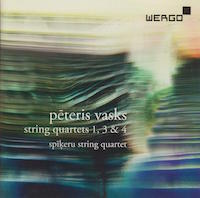
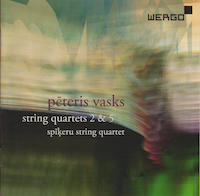
Pēteris Vasks String Quartets No. 1 – 5
Wergo WER 7329 2 (Quartets 2, 5), 2015
Wergo WER 7330 2 (Quartets 1, 3, 4), 2016