Jumprava’s hits are hits once more

Labāko dziesmu izlase

One of the veteran and most well-known groups of the Latvian rock scene are Jumprava, who have been recording and releasing albums since the 1980s—and creating many recognizable Latvian hits along the way. Popular songs include “Baltā” and “Peldētajs,” which achieved first place in the Mikrofons song competitions in 1990 and 1991, respectively. And the recently released retrospective album Labāko dziesmu izlase is a hit as well, selling many copies and introducing and re-introducing many to the songs of Jumprava.

To be honest, I have not heard much of Jumprava’s work and am not very knowledgeable of their history. I know that they have released many albums over the course of their career, but the only album besides this one that I am familiar with is the 1998 release Laika atšķirību romance (which was a great album, by the way). But listening to Labāko dziesmu izlase I realized how many of their songs I was familiar with. Not only had I heard the aforementioned “Baltā” and “Peldētajs,” but I had heard the song “Lietus” from the Mikrofons 89 collection, as well as the song “Ziemeļmeita,” which can be found on the obscure Melodiju stafete Nr. 8 record, released in 1988.

This is not the only Jumprava collection available; a compact disc of their earlier work, Jumprava 88/90 has also been released. The song selection on Labāko dziesmu izlase and Jumprava 88/90 are very similar, as there are eight songs that are the same between the two collections (actually, two of the songs from the 88/90 collection have been remixed for the Labāko album.)

The best way to describe Jumprava’s music is “keyboard rock,” as the dominant instrument in almost all of the songs on this album is the keyboard. That’s fine, but it would be nice to hear more guitar sometimes! Regardless, the selection of songs show a Latvian group at the peak of its songwriting ability.

The collection also borrows heavily from the 1998 release Laika atšķirību romance, as there are five songs from that album—which is not at all a bad thing! One of my favorite Jumprava songs is “Pastorāle”, with a great keyboard intro, a very catchy chorus and the haunting voice of Marija Grauba that closes out the track. Other favorites from Laika atšķirību romance are “Ēna” and “Jaganatha,” both of which reappear on the latest release. “Jaganatha” features an Indian feel and, like “Ēna” and “Lēna upe,” is based in part on the work of Nataradža.

One of the questionable inclusions from Laika atšķirību romance is “Auto.” Besides not being a particularly good song, it includes yet another example of why some Latvian groups should avoid writing lyrics in English: “This is my servant and this is my car, I want to drink and I drive to the bar.”

The older songs withstand the test of time well. The quirky hit “Peldētajs,” details the story of someone who swims the crawl stroke on his back from Ventspils to the island of Visby (a rather long distance!). This song references the movie Peldētajs, apparently the same as the 1981 Soviet film Plovets by director Irakli Kvirikadze.

“Lietus” is another great song, written at a time when the movement for Latvia’s independence was getting louder and stronger. It appeared on the Mikrofons 89 collection, on which practically every song was about the topic of freedom, renewal and unity. The singer’s sentences about what pains him are written in chalk on the street, but are washed away by the unending rain.

The two newly remixed songs, “Šeit lejā” and “Vēl jāgaida” are nothing special. I have not heard the original version, so I cannot compare them, but the remixing has not added much to the song.

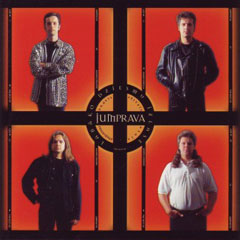
Thankfully the packaging contains the lyrics to all the songs (although the printed lyrics are not in the exact order as they appear on the CD, which is slightly annoying), but not much else. It identifies the band members on the front cover, but doesn’t specify what instruments they play. It would also be nice to know when the song was recorded, as well as what album it originally appeared on, but those are just minor complaints.

Overall, it is a great CD, both for those who are unfamiliar with the work of Jumprava and need a good introduction to them, as well as to those who are familiar with their work, as it collects all of their best songs onto one CD.

Details

Labāko dziesmu izlase

Jumprava

Platforma Records,  1999

PRCD 027
Egils Kaljo is an American-born Latvian from the New York area . Kaljo began listening to Latvian music as soon as he was able to put a record on a record player, and still has old Bellacord 78 rpm records lying around somewhere.

Son’s music tribute is good, mixed bag

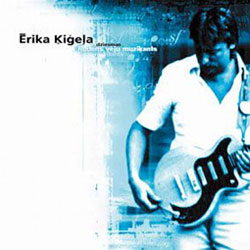
On Rudens vēju muzikants Feliks Ķiģelis, the son of the late Latvian rock composer Ēriks Ķiģelis, brings together an all-star group of Latvian musicians to pay tribute to his father and his music.

Ēriks Ķiģelis was the guiding light behind the famous Latvian rock group Līvi. Up until his untimely death in 1985, he was the main composer for the band. His musical talent is apparent in many well-known Latvian songs including “Zīlīte”, “Saldus saule”, “Aprīļa pilieni” and “Kurzemei – Saules ceļš”—a song that, although he did not live to see it completed, was finished and presented on 1988’s self-titled Līvi album.

Ēriks was a great influence on many Latvian acts. Not only can his spirit still be found in the recent records of Līvi, but, judging by the varied performers found on the Rudens vēju muzikants collection, he has influenced many other rock and pop performers. Famous names such as Igo, Gvīdo Linga, Guntars Račs and past and present members of Līvi have come together to pay tribute to Ēriks and his music. The testimonials from many famous Latvian names contained in the compact disc booklet attest to his great influence. It was a great loss to Latvian rock music when he died.

However, this is not the first tribute record to Ēriks Ķiģelis. The 1997 Līvi album Bailes par ziņģēm was dedicated to his memory and included many re-recordings of Ēriks’ songs. It would seem inevitable that Rudens vēju muzikants would inspire comparisons to Bailes par ziņģem as there are five songs that can be found on each record.

I have heard very little of Ēriks Ķiģelis’ original works. The only song that I have heard the original version of was “Zīlīte,” included on the Mikrofons 1982 collection, so I am unable to compare these versions to the originals (except for the posthumously recorded and released “Kurzemei – Saules ceļš”). Hopefully this record will generate enough interest in Ķiģelis that MICREC can dig into its vaults and re-release all of the old recordings by Ēriks, since as far as I am aware, they are not available anywhere. That’s a shame, because by listening to the songs on Rudens vēju muzikants one can tell that Ēriks was a great musician and songwriter who was taken away too quickly.

As with many of the Latvian compilation and collection CDs, the results are a mixed bag. While there are many strong tracks, there also are tracks that do not live up to expectations. However, there are enough songs on the album to make it a worthwhile purchase to those unfamiliar with Ēriks Ķiģelis and his work.

Rudens vēju muzikants starts off with a rousing instrumental—“Mazais sapnītis”—which teams up Feliks Ķiģelis with current Līvi guitarist Ainars Grodums, who makes many appearances on the album. On “Mazais sapnītis,” as well as every song on the album, Feliks plays guitar.

Gvīdo Linga adds his vocal talents to “Elektriskā zivs,” which is followed by Igo taking over the vocal responsibilities on “Istabā tumsā” (with distorted vocal effects, no less!). “Zušu sziesma,” featuring Māris Žigats on vocals, is one of the weaker entries on the album, as it tries a funkier approach to the song, but the desired effect is not achieved—and the vocals are nothing special.

The strongest track on the album is “Deviņvīru spēks”—which is one of the sections of the previously mentioned Līvi epic “Kurzemei – Saules ceļš.” Aivars Brize, the ex-lead singer for Līvi, as well as the original vocalist for the song, returns to replay the piece in all of its original heavy glory. This time, the song is given an electronic feel, which strengthens it and perhaps makes it superior to the original recording. “Deviņvīru spēks” is one of my favorite Līvi songs, mainly due to the great guitar part, as well as the great riff that opens up the song.

Another Līvi member, current guitarist and lead singer Ainars Virga, returns to sing (well, growl would be the better word!) and play bass guitar on the song “Durvis,” another less memorable track on the collection. “Svētelis,” one of my favorite Ķiģelis songs, is assisted by Inguss Ulmanis on vocals and by Guntars Račs, famous Latvian producer, on drums, who also appears on “Zīlīte,” the next track. “Zīlīte” is the only song on the album that features a female vocalist, Agnese. Her vocals add greatly to the song and make “Zīlīte” another standout track on the album.

Zigfrīds Muktupāvels appears on “Kurzeme,” which, although a good song, does not really differ from the original much. Gunārs Kalniņš appears on the song “Kursas putni,” and Feliks Ķiģelis himself takes over vocal duties on my all-time favorite Ēriks Ķiģelis song, “Saldus saule.” Though Feliks has a great voice, the rather slow tempo he takes with the song gives it a plodding feel.

The verdict? Well, I believe Bailes par ziņģēm is the stronger record and perhaps a better introduction to the works of Ēriks Ķiģelis. However, hearing other artists’ interpretations of Ēriks’ works is worthwhile. It would have been nice to have the song lyrics as well. For those who might have heard and enjoyed Bailes par ziņģēm, I would recommend this record. I would also recommend this record for those who enjoy Latvian rock music, as it is a solid effort, though not very memorable.

Details

Rudens vēju muzikants

Ēriks Ķiģelis

MICREC,  1999

Egils Kaljo is an American-born Latvian from the New York area . Kaljo began listening to Latvian music as soon as he was able to put a record on a record player, and still has old Bellacord 78 rpm records lying around somewhere.

Classic Pērkons still thunders on CD

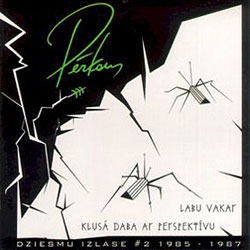
One of the all-time classic Latvian rock groups must be Pērkons, which has been releasing albums for more than 15 years. Thankfully for all of the many Pērkons fans, MICREC has released two compact discs with many of the group’s top songs. The most recent is Dziesmu izlase #2, 1985-1987.

In the summer of 1990, I had the good fortune to be able to participate in a Latvian music camp in Canada. The camp was organized by the renowned Latvian-American musician and composer Dace Aperāne, and Latvian musicians came from all over the world to participate. Among the musicians invited was Juris Kulakovs, the keyboardist and music composer for the famous Latvian rock group Pērkons.

Working with such a respected musician was quite the thrill. I wasn’t too familiar with the music of Pērkons at the time, having only heard one song, “Zaļā dziesma,” off the classic Mikrofons 88 collection. The song still today remains one of my favorite Perkons songs, and one of my favorite songs by any Latvian group.

During the closing show of the music camp, all the campgoers joined in and performed “Gandrīz tautas dziesma” with orchestra and choir! Quite an experience.

Around that time, Pērkons had released two of its albums—Labu vakar and Klusā daba ar perspektīvu—in the United States in cassette format and I was able to pick up a copy during the music camp. Though the sound quality of the recording wasn’t the best, and there were a few mistakes in the song listings, this was a tape I would continually listen to ever since.

During a trip to Latvia in the fall of 1998, I picked up the official Latvian cassette release of the two albums—this time with much better sound quality and the correct track listing. And all over again I began to listen to this tape all the time.

And now this collection of songs finally makes the transition to CD format—and what better format to hear these Latvian rock music classics in?

The CD is the second in the Dziesmu izlase series from Pērkons. The first CD, Dziesmu izlase #1, released in 1994, represented the years 1981 and 1982, and this CD represents the years 1985 to 1987. (Editor’s note: MICREC tells SVEIKS.com that “with luck” a third CD might be issued to complete the collection.)

Two songs were lost in the transition to CD—I’m assuming because of the space limitations of the CD format—“Sastrēgumstunda” and “Kā pasakā.” This is unfortunate, because “Sastrēgumstunda” is a favorite of mine.

Dziesmu izlase #2 contains Latvian songwriting and musicianship at its finest. Memorable songs include:

  • “Gandrīz tautas dziesma” with faux folk song lyrics.
  • The aforementioned “Zaļā dziesma,” a song dedicated and written for Greenpeace, showcasing the beautiful soprano voice of Ieva Akuratere.
  • The catchy humor of “Baletomānija,” featuring Kulakovs on his only lead vocal performance, and also Akuratere making a very off-key performance!
  • “Cik pulkstens,” which details the end of a relationship when two people are unable to express their feelings for each other.

Other favorites include “Mana dienišķā dziesma,” “Labu vakar” and “Slidotava”.

Many of the songs are very catchy and the group displays a growing maturity in its songwriting style and lyrics. A few of the longer songs drag a bit. “Lampas un zvaigznes” goes on for a bit longer than it should, and “Neatvadīsimies” is a bit repetitive, but these are just minor criticisms of this excellent CD.

Bonus points for including in the CD packaging all of the lyrics as well as previously unreleased photos of the band. But you have to wonder who was offering the band fashion advice in the photo on the inside back cover!

All in all, a great CD from a great band. Grade: 5 (the highest grade available in Latvian school – for those who might not know!).

(Editor’s note: This article orginally appeared on SVEIKS.com.)

Details

Dziesmu izlase #2, 1985-1987

Pērkons

MICREC,  1996

Egils Kaljo is an American-born Latvian from the New York area . Kaljo began listening to Latvian music as soon as he was able to put a record on a record player, and still has old Bellacord 78 rpm records lying around somewhere.