Māsas proves girls can play

Māsas

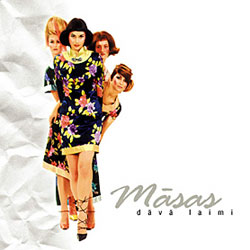
The all-female rock band is a scarce species, but in the past few years one has emerged in Latvia. They are the quaintly named Māsas and their debut album, Dāvā laimi, was released by MICREC in 2001.

The name Māsas is appropriate because the four-member band contains two sets of sisters. Līga Celma is on vocals and guitar, and her sister Daina Celma is on vocals and keyboards. Kristīne Dortāne sings and plays bass, while her sister Ingūna Dortāne sings and plays the drums.

I had heard the song “Dāvā laimi” on the compilation SuperIzlase 2, released in 2001 by MICREC. It is a very catchy, poppy song, and I really liked the lyrics by Līga Celma: “Dāvā laimi, nelaime nāks pati” (“Give the gift of luck, bad luck will come on its own”).

Having only heard that song prior to purchasing this compact disc, I was expecting a recording of mainly pop songs. I was pleasantly surprised to find that this was not the case. The music performed by Māsas is hard to classify. The album contains many different styles, giving it an eclectic feel. This range of styles, as well as strengths in songwriting and performing, makes this CD enjoyable and also stand up after repeated listenings.

Some of the songs even have a jazzy flavor. I especially like “Stacija,” a very pretty song about waiting with a loved one for a train. Another song I liked is “Laidīsimies prom,” a more up-tempo tune.

Another enjoyable aspect of Māsas is their sense of humor. This is evident not only in the photos in the CD booklet (showing the members of the band dressed up in some rather absurd fashions, not to mention a bit too much makeup) but in the songs as well. To close out the album, there’s “Intervija ar skumjo govi,” a song about a sad cow. The song even starts out with band members mooing.

The packaging contains the lyrics to all the songs, which was very nice to have.

Make no mistake about it—this is a band here, not just a collection of four female singers. Songwriting and musicianship are top-notch, leading to an enjoyable CD in Dāvā laimi. Adeptly switching between many different styles over the course of the album, Māsas have created a great collection of songs. For those who still might hold the outdated notion that “girls can’t play,” look no further than this album. Māsas can play with the best of them!

Details

Dāvā laimi

Māsas

MICREC,  2001

MRCD 160
Egils Kaljo is an American-born Latvian from the New York area . Kaljo began listening to Latvian music as soon as he was able to put a record on a record player, and still has old Bellacord 78 rpm records lying around somewhere.

Compilation provides glimpse of early Līvi

Description of image

Even though they are one of the biggest Latvian rock acts, Līvi’s back catalogue has long been out of print. Albums such as Iedomu pilsēta and the self-titled Līvi are available only on vinyl, if at all. And as with many other Latvian artists, not all the group’s early songs were released on proper albums, but appear on multi-group collections such as the old yearly releases from Mikrofons.

Fortunately, Līvi’s older songs are no longer just on scratchy records. The 2002 compact disc release, Līvi Zelts 1, is a compilation of songs from earlier in the group’s career.

This is not the first Līvi compilation. The first was Karogi, a 1994 recording that was one of the first CDs of Latvian music released in Latvia. However, that compilation was incomplete, skipping over the group’s earliest history—the Ēriks Ķiģelis years. Līvi Zelts 1 is a more thorough overview and a welcome historical document of one of the most important Latvian rock groups.

The 18-track album includes one new song. “Vairogi” is a march-like song with lyrics that return to the group’s 1980s patriotic style. The song doesn’t really grab my attention, what with its spoken verses. It’s also a bit out of place, as it is a new piece on a compilation of songs that are all 15 or more years old.

The true “gold” on the album are the songs from the Ķiģelis years, which to my knowledge are released for the first time on CD. A number of these songs were re-recorded for the Līvi album Bailes par ziņģēm, but on this CD you get to hear the songs as they were originally recorded.

Presumably due to the limitations at the time they were recorded, some of the songs have a somewhat rough quality, even scratchy at times. But don’t let that discourage you. Though they may sound a bit outdated, these songs can still be treasured today. One example is the song “Bailes par ziņģi.” The audio quality is less than excellent, but the song itself stands up to the test of time.

One of the most popular of Līvi’s earlier songs is “Zīlīte,” which I first heard on the Mikrofons 82 record. A critic in the music magazine Mūzikas saule called this a “modern Latvian folk song” and I cannot think of a better term. It is certainly one of the classics of modern Latvian rock music.

Also on Līvi Zelts 1 are a few songs from the 1986 album Iedomu pilsēta and the 1988 self-titled album (by which time Ķiģelis had tragically died). A favorite from the self-titled album is “Dzelsgriezējs.” That album also contained one of Ķiģelis’s last compositions, the beautiful “Kad saule riet.”

Perhaps the group’s biggest hit, “Dzimtā valoda,” also is included on this compilation. “Dzimtā valoda” was the most popular song in Latvia in 1985, in part because it is a very patriotic song. Lyrics such as “Vienā valodā raud visi ļaudis” (all the people cry in one language) likely struck a nerve in final years of Soviet Latvia.

The major disappointment in this collection is the packaging. It takes the concept of “let the music speak for itself” to the extreme. What I would have thought to have been a golden opportunity to provide some historical notes and pictures of Līvi throughout the years is wasted on the minimalistic packaging. There isn’t even a booklet, just a list of songs and that is it.

Particularly frustrating is the fact that there is no mention of who was in the band when each of these songs was recorded. Līvi have gone through many lineup changes throughout the years. In some songs it is Igo (Rodrigo Fomins) singing, in others it is Ķiģelis, in others it is Aivars Brīze, and in others I have no idea who! It would have also been nice to have the lyrics.

Packaging aside, this collection of songs from Līvi’s early years is invaluable for any student of Latvian rock music. Great thanks has to be given to MICREC for releasing many songs that until now had been lost in its vaults. Hopefully this signals the start of releasing all of Līvi’s music onto CD. The group has many unreleased tracks and songs that were not on any proper album. Presumably calling this album Līvi Zelts 1 indicates the possibility of a Zelts 2. This CD not just contains some of the greatest Latvian rock music ever written, but also shows the rise of Līvi and how they became one of the most important and beloved bands in Latvia.

Details

Līvi Zelts 1

Līvi

MICREC,  2002

MRCD 194

Egils Kaljo is an American-born Latvian from the New York area . Kaljo began listening to Latvian music as soon as he was able to put a record on a record player, and still has old Bellacord 78 rpm records lying around somewhere.

CD offers overview of composer Stabulnieks

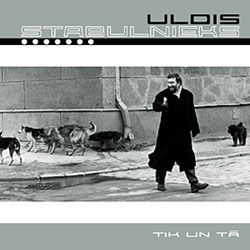
Tik un tā

As a young devourer of all things musical, I was fortunate that my family had friends in Latvia who would send us many of the latest recordings. One of my favorite releases was Mikrofons 81, which covered the best songs of 1980, including “Dāvāja Māriņa” by Raimonds Pauls, “Princesīte” by Kaspars Dimiters and “Zelta dziesma” by Ivars Vāgners, among many others.

One song that was a favorite of mine was “Tik un tā” by Uldis Stabulnieks. The song is the title track of a recently released compilation of Stabulnieks’ work, the fifth in MICREC’s series, “Latviešu populārās mūzikas izlase.”

Though a mellow song, “Tik un tā” stayed with you due to its simple melody sung by Stabulnieks, as well as the lyrics by Māra Zālīte, which were borderline patriotic (with words like “Mums viņa ir visskaistākā, tik un tā,” or, “Just the same, to us she (Latvia) is the most beautiful”)—still a bit of a no-no in 1980.

According to the Latvian music magazine Mūzikas Saule, “Tik un tā” was the most popular song of 1980 and should have been awarded first prize, instead of that year’s winner, “Dāvāja Māriņa.” Tough call for me, as “Dāvāja Māriņa” is just about my favorite Pauls song. I can see how it could be close. Besides, a rigged election in Soviet Latvia? Say it ain’t so!

Because most of the songs from that era have not been available on compact disc, and I don’t go that frequently into my vinyl archives, “Tik un tā” faded from memory as the years went by. But upon hearing that MICREC had released a comprehensive collection of Stabulnieks’ best works on a CD simply titled Tik un tā, I picked it up on a trip to Latvia.

Prior to buying the CD, I only knew the title track. I had no idea what to expect from a full CD (70-plus minutes) of 25 songs by Stabulnieks. I am glad I bought it, because it is full of original and catchy songs.

Stabulnieks composed all of the music on this album and he sings on almost all the songs. The bulk of the songs on this CD were taken from his two LP records,  Tik un tā (1985) and Svētki daudzskaitlī (1986).

An unexpected but very pleasant surprise was learning that “Tik un tā” was not the only song I knew by Stabulnieks. A song that was a favorite of mine in my pre-teen days, but since then had been forgotten, is “Solījums.” I had originally heard this song on the Mikrofons 82 record, but I had not known that it was performed by Stabulnieks. The song again shows his ability to write an appropriately beautiful melody to match beautiful lyrics, this time by P. Zirnītis. Though it is a simple love song, the words are quite moving.

The variety of styles contained on this CD also shows Stabulnieks’ versatility. Whether it is the Middle Eastern-tinged “Alibeka” (written for the Leļļu teātris), or the folksongy “Dziesmiņa par buciņu” (from the theatre production Aug buciņš, lauž radziņus), or the satirical “Dziesmiņa par diplomātiju,” or the comedic “Ananās” (from the musical comedy Svētki daudzskaitlī), Stabulnieks is adept at writing the appropriate music to fit the lyrics and the mood.

The variety of styles on the CD does detract from the flow a bit. I’ve also never been a fan of overly liberal use of strings in pop songs, but where the strings are used in Stabulnieks’ songs, they are tastefully done.

Some of the songs also have a Raimonds Pauls influence, mainly due to some of the lyrics being written by frequent Pauls collaborator J. Pēters, as well as Margarita Vilcāne and Ojārs Grīnbergs showing up to sing on “Margarita” and “Zirgu tirgus.”

The booklet that comes along with the CD reprints the original liner notes that came with the Tik un tā vinyl record, as well as a new write-up by Gunārs Freidenfelds, both of which provide for some interesting reading about a composer for whom information is not that readily available. Unfortunately, no lyrics are included, but there are a few pictures.

MICREC deserves great thanks for reminding all of us what a great composer and talent Stabulnieks is. This CD hopefully will raise his profile to a loftier perch, where he so clearly deserves to be.

Details

Tik un tā

Uldis Stabulnieks

MICREC,  2002

MRCD 189

Egils Kaljo is an American-born Latvian from the New York area . Kaljo began listening to Latvian music as soon as he was able to put a record on a record player, and still has old Bellacord 78 rpm records lying around somewhere.