Here’s to good, old Latvian rock and roll

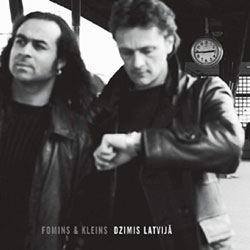
Dzimis Latvijā

With but a single album, the Liepāja duo Fomins & Kleins established themselves as one of the premiere rock groups in Latvia. Their debut album Muzikants, released in 2003, contained hit single after hit single and brought them prominence and popularity.

Could they keep up this momentum on their successive albums? On their second album, Dzimis Latvijā (Born in Latvia), they continue right where they left off, with their lyrical rock and roll, not skipping a beat.

The lineup of the group remains almost the same from their first album. Ivo Fomins (lead vocals) and Tomass Kleins (guitars, keyboards, vocals) are joined by Egils Mežs on bass, Valērijs Iņutins on drums, and new keyboardist Jānis Lūsēns Jr. Once again, Kleins wrote all the music, and lyrics were written by omnipresent Latvian wordsmith Guntars Rāčs. Since the ingredients in the formula did not change much, the resulting concoction has a welcome familiarity, like a dependable friend.

Fomins & Kleins also are notable as they are the Latvian entries in the Eurovision Song Contest this year. Nearly winning the Latvian national competition in 2003 with the song “Muzikants,” they re-entered this year with the song “Dziesma par laimi” (Song of Happiness), and won convincingly. As in 2003, this was the only entry in the Latvian competition that was performed in Latvian. The songs are somewhat similar—they are both in the same key and use the same chords. But I don’t mind really and do like both songs. Though conventional wisdom would say that a song sung in Latvian has little chance of winning Eurovision, it will be nice to have a break from the overly slick pop that seems to dominate the competition every year. All of Europe will have the chance to hear what the Latvian language sounds like. Besides, I think there are worse things that could happen to the band than not winning Eurovision, though it would be nice to have a pair of rockers in their mid-thirties triumph over the usual mundane stuff the contest offers! The song itself, as its title indicates, is a song of happiness and hope, that even when all is lost, this song will still remain.

I think the key to their success is the simplicity. “Professional” musicians might scoff at Fomins & Kleins’ simplistic songs, but great songs are rarely made great simply due to the number of chord changes and modulations. Do remember that many Latvian folk songs get by with three or four chords, and they have remained popular for hundreds of years. For example, the duo’s song “Nekas” (Nothing) is a song about a lonely girl whose only greetings come from the morning sun. The chorus, as with many of their songs, stays with you, since it is easy to remember.

Another favorite is “Aizejošas dienas” (Departing Days), a song about time flying and time lost, once again with an anthemic chorus. Also in this vein is the opening song “Otrās dienas rīts,” which starts with the line “Tici vai nē, bet šī diena ir skaista bez tevis” (Believe it or not, this day is beautiful without you).

Since the release of their first album, the Latvian rock music world was hit by the tragedy of the death of Dainis Virga (drummer for the group Līvi) in an automobile accident. There is a tribute to him on this album called “Ar Dievu bral’” (Go with God, Brother), a touching ballad with the words “Ir tikai beigas vēl vienai dziesmai, bet piedziedājums pārāk īss” (It is just the end to another song, but the chorus was too short.)

Without missing a beat, Fomins & Kleins’ second album picks up where their debut left off. As the old saying goes, if it ain’t broke, don’t fix it, and certainly the songs of Fomins & Kleins ain’t broke! I think their songs can be appreciated by just about any listener. Even though they are simple, the songs can speak to many different kinds of listeners. Here’s to good old fashioned Latvian rock and roll triumphing over manufactured pop at Eurovision!

Details

Dzimis Latvijā

Fomins & Kleins

MICREC,  2004

MRCD 237

Egils Kaljo is an American-born Latvian from the New York area . Kaljo began listening to Latvian music as soon as he was able to put a record on a record player, and still has old Bellacord 78 rpm records lying around somewhere.

Rock pedigree shows on duo’s debut album

Mūzikants

Like other countries, Latvia is being overrun by boy bands, pop starlets, and “reality show” talent. Though the voice of “traditional” rock music is being silenced elsewhere, it is alive and well—if not as strong as ever—in Latvia. Case in point: the debut compact disc Muzikants from Fomins & Kleins.

Between the two of them, Ivo Fomins and Tomass Kleins have a very respectable rock pedigree. Fomins sang with the group Liepājas brāļi (along with well-known singer and brother Igo Fomins). Kleins has played with the eternal Latvian warhorse Līvi. When I heard that these two were getting together to record an album, I had high hopes for a great record. Did they deliver? I would say that they have.

Of course the recording is not just Fomins (vocals) and Kleins (guitar, keyboards and vocals). They are complemented by Egils Mežs (bass guitar), Valērijs Iņutins (drums) and Jānis Strazds (keyboards). All the music was written by Kleins, and the lyrics were provided by Guntars Račs. Together this group has put together one of the most solid rock records in recent memory.

The album starts off with “Solījums” (Promise), one of the rockier numbers on the CD and through which it becomes clear that the focus of the album will be on the guitar. Although some might consider the guitar lines simplistic, they are exactly what this kind of music needs. The track is one of my favorite songs on the album.

Every rock album must have its ballads (or so says a rule somewhere!) and one of the prettiest is “Sniegs.” The song was released prior to the album and became one of the most popular tunes in Latvia in 2002.

Perhaps the catchiest song on the album is “Muzikants,” which Fomins & Kleins entered in last year’s national runup to the Eurovision Song Contest. (In retrospect, perhaps the song might have been the better choice for Latvia, given that F.L.Y.‘s “Hello From Mars” received a disappointing score in the contest.) “Muzikants” is a short yet infectious number.

Another ballad is “Kur esi Tu?,” a sad song about a dear friend who is no longer around. From my understanding, the song was dedicated to Ainars Virga, who at the time was taking an extended leave of absence in the United States but has since returned. Making the song even sadder is the fact that Ainars’ brother Dainis Virga plays drums on this track. Dainis died tragically in a car accident in 2003, making this one of the last songs that he recorded.

The rap group Device shows up on the song “Ātrāk, augstāk, tālāk.” They add bits of vocals here and there and an extended rap near the end of the song. I think it works well and adds a new dimension to the sound of Fomins & Kleins.

The album has many more great songs on it, and I highly recommend it to any fan of Latvian rock. Due to Kleins’ involvement, there certainly is a Līvi feel to many of the songs, but I think Fomins & Kleins have made a truly distinctive record with a sound of their own. This is a solid album about which all fans of rock music, and especially of the guitar, will be able to rejoice.

Details

Mūzikants

Fomins & Kleins

MICREC,  2003

MRCD 199

Egils Kaljo is an American-born Latvian from the New York area . Kaljo began listening to Latvian music as soon as he was able to put a record on a record player, and still has old Bellacord 78 rpm records lying around somewhere.

After a few spins, Māsas’ second disc satisfies

Māsas

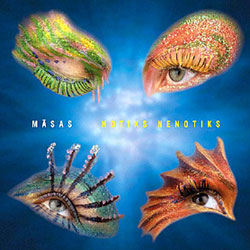
Notiks nenotiks, the second album by Māsas (The Sisters), was released a year ago. Their first album, Dāvā laimi, was quite the eclectic collection of tunes, so I was not really sure what to expect. But after a few times listening (as it takes a few to get into this compact disc), I found that I enjoyed Notiks nenotiks just as much as their debut.

The Māsas are still sisters Līga Celma (vocals, guitar and keyboards) and Daina Celma (keyboards and backing vocals), and sisters Ingūna Dortane (percussion, keyboards and backing vocals) and Kristīne Dortāne (guitar and backing vocals). Joining them in rounding out the group’s sound are non-sisters Mihails Zaļivko on bass and Alvils Cedriņš on drums, xylophone and backing vocals. Also appearing on the CD is a virtual army of backing musicians—violinists, flutists, trombonists and even a bagpiper. This all comes together to form one of the more distinctive collections of songs in the Latvian music world. Līga Celma composed all of the music on the album.

As with their first CD, perhaps the best word to describe this album is “eclectic.” A wide range of sounds and melodies are heard here. Māsas are certainly not your everyday, standard girl band, and it seems they have gone out of their way to develop their own sound—it is rather difficult to compare them with any other group.

Because the music is eclectic, it can be a challenge, but I think those who give the album a few spins will be very satisfied.

The album opens up with one of the “poppier” songs, “Tevi mīlu es” (with lyrics credited to the whole group), but near the end of the song there is an extended interplay between the guitar and keyboards, adding a surprising twist to the song.

Andris Ābelīte shows up to sing on “Nabadziņi” (lyrics by K. Vērdiņš), and even performs some of the lyrics in falsetto.

A favorite on the album is the simply named “Tautasdziesma,” with lyrics taken from Latvian folk songs. The track also features Māris Muktupāvels of Iļģi on bagpipes.

Also standing out on the album is the slightly vulgar song “Sūdabrālis” (lyrics by K. Vērdiņš), which appears to be an ode to a departed boyfriend. The song features “scratch” by Gatis Rozenfelds and shows the “humorous” side of the group.

Normunds Rutulis makes a guest appearance on “Mana mīļā” (lyrics also by Līga Celma), a gentle ballad that also features a very pretty piano part.

Only some of the lyrics are included in the CD booklet. More than making up for that deficiency are the pictures of the sisters in body art provided by Guna Stikāne.

Some that say there is nothing new or interesting anymore in the world of Latvian music. I would encourage anyone who says that to take a listen to this CD. The varied styles and musical arrangements make for a very enjoyable listening experience. The only potential criticism is that there are perhaps too many guests on this album. With all these extra musicians, I am curious to see how they perform in concert.

Notiks nenotiks is a very satisfying follow-up to Dāvā laimi. I hope these sisters will continue to make great music!

Details

Notiks nenotiks

Māsas

MICREC,  2003

MRCD 203

Egils Kaljo is an American-born Latvian from the New York area . Kaljo began listening to Latvian music as soon as he was able to put a record on a record player, and still has old Bellacord 78 rpm records lying around somewhere.