Album reviews Ingus Pētersons before opera career

Ingus Pētersons

Every so often, I go to a Latvian club in Rīga called Četri balti krekli, where music by only Latvian artists is played. One song that always seems to throw the crowd into a frenzy is this strange tune about windsurfing. At first, I had no idea who performed the song. It was nice enough, if a bit cheesy (especially the English-language chorus: “Surfing, surfing—windsurfing!”). I was surpised to learn that the song is performed by Ingus Pētersons.

From what I knew about Pētersons and his repertoire, I would never have guessed that he was the singer. Pētersons, the artist who in his youth sang slightly more serious songs? Pētersons, the popular singer who abandoned popular music completely to focus on opera? That Pētersons? I didn’t believe it.

But it was true. Though he has had success as an opera singer, his popular songs recorded in the late 1970s and early ‘80s live on, and are being enjoyed by listeners who weren’t even born then.

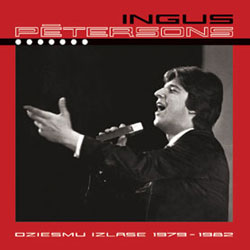
The recording company MICREC, wisely realizing that there is still a market for these old songs by this older singer, in March released Dziesmu izlase 1979–1982, a career retrospective of Pētersons’ work. The release is part of MICREC’s “Latvijas populārās mūzikas klasika” series. (MICREC competitor Platforma Records in June re-released Pētersons’ first album, Zelta dziesmas šodien in June.)

Up until now, most of these songs were not available on compact disc. One had to go back to scratchy 20-year-old records to find them. Pētersons’ popular music career lasted only about three years, but what a rich three years it was.

The CD collects 22 of Pētersons estrādes songs (“stage” is the most direct translation, but probably translates better as “popular”) from the years 1979-1982. For anyone who listened to the old Mikrofons records back then, many of these songs already will be well known, including classics such as “Par nesatikšanos” (About Never Meeting Again) and “Varavīksne” (Rainbow).

The CD starts off with “Dziesma par skūpstīšanu” (A Song About Kissing), which sounds like it was recorded when Pētersons was a teenager. That’s rather appropriate, as it’s a song about a young guy who has had no luck with the young ladies of the town, and he wonders what he is doing wrong. Hopelessly out-of-date synthesizer sound notwithstanding, this is one of my favorites on the album.

Also on the CD is the aforementioned windsurfing song, “Dziesma par vindserfingu,” which I have grown to like. I originally saw this as just about the cheesiest song in the entire Latvian repertoire, but it is catchy enough that I have even gone as far as to learn to play it on the guitar. “Dziesma par vindserfingu” was originally done as “Windsurfin’” by the Dutch band The Surfers. The Latvian lyrics were written by the well-known songwriter and activist Kaspars Dimiters. The CD booklet contains a biography by Daiga Mazvērsīte, who notes that Pētersons was interested in taking popular songs from outside of Latvia and having them redone in Latvian. Another example is “Mana sirds ir brīva” (My Heart is Free), taken from a Hungarian song.

Another favorite on the album is “Jūra, es dziedu tev,” with music by Raimonds Pauls and lyrics by Jānis Peters. It’s one of many songs that shows not just Pētersons’ range vocally, but also emotionally. On these songs, he is backed by the Latvian Radio Popular Music Orchestra, directed by Alnis Zaķis, or by the Ivars Vīgners Instrumental Ensemble.

Many composers wanted to work with the young Pētersons. As one can see by looking through the credits, practically every important Latvian composer of the day wrote a song for Pētersons, including Pauls, Ivars Vīgners and Uldis Stabulnieks. It is actually a shame that Pētersons left the popular music world so quickly. If he was able to accomplish this much in three years, what could he have done in 10 years or more?

The CD booklet only contains the biography and some pictures. It would have been nice to have the lyrics as well. The sound of the CD is excellent, considering that all these songs are more than 20 years old. Thanks must be given to MICREC for releasing this and many other albums and songs from the classic Latvian popular music repertoire, as well as for spotlighting artists who perhaps aren’t as well known as Pauls. Though some songs clearly show their age, many are still as fresh as when they were released. This album is highly recommended, not just as a historical document, but also as a great collection by one of the great Latvian popular singers.

Details

Dziesmu izlase 1979-1982

Ingus Pētersons

MICREC,  2005

MRCD 264
Egils Kaljo is an American-born Latvian from the New York area . Kaljo began listening to Latvian music as soon as he was able to put a record on a record player, and still has old Bellacord 78 rpm records lying around somewhere.

Hospitāļu iela offers something fresh to Latvian pop

Nav centrs

It is once again time to get some new blood, some new ideas into Latvian popular music. It is no coincidence that most of the reviews that I write are about Latvian groups that have been around for decades (such as Līvi or Jumprava), or about new groups made up of musicians who have been around a long time (such as Fomins & Kleins). Even groups that are considered “younger” aren’t necessarily “young” any more. Prāta Vētra has been playing for more than a decade now, and Tumsa already has five albums under its belt, so it can’t be considered the “new guard” either.

Of course, there are plenty of new groups, but many of them aren’t offering any new takes on any styles, as they are often very derivative (this would apply to many of the hard rock and heavy metal bands today) or simply recycling or copying what has been done before (this applying to many of the schlager bands and pop stars, something that could be said about this type of music anywhere in the world).

But all is not lost. Far from it. Last year in fact had two very significant debut albums: Strēlniece (The Archer) by the group re:public, featuring the mega-hit title track, and Pilnmēness (Full Moon) by Hospitāļu iela, featuring hits “Par pogu” (About a Button) and “Sinepes (par Raimi)” (Mustard (About Raimis)). Re:public would fall into the straight-ahead rock category, but Hospitāļu iela has a rather distinct style that is hard to describe, containing elements of pop, rock and reggae, with a violin thrown in for good measure, not to mention creative lyrics that exhibit an at times dry sense of humor. Pilnmēness was also presented with the “Pop Album of the Year” and “Best Debut” award at the 2005 Latvian Music Awards. Pilnmēness is also notable as one of the producers of the album was one of the pioneers of Latvian electronic music, Ingus Baušķenieks.

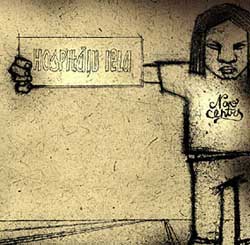
I thought Pilnmēness was a good album, featuring the above-mentioned tracks, as well as songs like “Par kiosku” (About a Kiosk) and “Putni prom” (Birds Away), so when the group’s latest album, Nav centrs (Not the Center) came out earlier this year, I picked it up.

Taking its name from a poem by Klāvs Elsbergs, Hospitāļu iela was founded in 1997 by leader, singer, guitarist and principal songwriter Edgars Šubrovskis, according to the MICREC recording house. However, at that time nothing got off the ground and the group went through many changes in its lineup. An album, Ir maiga nakts (It is a Gentle Night) was released independently in 1999. The group finally settled down and began work on is first proper major label release in 2001, which was finished in 2003 and released in 2004 on the MICREC label Raibā taureņa ieraksti.

The group now is made up of Šubrovskis, Dina Skreitule (violin), Maija Ušča (bass guitar), Toms Circenis (drums), Laima Ivule (vocals, keyboards), Jēkabs Kacens (djembo), Biāna Pette (accordion) and Reinis Ozoliņš (contrabass). With a lineup like that, once can certainly expect an eclectic mix of music styles and sounds, particularly the reggae plus violin sound, as well as the dynamic between the vocals of Šubrovskis and Ivule, which gives Hospitāļu iela a distinct sound.

Nav centrs sees the group continuing down its own experimental path, and has some songs that will help cement the group’s reputation as not just a creative, unique force in Latvian music, but as strong songwriters as well.

I like the Hospitāļu iela songs that are more up-tempo, so one of my favorites on the album is “Par dimantiem” (About Diamonds). Following after a number of slower songs, the song sees the group performing with a nervous energy. Also I liked “Paspēlēties” (Playing), which is more of a duet between Ivule and Šubrovskis, not to mention being one of the group’s “cheerful” songs.

To be honest, I’ve never been a big fan of reggae. Not that I think it is bad, it just has never captivated me as it seems to captivate others. I will never deny the talent of someone like Bob Marley, but I guess I never “got” it. However, from time to time I do enjoy a song in that style, for example the very reggae “Nesaki nevienam” (Don’t Tell Anyone).

At 60 minutes and 17 songs (well, more like 16, as one track, “Izejam ārā” (Let’s Go Outside), is only 19 seconds), the record does seem a bit over-long. It begins and ends strongly, but the middle remains a bit foggy to me.

Nav centrs is overall an enjoyable record, certainly something fresh and unique, and it certainly is encouraging that interesting things are happening in Latvian popular music. Both Pilnmēness and Nav centrs have some great songs on them, so both records are recommended to those who are looking for something a bit different.

Details

Nav centrs

Hospitāļu iela

Raibā taureņa ieraksti,  2005

RTCD 002

Egils Kaljo is an American-born Latvian from the New York area . Kaljo began listening to Latvian music as soon as he was able to put a record on a record player, and still has old Bellacord 78 rpm records lying around somewhere.

Jumprava remains at top of its game

Inkarmo

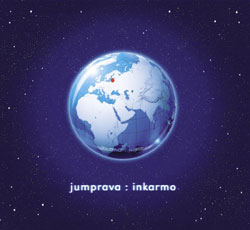
Jumprava, one of the old guard of Latvian rock music, celebrated its 20th anniversary this year with a big concert at the Dzintari Concert Hall in Jūrmala. Shortly before the concert, the band released its latest album, Inkarmo. According to the group, “inkarmo” means “the place and time we find ourselves in at this moment.” This is illustrated by the album’s cover, which features a map of the world with a small red dot to indicate Latvia.

Jumprava’s prior two releases, 1998’s Laika atšķirību romance and 2001’s Trajektorija, were among the band’s best albums. Though Jumprava’s most popular works remain old standards like “Vēlreiz” and “Ziemeļmeita,” I actually prefer their newer songs. And I think that Inkarmo continues where the band left off with Trajektorija—another very strong album of Jumprava’s blend of electronic and acoustic music with thoughtful lyrics, smoothly going from laid back and pensive songs to highly emotional and energetic songs without missing a beat.

The group’s lineup has not changed: Aigars Grāvers, Aigars Grauba, Aigars Krēsla and Ainārs Ašmanis.

The album starts out in a particularly odd way, with the low-key song “Elpas cena” (The Price of a Breath). It’s a very quiet song that sounds more like it would have fit better on one of the Rama Dance albums (Grāvers’ side project, melding Latvian and Indian music). Also interesting is that the music’s author is Krēsla, and not Grāvers as I originally thought when I listened to the song. This song’s refrain includes lines about a lonely yak in Tibet, certainly a topic rarely mentioned in popular music.

The album does have a number of mellower moments, including the songs “Man pietiek ar to” (That is Enough for Me) and the lullaby “Miega dziesma mazajai meitenei” (A Sleepy Song for a Young Girl), both composed by Krēsla. “Miega dziesma,” featuring lead vocals by Grauba, is a sweet, quiet song—uncharacteristic for Jumprava, but still effective.

But that, of course, does not mean the album is not without its up-tempo songs, such as “Laimīgs” (Happy) and “Liekos dīvains” (Seem Strange), which includes one of my favorite lines from any Jumprava song: “Ja es Tev liekos dīvains, tad kāds Tu liecies man?’ (If I seem strange to you, how do you seem to me?)

Jumprava also continues the dabbling in techno music that was started on the Trajektorija album. This is most notable in “Stacijā” (At the Station), a song about a chance encounter at a train station. Honestly, I’m not a fan of this song, though I do like the almost-techno title track, “Inkarmo.”

Production of the album is almost too perfect, and as a result it sounds too polished, almost sterile. One of the reasons Jumprava became so popular was its experimentation with non-traditional arrangements and melodies, much different than what was popular in the 1980s and 1990s.

It could be said that this album is a bit too safe. But this is a minor complaint. One of the drawbacks of music made almost entirely with synthesizers is that at times it will sound mechanical. Don’t let that frighten you, because the songwriting on Inkarmo is top-notch.

Almost all the lyrics on the album are written by outsiders. Rolands Ūdris (a.k.a. Ūdrītis), lead singer of The Hobos, wrote the words to “Inkarmo.” Also writing lyrics were Ingus Bērziņš, Viktors Duks and Aija Strazdiņa. Curiously, no lyrics were provided by frequent collaborator and poet Nataradža.

The booklet accompanying the compact disc contains all the lyrics, but very little else. The CD is presented in Digipak form (a cardboard case) as opposed to the regular plastic jewel box. To be honest, I prefer the regular CD cases, as the cardboard cases tend to get worn out after a while and cannot be replaced.

Inkarmo is a worthy addition to the Jumprava canon. In a time when many bands (Latvian and otherwise) with a strong back catalogue are content to rest on their laurels and release sub-par albums, Jumprava still is at the top of its game, challenging itself musically and pleasing old fans as well as bringing in new fans. At the close of the anniversary concert in the Dzintari hall, the band seemed taken aback by the sight of 3,000 fans, all on their feet and screaming for the group’s return to the stage. But such is the strength of Jumprava, and it shows no signs of diminishing.

Details

Inkarmo

Juprava

Platforma Records,  2005

PRCD 164

Egils Kaljo is an American-born Latvian from the New York area . Kaljo began listening to Latvian music as soon as he was able to put a record on a record player, and still has old Bellacord 78 rpm records lying around somewhere.