


Egils Kaljo is an American-born Latvian from the New York area . Kaljo began listening to Latvian music as soon as he was able to put a record on a record player, and still has old Bellacord 78 rpm records lying around somewhere.
Author: Egils Kaljo
Huskvarn’s aggressive music, growling vocals not so special
One would think that heavy metal, full of aggressive notes and despairing lyrics, would have quite the following in Latvia, where the long dark winters and varied social problems would facilitate a particular fondness for this type of music. Tickets for seminal metal band Metallica’s July 2007 concert in Rīga’s Skonto Stadium sold out in a very short period.
Oddly though, local Latvian metal bands have had a much tougher time. Very few, if any, reach any kind of critical or commercial success. The only groups I can think of that have been somewhat successful are Dzelzs vilks (though some might call the group more “industrial” than “metal”) and Skyforger (which plays pagan folk metal).
A heavy metal band with a long history, not to mention a devoted if small following, is Huskvarn. From the band’s Web site, we find out that Huskvarn was founded in 1989. For those wondering, the name Huskvarn (or, originally, Husqvarn) was taken from of all things Husqvarna, a company that manufactures chainsaws and other power tools. This may very well explain the cover of the band’s first album, On the Road, featuring a zombie-looking guy holding a rather demonic chainsaw.
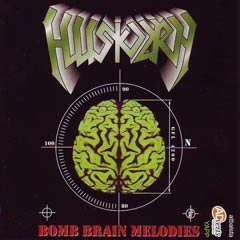
In celebration of its almost 20-year existence, the group in March re-released its first two albums—1992’s On the Road and 1995’s Bomb Brain Melodies—as a set of two compact discs. On On the Road, band members are Edgars Ķauķis (Blackie) and Ivars Talcis (Sheriff) on guitars, Normunds Orļonoks (Urbix) on vocals, Kaspars Žers (Long) on bass and Māris Balcers on drums. Orļonoks also is the principal lyricist. Bomb Brain Melodies features Orļonoks and Ķauķis joined by drummer Ēriks Šalapajevs, bassist Sergejs Karševs and guitarist Andrejs Mingačovs.
Huskvarn plays a rather ferocious type of heavy metal, often called “death metal,” mainly due to its relentless aggression both in music and lyrics, as well as (more often than not) unintelligible vocals, either screamed or growled. For this reason, this type of music is inaccessible to most listeners, except the very dedicated. Even though I was brought up on a strict diet of heavy metal, I myself found it a struggle to listen to these CDs all the way through. Where others may quickly dismiss this type of music as noise made by talentless hacks, I would strongly disagree with those sentiments. It is certainly a difficult task to be able to play the guitar or bang the drums at such a blinding speed, and it takes powerful vocal chords to be able to sing this type of music for a long period of time. Thankfully the lyrics for all the songs are included, otherwise it would be difficult to make sense of what they are singing.
On the Road features longer songs. Although there are only six songs, the album is nearly 40 minutes in length. It begins with “Dark Side,” featuring a somber introduction on keyboards, before launching into the first of many aggressive musical assaults. “Absurd Confusion” features a particularly shredding guitar solo by Talcis. The song “On the Road” also begins with an uncharacteristically melodic acoustic guitar before launching into an almost march-like, thundering distorted guitar riff.
With Bomb Brain Melodies, the group began writing slightly shorter songs, but what the band lost in length it made up with intensity. Compared to this album, On the Road seems almost melodic. I assume the title indicates that these songs should make your head explode, which I believe it will after too many listens. Bomb Brain Melodies begins with “Deliberately Lost in Infinity,” featuring a rather sinister introduction on acoustic guitar (reminding one slightly of Metallica’s song “Battery”). From titles like “Crazy Death,” “Bloody Nightmare” and “The Right to Revenge,” one can see the group has stepped up the intensity in its song writing. There are also three songs in Latvian—“Divas sejas,” “Pasaule mūsu palāta” and “Zudušais laiks”—though I probably wouldn’t have been able to tell that they were in Latvian without the lyrics sheet. The slower song “Follow Our Trail,” in contrast with most of the other songs, has a hopeful message, with the words “Together we’ll find all we need.”
I prefer On the Road to Bomb Brain Melodies mainly due to the fact that, ironically, On the Road features more melodies as well as tempo changes—and slightly more intelligible vocals.
A minor quibble about the packaging: To keep the albums separate, there are two separate booklets, one in the front cover of the CD and one in the back cover. Unfortunately, the booklet in the back cover is a few millimeters too large for the case, thereby leading to a slightly mangled booklet. There are also a few spelling mistakes here and there, which give the impression that this is not the most professional release.
The group continues to soldier on. Its most recent release of new material was 2006’s Sadistika.
It is admirable that Huskvarn refuses to compromise and plays the most aggressive music it can. The problem with that approach is that it leaves the group (and many other groups like Huskvarn) in a bit of a rut, which, sadly, makes many of the songs sound similar. Though it clearly takes a certain level of talent to be able to perform music like this, there is simply not enough to distinguish Huskvarn from the legions of other metal bands that sound virtually alike. On these albums, the group had yet to find its own unique sound and niche, which leads to rather generic songs, and two full CDs of this stuff was difficult to digest. If you like your music relentless and uncompromising, and are not too fussy about lyrics and originality, then this is the band for you. Otherwise, give this one a pass.
Details
On the Road / Bomb Brain Melodies
Huskvarn
Pasadena Group Promotions, 2008
On the Web
Huskvarn
The band’s official Web site provides background on the band, details on upcoming concerts, a space for comments from fans and a listing of band merchandise. LV
Huskvarn on MySpace
The band’s MySpace page has basic information about the group, plus some song samples. EN
Voice, saxophone combine on unusual recording
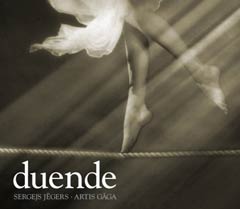
Continuing to showcase talented young artists, in 2007 record label Upe tuviem un tāliem released Duende, a collection of duets between countertenor Sergejs Jēgers and saxophonist Artis Gāga. The collaboration is unusual as it is just voice and saxophone—no orchestra, no piano, nothing besides the two musicians themselves (though one song does feature a tambourine). Can just two musicians, who are limited to playing one note at any given time (so there are not even any chords on this compact disc), engage the listener throughout the length of the album?
Jēgers has achieved much in a very short period of time. According to his Web site, he has given solo performances at the Latvian National Opera and has performed the role of the Angel in A. Rubinstein’s opera “The Demon,” as well as roles in other operas. His first solo CD, Ave Musica (2006), was a collection of sacred baroque songs. The album won the 2006 Latvian Music Recording Award for Best Debut.
Saxophonist, composer and arranger Gāga has performed with many different ensembles in a variety of styles. He has given concerts with various orchestras, including the Latvian National Symphony Orchestra, the Latvian National Opera Orchestra and other orchestras internationally. He has also performed with New Age group Kopējā izteiksme on its 2000 CD Putni maina virzienu. Earlier this year, he picked up three Latvian Music Recording Awards for 2007, including Best Debut Album and Best Instrumental, Film, or Theater Music Album for his solo CD, Mūzikālās impresijas: Zīmējumi debesīs.
Duende was recorded at the Sesava Lutheran Church, which, as the liner notes indicate, has excellent acoustics (proven admirably by this recording). Most of the songs on Duende are by French composers and, much like the songs on Ave Musica, are of a sacred nature. We get a performance of “Pie Jesu” from Gabriel Fauré’s “Requiem.” There are also two “Ave Marias” by Camille Saint-Saëns, not to mention “Amarilli, Mia Bella” by early Italian baroque composer Giulio Caccini. The CD also features the duo’s interpretation of the old French standard “Placer D’Amor” (elsewhere titled as “Plaisir d’amour”) by Jean Paul Martini.
The booklet features plenty of photos of the artists, as well as some philosophical musings by Latvian writers, and we also discover that the term “duende” is taken from Spanish poet Federico Garcia Lorca. I would not have minded if the recording company had dropped some of the deep thoughts and replaced them with perhaps a bit more information about how these two artists came to collaborate and their own thoughts on the collaboration. The liner notes are in Latvian and in English.
Though an unusual pair, the countertenor Jēgers and saxophonist Gāga have made one of the most interesting and absorbing recordings in recent memory. To answer the question from before, yes, these two artists, with just voice and saxophone, make for compelling listening. The melodies effortlessly flow between voice and saxophone, complementing each other with beautiful textures and deep emotions. The jury of the Latvian Music Recording Awards agreed and awarded the CD the Best Academic Music Award of 2007, acknowledging and rewarding the performance and talents of these two exceptional musicians.
Details
Duende
Sergejs Jēgers and Artis Gāga
Upe tuviem un tāliem, 2007
UPE TT 030
On the Web
Artis Gāga
Hear samples of Artis Gāga’s music, read about his life, learn about his concerts and recordings on this official Web site. EN LV
Kontrtenors Sergejs Jēgers
Sergejs Jēgers’ Web site includes his biography and information about his repertoire, recordings and foundation. LV
