Sudraba shows why Latvians are great musicians

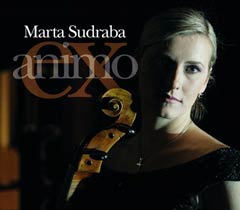
Ex animo

One source of continual amazement about life in Latvia is that most every town has a music school. Any student, should they so desire, can spend time learning about music and playing instruments. Unlike my experience growing up in the United States, when music education in public school was limited to less than an hour per day playing in band, Latvian kids, if they choose to, can spend multiple hours per day in music school. Though this is perhaps not the most practical use of their time, it does ensure that the musicians of Latvia are of a world-class level. It may not be good for the Latvian economy to have a nation of starving musicians, but it sure does make for a nice soundtrack.

Latvia-born violinist Gidon Kremer has long been aware of this. He formed the Kremerata Balica chamber orchestra in 1997, featuring young musicians from Estonia, Latvia and Lithuania. One of the key musicians in the group has been cellist Marta Sudraba, who has been with the group since its founding. Educated at the Latvian Academy of Music and the Guildhall School of Music and Drama in London, her playing has been one of the cornerstones of Kremerata Baltica. The record label Upe tuviem un tāliem, in its quest to spotlight talented young Latvian musicians, last year released Ex animo, a compact disc of chamber music works featuring Sudraba.

Sudraba is joined by pianist Ventis Zilberts on the CD, as they tackle the classic (Beethoven), the impressionistic (Debussy), Russian (Shostakovich) and Latvian (Vasks).

The Beethoven work is the Seven Variations on “Bei Männern, welche Liebe fühlen” (from “Die Zauberflöte) for cello and piano. I’ve always thought Beethoven was one of the most difficult composers to perform because so very many musicians have performed his work, making it difficult to stand out. However, Sudraba ably takes on this work. The original song is about love and is meant to be charming and playful, and Sudraba and Zilberts approach it with the necessary lightness to make the variations a joy to listen to.

Dmitri Shostokovich is represented by the “Sonata in D Minor for Cello and Piano.” Shostakovich, a 20th century Russian composer, often ran into trouble with the Soviet government, but is considered one of the greatest composers of that era. The sonata has a broad emotional range. As Sudaraba says in the liner notes, it displays “seriousness and craziness, mourning and sarcasm and light humor.” Deftly navigating the varied emotions, Sudraba brings out all the nuances of the work.

Modern Latvian classical music is represented by its most famous composes, Pēteris Vasks, and his work for solo cello, “Grāmata čellam.” This is another work of a very heavy emotional weight, as Vasks’ music can be very difficult and somber. Range again here is key. The first part of the work is fortissimo, and the second and final part is pianissimo, so the artist must be able to perform both the loud and the quiet, and give each part its own individual life. Especially in the fortissimo, Sudraba gives the work the urgency and tension expected. No less tense is the more melodic and subtle pianissimo, which also features Sudraba singing a simple melody over the sound of the cello.

To close out the CD, a work by the French impressionist composer Claude Debussy, the “Cello Sonata,” is included. Sudraba captures the very French charm of this work from the final years of Debussy’s life.

The packaging is excellent. Liner notes are in both Latvian and English and include short biographies of Sudraba and pianist Zilberts, as well as some discussion of the works contained on the CD. Upe tuviem un tāliem has once again done an excellent job in presenting a distinguished young Latvian artist. The CD highlights a truly gifted cellist, performing works of several different eras and styles, and is yet another document that shows why Latvian musicians are considered some of the best in the world.

Details

Ex animo

Marta Sudraba

Upe tuviem un tāliem,  2007

Upe TT 025

Where to buy

Purchase Ex animo from BalticMall.

Note: Latvians Online receives a commission on purchases.
Egils Kaljo is an American-born Latvian from the New York area . Kaljo began listening to Latvian music as soon as he was able to put a record on a record player, and still has old Bellacord 78 rpm records lying around somewhere.

Mednis and Kīns take flight with first album

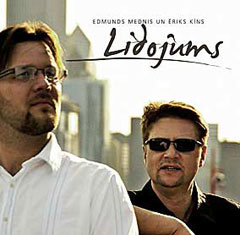
Lidojums

The very fact that there still remains interest in Latvian music in North America is rather remarkable. The “glory days” of groups like Čikāgas piecīši and Trīs no Pārdaugavas, bands that could fill Latvian centers to bursting, has long since passed. However, Latvian music has remained a fixture at Latvian events—not just at song festivals but other events as well. Two musicians who have been keeping the flame alive are Edmunds Mednis and Ēriks Kīns.

Mednis, as readers might already know, was a longtime member of the popular Latvian šlāger group Bumerangs, playing drums and singing, as well as composing a number of the band’s most popular songs. Mednis, though born in Latvia, has been living in the United States since 1999. Ēriks Kīns, from the Chicago area, performed in such groups such as the Minnow Buckets and Adam Zahl. Mednis joined Adam Zahl in 2004 and in 2006 the duo branched out to work on their own material.

At Bumerangs’ 20th anniversary concert in Rīga on March 4, 2006, the duo appeared via video to perform their new song “Putni” (Birds). From there, the song became a major hit in Latvia, and the duo began work on a full length album, Lidojums, which was released this summer. On the record, Mednis no longer plays the drums, but sings and plays guitar and keyboards, while Kīns sings and plays guitars. They are joined by other musicians, including Artūrs Rūsis on guest vocals, Juris Skrajāns on guitars, Eduards Glotovs on bass and Vilnis Krieviņš on drums. The group has become popular enough that it was able to give a concert tour in Latvia this summer.

Listening to the record, one can understand why Mednis and Kīns have become so popular. Building on Mednis’ work with Bumerangs, as well as Kīns’ work with Adam Zahl, the group has recorded an album full of catchy and memorable songs. On their profile on the networking Web site draugiem.lv they describe themselves as “alt country.” Mednis’ vocals and the harmonies with Kīns give their music more than just a passing resemblance to Bumerangs—but this is a positive thing, as Bumerangs is far and away among the best of the legion of šlāger or country groups in Latvia.

Mednis is also a very talented songwriter, composing some of Bumerangs’ most popular songs, such as “Deju zāle,” “Klaidonis” and “Mazais ceļinieks.” He shows no sign of slowing down, as mega-hit “Putni” is also by his pen, as are songs like “Lidojums” and “Tevis man nav par daudz.”

Kīns also has a talent for songwriting. His tracks on Lidojums include “Kā tas var būt?” and two songs that had originally appeared on Adam Zahl’s Pirmā plate album: “Acu spēles” and “Iesim peldēties!”. There is also “Vaimanas,” a Latvian version (text by Kīns) of the song “Valentine” by alt country group Old 97’s.

To my knowledge, no other “new” Latvian group based in the United States has had a full album released in Latvia. The fact that Latvia’s largest music label, MICREC, has released their album is just another indication of the duo’s talent and hard work. With many catchy songs and soaring harmonies, Mednis and Kīns have a rare chemistry that shines through all the songs on Lidojums. This is one flight well worth taking.

Details

Lidojums

Mednis un Kīns

MICREC,  2007

MRCD 358

Where to buy

Purchase Lidojums from BalticShop.

Note: Latvians Online receives a commission on purchases.

Egils Kaljo is an American-born Latvian from the New York area . Kaljo began listening to Latvian music as soon as he was able to put a record on a record player, and still has old Bellacord 78 rpm records lying around somewhere.

Reborn, Otra puse releases career highlights

Description of image

The early 1990s were one of the brightest periods for Latvian rock and popular music. Perhaps it was the newly restored independence of Latvia, but so much creative and enduring popular music was composed during that time. The period saw the debut of standard bearers like Prāta vētra, Labvēligais tips and bet bet, as well as groups like Jumprava reaching a new artistic peak. With so much good music being released and performed, some groups unfortunately would get lost in the shuffle.

One such group is Otra puse. After the temporary breakup of Jumprava in 1992, Jumprava’s lead singer and guitarist Aigars Grāvers wanted to keep active in music performance, so he and drummer Aigars Krēsla (also of Jumprava), as well as previously unknown singer Normunds Pauniņš, keyboardist Ivars Makstnieks (formerly of Vaidava and Linga) and bassist Aldis Miodle, formed the group Otra puse.

Much like Jumprava, the group’s sound was based upon keyboards and synthesizers, with many layers of together to make deeply textured melodies and songs.

Thankfully the group has not been completely forgotten, as Pēc lietus, a collection of its best work was released in early 2007 by the recording company MAPLS. The compact disc collects all the great songs the group recorded over its more than 10 years of history. Many of the songs were only available on a long out-of-print cassette issued in the mid 1990s. Some of the songs were also included on the also out-of-print Grāvers retrospective Pret vēju pēc 90-ta. The CD includes one new song “Ieskaties.”

Otra puse had a turbulent history. Grāvers, Krēsla and Miodle departed the group in 1994. The group was then joined by Arnolds Kārklis (formerly of the Latvian-American band Akacis) on guitar and Mārtiņš Linde (later a member of Time After Time) on drums. Later the band was joined by Gints Saulītis on bass guitar. Today, Otra puse is a three-piece band made up of Pauniņš, Makstnieks and Saulītis.

One of my favorite songs by Otra puse is “Balāde par 3 saucieniem” (music by Grāvers, text by Aigars Grauba). It has almost a folk song sound to it.

The departure of musical heavyweights Grāvers and Krēsla did not affect the songwriting quality of the group. Keyboardist Makstnieks turned out to be an excellent composer in his own right, composing the music for songs such as “Dziesmiņā,” “Rīts” and “Enģelis” (all with words by frequent collaborator Ivars Kurpnieks). Pauniņš also established himself as a capable songwriter with “Dejas sapnī,” providing both words and music.

The CD booklet has all the lyrics for the songs, as well as a short biography of the group by journalist Daiga Mazvērsīte.

I am overjoyed that these songs are now collected on CD. Otra puse is one of the best groups from the 1990s. To lose these songs would have been tragic. Hopefully this will rekindle interest in the group, which is working on a new album, and it will continue to record and perform great songs.

Details

Pēc lietus

Otra puse

MAPLS,  2007

MVTT CD 020

Egils Kaljo is an American-born Latvian from the New York area . Kaljo began listening to Latvian music as soon as he was able to put a record on a record player, and still has old Bellacord 78 rpm records lying around somewhere.