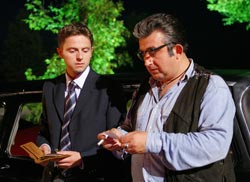
Orlando Wells (left) as Curt and Gundars Āboliņš as taxi driver Oskars are among the various actors in the comedy Midsummer Madness. (Photo courtesy EastWest Filmdistribution)
Much like every other culture and ethnic group, Latvians have their particular quirks. Celebrating the ancient pagan festival Midsummer (Jāņi) is just one of many. Besides singing songs, drinking a lot of beer, eating a lot of cheese and jumping over the bonfire, there is also the quest for the allegorical “blooming fern.” One might think that a reasonably funny and interesting film could be made about experiencing this in Latvia, which is what the comedy Midsummer Madness attempts.
The film was released in 2007 and the DVD (for Regions 2 and 5) became available in 2008. The movie was directed by filmmaker Alexander Hahn, who was born in Latvia in 1967 and immigrated to Germany in 1977, according to the Internet Movie Database. Perhaps it was the childhood in Latvia that compelled him to not just direct but also co-write the screenplay.
Though based mostly in Latvia, the film isn’t really directly about Latvians. It is more a collection of various stories of foreigners and their experiences in Latvia during the Līgo celebration (June 23) as well as Jāņi the following day (June 24). Several for the most part unrelated stories are contained in this film—perhaps too many. We have the story of the French woman Livia (Maria de Medeiros, Fabienne from Pulp Fiction), who has recently lost her husband, whose wish was that his ashes be dispersed in the Hill of Crosses in Lithuania. Joining her on this mission is Toni (Dominique Pinon, Joseph from Amélie), as well as their driver, Pēteris (played by Austrian Tobias Moretti, perhaps best known to Latvian audiences as inspector Richard Moser in the television series “Kommissar Rex”).
There is also the story of sex-crazed Aida (Chulpan Khamatova, Lara from Good Bye Lenin!), who is bringing home yet another new boyfriend, Yuki (Benito Sambo) from Japan, to meet her parents.
British firefighters from Liverpool, Lewis (James-William Watts) and Mike (Victor McGuire), meet Latvian fire chief Purviņš (Dainis Porgants) and, while celebrating with the Latvian firemen, go off looking for the mythical fern with, perhaps, unexpected results. Russian businessman Leonid (Yevgeni Sitokhin) tries to close some sort of deal with the Austrians Karl (Roland Düringer) and Axel (Detlev Buck). And Foma (Daniil Spivakovsky) and Jānis (Janis Blums) try to make their fortune by tapping into an oil pipeline.
Finally, there is the story of and American named Curt (Orlando Wells, from the British television show “As If”), whose father is dying. Curt is searching for his half-sister Maija (Birgit Minichmayr, Gerda Christian in Downfall) with the help of friendly taxi driver Oskars (Gundars Āboliņš, who is the only Latvian with a major role in the film), who provides Curt with some helpful notes about Latvia and Latvians (like how most every male name ends in “s,” and how you always bring a gift when visiting someone, even if you are meeting them for the first time).
If that sounds like there is a lot going on, well, there is a bit too much going on. Due to the number of stories, none of them get developed well enough to inspire more than a passing interest in any of them. The story that would have benefited the most from further development is Curt’s search,. However, at the start, Curt is made out to be an extremely unsympathetic and hostile character (given that his father is dying, this might be understandable though), so much so that the viewer may lose sympathy and not really care if he finds Maija or not.
Though meant as a comedy, some of the jokes are of the more obvious type. “Latvia? Lithuania? There’s a difference?” Check. Bribing corrupt policemen? Check. The Latvian city of Ogre pronounced a la Shrek? Check. Crazy old lady with a shotgun (always good for a chuckle)? Check.
The movie has other elements that perhaps only Latvians or those living in Latvia might find annoying, such as the taxi trip from Rīga to Ogre starting in broad daylight and ending in the dead of night (which, during Jāņi, is maybe about 3 a.m.). This implies that the taxi ride took about six hours, if not longer, when it should take no less than one!
I do think that there is potentially a very funny movie to be made about Latvia and Latvians and all the things that happen in the country, particularly during Jāņi, but Midsummer Madness is not quite there. Not quite straight comedy, and not quite the hyperactive ethnic comedy of, let’s say, one of Emir Kusturica’s films, it doesn’t flush out any of its stories. There are a few chuckles along the way (particularly the random kangaroo appearances), but not enough to sustain interest in the film. Mildly amusing at times, the film, bogged down with too many storylines and limited development, does not leave much of a lasting impression.
Details
Midsummer Madness
Alexander Hahn, director
Fischer Film, Steve Walsh Productions and Kaupo Filma, 2007
Notes: In English. Comedy, color, 90 minutes. Principal cast: Dominique Pinon, Maria de Medeiros, Tobias Moretti, Chulpan Khamatova, Orlando Wells, Birgit Minichmayr, Detlev Buck, Roland Düringer, Gundars Āboliņš, James-William Watts, Victor McGuire, Dainis Porgants, Yevgeni Sitokhin, Daniil Spivakovsky and Janis Blums; screenplay: Alexander Hahn, Alexander Mahler and Norman Hudis; director of photography: Jerzy Palacz; production designer: Ieva Romanova; costume designer: Thomas Oláh; editor: Justin Krish.
Egils Kaljo is an American-born Latvian from the New York area . Kaljo began listening to Latvian music as soon as he was able to put a record on a record player, and still has old Bellacord 78 rpm records lying around somewhere.