Compilation honors career of the other Fomins

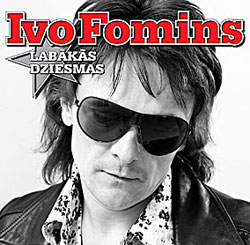
Labākās dziesmas

One of the most recognizable voices of the Liepāja rock scene has always been Ivo Fomins. To honor his career so far, MICREC this summer released the compilation compact disc Labākās dziesmas.

Brother of legendary Latvian singer Igo Fomins, Ivo has always tended toward a harder rock sound while Igo—despite having spent time in the hard rock band Līvi—leaned more towards pop songs as well as theater music. Although he has often been in his brother’s shadow, Ivo established himself as a star in recent years, particularly through his work with Tomass Kleins in the duo Fomins un Kleins. Sadly, they have disbanded, supposedly due to the standard “creative differences,” with Fomins looking more towards a heavier sound in their music and Kleins embracing popular music. These trends are made clearer by the more aggressive sound on Fomins’ solid 2006 solo CD Palikt vienam, while Kleins went on to work with rising pop star Andris Ērglis in the group Cacao.

Fomins’ career did not start with Fomins un Kleins, but the duo’s popularity brought him many new fans. One of the first groups he performed with professionally was Neptūns during the mid 1980s. He was also one of the members of Liepājas brāļi. Other groups with which he has been associated include Libau and Melnā princese, where he performed with guitarist Felikss Ķiģelis. In 2003, he began work with Kleins, producing two excellent albums—2003’s Muzikants and 2004’s Dzimis Latvijā—and even participated in 2004’s Eurovision Song Contest with the tune “Dziesma par laimi.”

The bulk of the Labākās dziesmas collection is taken from the two Fomins un Kleins albums,  but two of their bigger hits, “Solījums” and “Sniegs,” are conspicuous by their absence. There is also an unreleased track, “Uz neatgriešanos.” It is odd that no space was found for another track, “Notiks tā kā jānotiek,” which can only be found on the collection 100% svaigs Nr. 8. But no matter. The work of the duo was outstanding and they produced some of the best Latvian pop-rock songs in recent memory.

Many of the tracks have been newly re-recorded, including one Fomins un Kleins song, “Muzikants.” The albums also has one completely new song, “Mēs dzīvojam pasakās.” I think it would have been far more interesting to hear the originals, so that one could follow the progress of this singer, but since many of these older recordings are no longer available, new versions are just as good. Songs re-recorded include the old Līvi track “Sniega velns,” as well as “Viņa raud,” from his solo album Palikt vienam. Both songs feature singer and actress Ieva Pļavniece, with whom Fomins performed on the Latvian reality TV show “Zvaigžņu lietus” earlier this year. Also re-recorded are two songs from Melnā princese, “Melna saule” and “Lūdz lai.” The song “Viena dziesma” from the new theater work “Liepājas stāsts” is included, too.

Lyrics for a few of the songs are offered in the liner notes, as well as chords for “Viņa raud.” Unfortunately, no real biographical information is included about the singer, and it is not made clear with which groups he originally recorded the older songs.

Otherwise this is an excellent set from an excellent vocalist. It is unfortunate that Fomins un Kleins broke up, since the best songs on this set are from the duo. Also, the songs chosen for this set do not indicate the heavier direction that Fomins went with his solo album. They seem to be re-recorded with a more “popular” sound for a larger audience. In any case, it is great to have these older songs, as well as the best of Fomins’ more recent work, all on one CD. As one of the most distinctive voices to have come from Liepāja, it is a well-deserved honor.

Details

Labākās dziesmas

Ivo Fomins

MICREC,  2008

MRCD 385

Where to buy

Purchase Labākās dziesmas from BalticShop.

Note: Latvians Online receives a commission on purchases.

Egils Kaljo is an American-born Latvian from the New York area . Kaljo began listening to Latvian music as soon as he was able to put a record on a record player, and still has old Bellacord 78 rpm records lying around somewhere.

CD release helps assure composer Ivanovs’ legacy

Jānis Ivanovs

The composer of 20 full symphonies, Jānis Ivanovs (1906-1983) left an enduring mark on Latvian orchestral music. Much of what he composed is difficult to find on compact disc, but earlier this year Upe tuviem un tāliem released a collection of Ivanovs’ instrumental concertos—his cello concerto, violin concerto and piano concerto. The orchestra behind them all is the Latvian National Symphony Orchestra, conducted by Imants Resnis.

The highlight of the CD Jānis Ivanovs (1906-1983): Instrumentālie koncerti is the “Cello Concerto in B minor.” Composed in 1938 (before the Soviet occupation), the work shows Ivanovs at his melodic best. The cello is performed by Agnese Rugēvica, principal cellist in the Latvian National Symphony Orchestra as well as the Bergen Symphony Orchestra in Norway. The second movement, the “Adagio,” is particularly lyrical and haunting, emotionally expressed in the minor key.

This is one of Ivanovs’ best known works and it is clear why. The melancholy and stress of the work (elegantly brought out by Rugēvica) leave a lasting impression on the listener. Perhaps Ivanovs was sensing that war was soon to break out—or perhaps not. (The completist may also want to seek out the CD Janis Ivanovs: Orchestral Works, Vol. 2, released on the Campion label but long out of print. It features another excellent interpretation of the concerto, this time by renowned cellist Māris Villerušs.)

Thirteen years later, in 1951, Ivanovs composed the “Violin Concerto in E minor.” With Soviet occupation well underway, composition had a Stalinist ideology forced upon it. Music needed to be composed in a way that the people could understand. Even with that enforced ideology, Ivanovs crafted an excellent work, even incorporating some scenes from everyday Latvian life into the music. This performance features the young violinst Vineta Sareika, a graduate of the Paris Conservatoire who was nominated for the Latvian Music Award in 2007 for her performance of the concerto with the Liepāja Symphony Orchestra. Sareika adds a delicate touch to the almost naïve, though illustrative, melody, particularly in the first movement.

The most modern sounding work on the CD is the “Piano Concerto in G minor,” composed in 1959. Piano duties are performed by well-known Latvian pianist Juris Žvikovs, who teaches at the Latvian Academy of Music and who in 2006 released the excellent and thorough collection of Latvian piano music, Latviešu klaviermūizkas antoloģija. This concerto, composed at the end of the 1950s, helped usher in a new style in Latvian orchestral music that would develop further in the 1960s. It is characterized by more complex themes and even, at times, a certain amount of harshness. In contrast to the first and third movements, the second movement of the “Piano Concerto” displays Ivanovs’ trademark grasp of melody and interplay between the solo instrument and orchestra. Žvikovs seamlessly moves between the urgency of the first and third movements and the more melodic second movement, displaying an intimate knowledge of the work and how to present it.

Particularly notable about this release is the packaging. It is presented as a photo album, faux leather cover and all. There are plenty of pictures, as well as thorough liner notes on the composer, the works and the performers all written by Ilma Grauzdiņa. An English translation is provided. The packaging strikes me as a bit gimmicky, though it certainly stands out and shows a clear appreciation of the music and talent of the composer and the performers. At the same time that Upe tuviem and tāliem introduced the Ivanovs CD, it released a similar disc of instrumental concertos by composer Romualds Kalsons.

The packaging may be gimmicky, but the music certainly is not. These are some of the most important (and best) works of Latvian classical music, and are a worthy addition to any listener’s library. Though unfortunately long neglected, the orchestral work of Ivanovs is brought back out into the light by the always excellent Latvian National Symphony Orchestra and conductor Resnis, as well as the soloists. This great Latvian composer’s legacy remains assured.

Details

Jānis Ivanovs (1906-1983): Instrumentālie koncerti

Jānis Ivanovs

Upe tuviem un tāliem,  2008

UPE TT 032

Where to buy

Purchase Jānis Ivanovs (1906-1983): Instrumentālie koncerti from BalticShop.

Note: Latvians Online receives a commission on purchases.
Egils Kaljo is an American-born Latvian from the New York area . Kaljo began listening to Latvian music as soon as he was able to put a record on a record player, and still has old Bellacord 78 rpm records lying around somewhere.

Album reveals beauty of Latvian folk songs

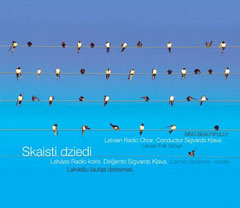
Skaisti dziedi

It goes without saying that Latvians have many beloved folk songs. It also goes without saying that Latvians love singing, especially folk songs. Also well known is the fact that the Latvian Radio Choir, conducted by Sigvards Kļava, is one of the best choirs in Latvia, if not the world. It is appropriate, then, that just in time for the 2008 Latvian Song Festival the record label Upe tuviem un tāliem would release a collection of folk songs, Skaisti dziedi.

When I heard about the compact disc, I picked it up as soon as I could. What surprised me is that only half of the songs are full choir performances. The rest are solo performances.

The choir arrangements are all the “classic” arrangements such as “Pūt, vējiņi” and “Kur tu skriesi vanadziņi” by Andrejs Jurjāns, “Rīga dimd” and “Krauklīt’s sēž ozolā” by Jānis Cimze, and “Cekulaine zīle dzied” and “Tumša nakte, zaļa zāle” by Emilis Melngailis. Though these songs have been recorded many, many times, the presentation by the Latvian Radio Choir and conductor Kļava remains fresh and engaging.

The other half of the disc contains performances by solo artists such as folk singer Zane Šmite (“Vedat mani ciema puiši”) and Kārlis Rūtentāls (“Kur tu teci gailīti mans” and “Skaisti dziedi lakstīgala”), as well as the duo of countertenor Ārijs Šķepasts and bass Gundars Dziļums on the old favorite “Kur tad tu nu biji, āzīti manu.” Most all of these performances feature kokle prodigy Laima Jansone (in fact, she arranged every song she plays on—more than a dozen). Still not quite yet finished at the Latvian Academy of Music, she already is able to make quite a name for herself as a rising star of the kokle, one of the most Latvian of all instruments.

The only spots where the collection stumbles are the performances of “Āvu, āvu baltas kājas” and “Bēdu manu lielu bēdu” by soprano Elīna Libauere. The songs, in my opinion, are sung way too fast! It is for the same reason that I wasn’t too fond of the Liku bēdu zem akmeņa folk song collection released by Upe in 2007. Certainly it is a technical achievement to be able to sing a song at 90 miles per hour with barely a breath, but at that speed much of the joy and fun of these songs is diminished.

All song texts are included, including English translations that perhaps may lead to bewilderment among some who may not understand why a tune about an “alleged” drunk horse runner became such a beloved song.

Honestly, instead of the half CD of choir arrangements and half CD of solo performances, I would have preferred a full CD of each. Conspicuously absent are the Latgallian “Aiz azara augsti kolni” (also by Jurjāns) or any of the many arrangements of “Ziedi, ziedi, rudzu vārpa.” Of course, with literally hundreds of choir arrangements of folk songs, one has to be very selective. Perhaps in the future we could hope for another CD of all modern folk song arrangements, including favorites such as Anita Kuprisa’s arrangmenet of “Ģērbies, saule, sudrabota,” or Imants Ramiņš’ arrangement of “Pūt, vējiņi,” or Selga Mence’s arrangement of “Neba maize pate nāca,” to name just a few.

As a collection of Latvian folk songs, containing old favorites and new arrangements for solo performers, this is one of the best to have ever been released, and well worth picking up. The Latvian Radio Choir and Kļava, not to mention kokle performer Jansone, are to be commended for such great performances, which will remind all listeners of the value and beauty of these timeless songs.

Details

Skaisti dziedi

Latvian Radio Choir

Upe tuviem un tāliem,  2008

UPE TT 038

Egils Kaljo is an American-born Latvian from the New York area . Kaljo began listening to Latvian music as soon as he was able to put a record on a record player, and still has old Bellacord 78 rpm records lying around somewhere.