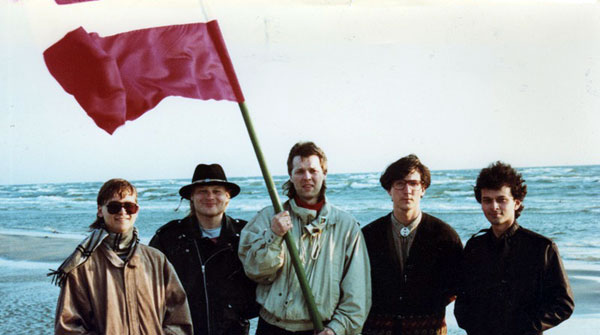
Arnolds Kārklis, Aivars Šmits, Gatis Gaujenieks, Vidvuds Mednis and Dainis Romāns pose in 1989 on the beach by the Put vējiņi outdoor concert pavilion in Liepāja, Latvia. (Used by permission of Plate Records)
Akacis, a musical group that existed from 1977 into the 1990s, was the longest lived Latvian-American rock band of its time. While groups like Čikāgas piecīši and Trīs no Pārdaugavas performed and were influenced by traditional songs, Akacis was one of the first Latvian-American groups to be guided by more contemporary sounds, with aspects in its music of pop, hard rock, progressive rock, and even jazz rock, folk and reggae.
The group performed throughout North America and Europe at Latvian song festivals, American Latvian Youth Organization (Amerikas latviešu jaunatnes apvienība, or ALJA) events and many other functions. The band also toured Latvia during the cultural exchanges of the Third National Awakening from 1989-1990.
The group’s name means “pit in a bog” in English, and is similar to the literal definition of the word “quagmire,” something the group would later allude to when it gave itself the more “American” name of Quags. Why the band chose the name Akacis (the name itself was suggested by drummer Aivars Šmits) remains unclear, but apart from the standard reason of “it sounds cool,” there is also the fact that it might be in the first bin at the record store.
Akacis officially began in New York in 1977. Many of the members had grown up together, either meeting at the Latvian school in Yonkers, N.Y., or at the Latvian summer camp in the Catskill Mountains upstate. However, the story begins in the spring of 1975, when members of two bands—New York-based ZMA (Zigfrīda Meierovica ansamblis, made up of Jānis Abens, Edvins Stots, Gatis Gaujenieks and Edgars Dāle), and Philadelphia-based Līgo (made up Raimonds Ramanis, Aivars Šmits and Mārtiņš Strauss of the band Trauksme, plus Vidvuds Mednis of Frikadeļu zupa)—performed together at the New York youth association “Stops” seminar at the Latvian camp in the Catskills.
Some of the musicians decided to get together and write their own material, with the idea of forming a true Latvian rock band. The original lineup of Akacis was Abens on guitar and vocals, Gaujenieks on bass and vocals, Strauss on keyboards and Šmits on drums. Laura Padega was to join shortly on violin as well. Gaujenieks’ father, the supervisor of a building in the Bronx, N.Y., helped find rehearsal space. The band later rented and lived in a loft in New York’s Garment District.
Akacis goes public
The band’s first public performance was in the summer of 1978 at the Fourth World Latvian Youth Conference in Williamstown, Mass. The group also performed internationally, with concerts in Toronto and at the 1979 European Latvian Youth Association Congress in Hemslingen, Germany. Akacis was the first Latvian-American rock band invited to play in then Soviet-occupied Latvia. Band members got as far as Sweden when, at the last minute, the Soviet government denied them entry visas.
Band members began work on their debut album, Akacis, in the fall of 1978 and it was released the following summer. The album, guitar- and keyboard-heavy and featuring complex musical arrangements, was a mix of rock, jazz rock and fusion. It included songs like the instrumentals “Tā lieta” and “Ar ko,” which most vividly displayed the band’s fusion and progressive rock leanings, and featured the wind instrument playing of guest Dainis Romāns. The album also included the more “traditional” pop song “Mājās braucot,” a thoughtful tune with acoustic guitar and harmonized vocals, about a group of friends going their own way after spending the summer together. The album also had guest performances by future members Mednis (on banjo) and Romāns (on saxophone, clarinet and flute).
During this period, Šmits, who had a day job as a bicycle messenger, made a delivery to the Directors’ Guild building in Manhattan. The receptionist asked if Šmits was by any chance of Eastern European descent. He was offered a part in director Michael Cimino’s film Heaven’s Gate, playing the role of cow thief Kovach.
Romāns was a classically trained musician, who often performed as a solo clarinetist at a number of Latvian song festivals and other functions. He has collaborated with a number of respected Latvian American composers, including Andrejs Jansons, Dace Aperāne and Imants Mežaraups.
Though not a member, an important figure in the band’s early history was Pēteris Rasums, a roadie and sound man who frequently traveled with the group and was a constant source of merriment on its adventures.
Comings and goings
After the release of the debut album, guitarist Abens reluctantly left the group to get married and live in Sweden. Padega, an academically trained violin player, also departed to join the folk ensemble Kolibri, leaving Gaujenieks, Strauss and Šmits as a trio. The group recruited new guitarist Arnolds Kārklis in 1981. Kārklis, Mednis’ cousin, had just returned from a year abroad at the Lettisches Gymnasium Münster in West Germany. Kārklis was also a former student of Stanley Whitaker of the American progressive rock band Happy the Man. The band moved into a house in Edison, N.J., while Kārklis dropped out of the University of Pennsylvania to pursue music with Akacis full time.
The first recording by the new quartet was a three-song single, including “Sirsniņam,” “Skābeklis” and “Iesvētibas.” The first two songs feature a more mainstream pop approach as compared to the complexity of the first album and became big hits in the Latvian community. “Skābeklis” (Oxygen), written by Šmits, was so named due to it being in a ska style. “Sirsniņa,” a reggae-style birthday song that was one of Akacis’ best known hits, was written by Gaujenieks for his first wife, Indra. The decision to move the sound towards the style of popular music was a conscious one, as there were complaints that the band’s more complex earlier work was too difficult to dance to.
The transition from progressive-fusion leanings to a more streamlined new-wave style continued into the band’s next album, 1984’s Tādi ir tie rēķini. The title was a phrase that Šmits’ sister’s godfather used to say frequently. The album still had songs with progressive instrumental breaks like “Pieturas punktsm,” which was perhaps one of the first appearances of the Latvian kokle in a rock song. “Negribu,” “Ja Tu būtu es” and the title track showcased the then-revolutionary Fairlight sampling synthesizer that Gaujenieks and Strauss were able to access from their synthesizer repair shop in New Jersey. Writing in the exile journal Jaunā gaita, reviewer Juris Mazutis called the record “the first professional North American Latvian rock album” and praised the originality of the songs.
The group became a trio again after the departure of keyboardist Strauss in 1984, not long after the release of the second album. Periodically, the group was joined by Laila Medne on vocals to further flesh out the Akacis sound.
In a parallel project in the fall of 1986, Akacis members Gaujenieks, Kārklis and Šmits join siblings Laila, Laima and Vidvuds Mednis to record Dāvana, a folk-oriented album of Christmas and wintertime songs. The project, originally begun as the Mednis’ idea to record a holiday project for friends and relatives, blossomed into an entire album and became very popular.
The group’s next release, still as a trio, was the cassette Aps’ties to vīru! in 1987, the title taken from the exclamation of a young child witnessing Pēteris Rasums riding a playground duck at the Gaŗezers summer camp in Michigan. The album included songs like “Sestdienas skola,” a look back at the experience of Latvian Saturday school, as well as “Nav vairs joku,” which was about the Chernobyl disaster viewed from a cow’s eyes. Aps’ties to vīru also included a cover version of “Kāpēc tu mani negribi?,” originally by new wave Latvian group Dzeltenie pastnieki, as well as the Akacis version of the traditional “Mīļā mazā Lulu.” The often alternative-sounding guitar-oriented album featured somewhat more serious, satirical and introspective lyrics. Reviewer Lolita Ritmane, writing in the ALJA journal Vēja zvani, noted the professional, modern and polished arrangements on the album, as well as the excellent vocal performances.
The group also celebrated its 10-year anniversary in 1987 with a concert at the Daugavas Vanagi House in the Bronx, inviting former members of the group such as Padega and Romāns.
During this time, the group’s self-formed record label, Plate Records, also began releasing to the U.S. market cassette albums by Latvian artists such as Jumprava, Pērkons, Dzeltenie pastnieki and K. Remonts, as well as compilations of songs by Latvian artists, in conjunction with the ALJA Cultural Section’s publishing arm. The label also helped organize U.S. tours for some of these groups as well, with many concerts also featuring Akacis as a warm-up act.
On the road
The group hit a few tour-related bumps along the way. A particularly infamous incident happened during the 1986 Toronto Song Festival, when Šmits was stopped at the U.S.-Canada border and his car searched. The car was loaded with Akacis albums and made t-shirts, all of which were confiscated and later destroyed, leading to thousands of dollars in losses for Šmits and the band. To add insult to injury, Šmits’ rental car was impounded, and Kārklis had to drive to the Niagara Falls border crossing with the cash needed to get it back. Šmits himself was banned from entering Canada, and was forced to make the long journey home in the barely roadworthy rental car. This left Kārklis and Gaujenieks, who were hours away from getting on stage, without a drummer. Fortunately, drummer Mike Morrow of the Latvian-Canadian band Skandāls was able to fill in.
In the late 1980s, the group’s base was in Philadelphia, but the group was only able to perform three or four times a year. However, in the summer of 1989, the group—now made up of Gaujenieks, Šmits, Kārklis, as well as their musical colleagues Mednis and Romāns (who had joined the band full time in 1988)—went on a two-week tour of Latvia, performing alongside groups such as Pērkons, Līvi, Elpa, Zodiaks and K. Remonts. Together with Zodiaks, headed by composer Jānis Lūsēns, members of Akacis recorded the song “Līdz palodai,” a song by Sniķere/Kārklis/Gaujenieks, which was included on the Mikrofons 89 compilation record. The two groups also recorded the Lūsēns song “Bērnam.” Romāns considered this tour one of the best and most creative times in the band’s history, even mentioning that the tour transformed the band from a “relatively obscure Latvian rock group” into “high profile Latvian pop culture icons.”
Not long before the band’s first tour of Latvia, Akacis had reached a critical juncture in its history. Kārklis had moved to Hollywood with the Washington, D.C.-based band Sleep of Reason, and that was one of the reasons Akacis had temporarily suspended its activity. The main question among the remaining members—Gaujenieks, Šmits, Mednis and Romāns—was whether to make the group more of a professional undertaking in the United States, to possibly make a full time job out of music. Kārklis eventually returned to the group, still based out of Philadelphia, and the band recorded its version of the Christmas song “Ne šūpulī greznā” (Away in a Manger) especially for Latvian State Radio. The group decided to focus on its English-language repertoire, adopting Quags as its name in the United States.
After being offered a music teaching position at a private prep school, Romāns departed the group prior to the band’s second Latvian tour in 1990. Quags remained focused on breaking into the American music scene, with performances at clubs in Philadelphia; Hoboken, N.J.; Washington, D.C.; and New York City.
However, the work of Quags was suspended to allow the band to prepare for the second tour of Latvia, which included a performance during the 1990 Liepājas Dzintars festival, where Akacis won the Audience Award and shared overall third place with the group Tango. Many of the shows on the tour also feature Latvian groups like Zodiaks and Elpa.
The final album released by Akacis was 1990’s Svešā malā, which featured many songs from the archives, including “Pūt, vējiņi”, with lyrics by Latvian lyricist Guntars Račs (the group Zodiaks also recorded a song with these same lyrics), and “Esība”. The 90-minute cassette album assembled dozens of tracks, some home demos, Latvian radio and television recordings and other selections from the Akacis catalog, exhaustively reflecting the tail-end of the group’s two decades of work.
Akacis becomes Quags
Quags released its only album, entitled One of Us, in 1991. The album, all in English apart from two songs, was perhaps the first Latvian rock album to be released on compact disc. The title was taken from the wedding chant scene in the 1932 Tod Browning film Freaks. The album featured an English-language version of three Latvian songs combined into one: the Jumprava song “Zem diviem karogiem” as well as the Opus Pro song “Brīvību Baltijai!,” entitled “Under Two Flags – Freedom for Baltia,” plus a short interlude quoted from “Tēvu zeme” by Zodiaks. “Under Two Flags” was a quite radical reinterpretation of all the original songs, and also featured sound clips of former U.S. President George H.W. Bush expressing his concern about the violence in the Baltic republics in the summer of 1991, when the Soviet government aggressively responded to protestors. The songs “Sometime Soon” and “Hangover,” both by Gaujenieks, were audience favorites.
In December 1991 and January 1992, Mednis, Gaujenieks and Kārklis took the second Dāvana project called, “Tāli zvani, klusas ilgas,” on a very brief winter holiday tour of Latvia.
Original drummer Šmits had gone his own way by this time. With that, Akacis as a musical entity had come to an end. However, Laris Kārklis (Arnolds’ younger brother) joined Quags as drummer and percussionist, and the band was able to continue recording an as-yet unreleased catalog of Mednis’ and Gaujenieks’ songs.
Quags continued to perform at Latvian events, such as the 1992 Seattle Song Festival to which the group had driven in a van across the U.S.from the East Coast. The trip included two stops in Nashville, where a music management group had expressed interest in having the band showcase for it. However, nothing ever came of this.
Quags recorded more than 50 songs, many of which still have not seen the light of day. The members of Quags also participated in a number of side projects, including groups like Toothpick Mary, Dish (which featured Gaujenieks, Mednis and Laris Kārklis and released one album), as well as the social-function band Los Pintos, which performed at many private Latvian parties. Los Pintos performances also featured many guest Latvian musicians such as Laurie Wood of the Čikāgas piecīši, Ivars Cinkuss, Māris Jansons and Richards Skulte.
The various incarnations of Quags continue into 1994. Arnolds Kārklis had moved to Latvia in the early 1990s, founding Plate Records as a true legal entity for publishing music. The band, though never officially broken up, for all intents and purposes ended when Gaujenieks also moved to Latvia in October 1994.
Where they are now
Gaujenieks’ move to Latvia began with an invitation to assist with the collaboration of New York-based Master Sound Astoria Studios and the Melodija studio in Rīga. The idea was that Master Sound Astoria would open a new studio in Latvia where American film studios could record soundtracks at a smaller cost than in the U.S. or England and also would not have to deal with American musicians’ union rules. Gaujenieks was hired to work as the technical director. For various reasons, the project did not materialize, but Gaujenieks decided to move to Rīga anyway to open a recording studio and to continue to pursue music.
In addition to playing bass for groups such as Jauns Mēness, appearing on the 1996 album Sirdspukstu intervāls, Gaujenieks worked as a technical director for the recording studio Sound Division Studios. Along with producer Edijs Gņedovskis and the record company MicRec, in 1994 Gaujenieks founded GEM Studios, where he has recorded and produced dozens of albums for various Latvian artists, including rock bands like the Hobos, UK, Autobuss debesīs and Līvi, folklore ensembles like Iļgi, Laiksne and Grodi, jazz musicians like Nic Gotham and Artis Gāga, and even former Latvian President Vaira Vīķe-Freiberga, who recorded a folklore album called Vairas dziesmas.
Gaujenieks also began working with post-folklore ensemble Iļģi, first appearing on the band’s 1998 recording Saules meita, performing on four songs and producing the album. As a full-time member, he not only sings and plays bass and ģīga (trough fiddle), but also has co-produced every album starting with 2000’s Sēju vēju (on which Arnolds Kārklis joined the group as a touring and recording guest) up to this year’s Īsākās nakts dziesmas, an collection of songs relating to the Latvian Jāņi (Midsummer) celebration.
Gaujenieks also continues to work as a songwriter. Some notable songs he has written include “Varbūt rīt” (originally “Sometime Soon” by Quags), which became a hit for female ensemble Dāmu pops, as well as writing the winning song “Jūrmala, Jūrmala…,” which was awarded first prize in a competition to determine the official hymn of the Latvian city of Jūrmala in 2008. Gaujenieks was also actively involved in writing the music for the Iļģi album Spēlēju, dancoju, as well as for the children’s folk musical “Reiz bija…”
Drummer Šmits, who Vidvuds Mednis would often introduce as “Āmurs” (Hammer) on stage, has played with many bands in the New York City area, including Lancaster County Prison, Defrokt, Blackflies, Vipers, Confederacy of Dunces, Trouble Dolls and Reverb MoFos. The last time he appeared on stage was in 2006 during the 50th anniversary celebration of the Latvian camp in the Catskills, where he performed with Laura Padega, Laila Medne, Richards Skulte and Lars Alversons. In the mid-1990s, Šmits traded in his drumsticks for a skillet and a whisk to study at The French Culinary Institute in New York. Throughout the late 1990s, he worked as a chef at several restaurants in Manhattan and Brooklyn.
Multi-instrumentalist Romāns, after departing Akacis, began to work with the Latvian band REMIX as a MIDI technologist and translator when the group decided to come to the United States to record an album. Since then, Romāns has continued to teach, record and perform with a number of musical and performing artists in the greater Philadelphia area. Romāns also has had a successful career as a video director and producer on a wide variety of projects for corporate clients like Sony, Comcast, Centocor and Genentech.
After leaving Akacis, guitarist Abens received his doctorate in biochemistry in Stockholm. He also arranged, produced and performed on an album by singer-songwriter Pavils Johansons, which was released in Stockholm in 1987. Abens and Johansons toured Latvia in December 1988, including a show in Liepāja. The duo was the first Western act to perform there since World War II, as the area was a military enclave and off limits to foreigners.
Abens also performed with Iļģi in the mid-1990s and appears on the recordings Riti riti and Saules meita. He briefly rejoined Iļģi for the band’s 2001 tour of the United States.
After moving to Riga in 2007, Abens started the band DeBillies together with banjo player Marks Feders, with Raivo Ozols on upright bass and Dzintars Beitāns on violin (both Ozols and Beitans perform in the Latvian National Symphony Orchestra). The group performed at the Bauska Country Festival in 2008, and recorded one tune, “Kalna galiņā” with vocalist Inese Greste.
Guitarist Kārklis was a member of Latvian band Otra puse from 1994-1996, and has recently rejoined the band and appears on the group’s most recent album, Nakts vai rīts. Kārklis recorded two albums with folk poet Valdis Atāls and was also a member of Iļģi from 1999-2001. He was often booked as a session guitarist and background vocalist for numerous other projects. Among his other significant contributions to Latvian music, Kārklis lists studio performances for the group Marana, composer Uģis Prauliņš, and songwriter-theatre artist Raimonda Vazdika (all recorded and produced by Gaujenieks). Kārklis also collaborated as lyricist and guitarist with rhythm-and-blues composer Arnis Mednis’ project ExPatriots, co-writing the hit “Shake Before Use” as well as most of the other songs on the album of the same title. However, Kārklis has struggled to keep his own musical side-project Zaļā vārna (Roller) active in light of his many other musical engagements.
Keyboardist Strauss, after leaving the band in 1984, became chief of maintenance for the now-defunct recording studio Unique Recording in New York. Most notably in 1987 the studio received five Grammy awards for works produced at the studio. He founded Manhattan Audio Consultants in the early 1990s. The shop catered to the professional music industry and built private recording studios for artists such as Moby, Ashford & Simpson, Lou Reed and Shania Twain, among others.
With the changes in the music business in the 1990s, Strauss departed the industry completely, and he and his family move to the Catskill Mountains—just a few miles away from where the Akacis story began. Strauss is combining his college architectural schooling and years in the music industry in designing and installing private home automation systems throughout New York, Connecticut and New Jersey.
Gaujenieks, Mednis and Laris Kārklis, as a one-time collaboration, recorded the song “Alus dziesma” (on the Latvijas dūdas album) with members of Iļģi. The song appears on the Dūdas Latvijā album released by UPE Recording Co. in 2000.
No Akacis recordings are available on compact disc. However, the band is considering releasing a limited edition collection of its repertoire, as well as making songs available as downloadable MP3 files. Some songs and video clips can be found on the Web site www.plate-records.com.
In its 15-year history, Akacis established itself as one of the premier Latvian-American rock bands. Its members were not only talented musicians, but talented songwriters as well. Successfully adopting and combining different styles of music throughout their career, the band recorded many songs that remain beloved by not just Latvian-Americans, but Latvians worldwide. Not bad for a bunch of kids who met in Latvian school and camp.
(Editor’s note: The author thanks Jānis Abens, Gatis Gaujenieks, Arnolds Kārklis, Vidvuds Mednis, Dainis Romāns, Mārtiņš Strauss and Aivars Šmits for their assistance with this article.)

Dainis Romāns, Gatis Gaujenieks, Arnolds Kārklis, Vidvuds Mednis and Aivars Šmits (partially obscured) perform on Latvian State Television in 1989.
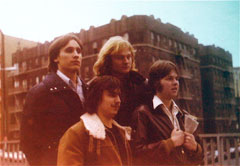
Akacis founding members Jānis Abens, Mārtiņš Strauss, Aivars Šmits and Gatis Gaujenieks in the Bronx in 1978.
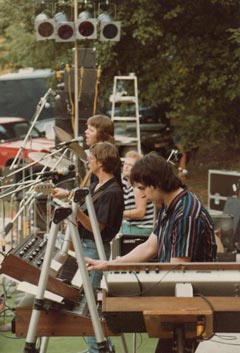
Akacis plays during the August 1983 Volleyball Weekend at the Latvian Center Gaŗezers in Michigan. (Photo by Pauls Bērzkalns, used by permission of Plate Records)
Egils Kaljo is an American-born Latvian from the New York area . Kaljo began listening to Latvian music as soon as he was able to put a record on a record player, and still has old Bellacord 78 rpm records lying around somewhere.