Compilation honors composer Pauls ahead of 75th birthday

The most famous Latvian popular music composer, Raimonds Pauls, will turn 75 in 2011. To celebrate the anniversary, the Rīga-based recording company MICREC has released a compilation on compact disc of some of his most famous songs, as well as some more obscure work.

The two-CD set, entitled Raimonds Pauls. Zelta 75, collects 49 popular songs from the 1960s to the end of the 1980s.

The set also collects a number of less familiar songs. Many of them are taken from the archives of Latvian Radio and from Soviet LPs produced by the Melodija recording company, and are being released on CD for the first time. Covering a range of styles from jazz to disco to popular to film music, these songs feature some of the greatest popular singers and other musicians of that time.

This is actually the third Pauls CD compilation set. The first was Zelta 60, released in 1995 to celebrate the composer’s 60th birthday, followed by Zelta 70 in 2005 to celebrate his 70th birthday.

Tracks and performed on the first CD include:

  1. Melodija (Eolika, from the film 235 miljoni seju)
  2. Reiz nāksi tu (Valentīna Butāne)
  3. Lai tik līst, perfored by Edgars Zveja)
  4. Tikai prieks (Zigfrīds Račiņš)
  5. Studentu brīvdienās (Valentīna Butāne)
  6. Ar tevi vien (Sieviešu vokālais ansamblis)
  7. Vecā jūrnieka stāsts (Zdzislavs Romanovskis)
  8. Vectētiņš un vecmāmiņa (Margarita Vilcāne and Ojārs Grīnbergs)
  9. Balāde manam vectēvam (Valdemārs Zandbergs)
  10. Hallo, Rostoka (Ojārs Grīnbergs)
  11. Kur tu biji? (Bruno Oja)
  12. Cik klusa nakts (Nora Bumbiere and Ojārs Grīnbergs)
  13. Ances Romance (Margarita Vilcāne, from the film Klāvs Mārtiņa dēls)
  14. Alus dziesma (Vīru vokālais ansamblis directed by E. Račevska)
  15. Precē mani, čigānzēn (Nora Bumbiere and Viktors Lapčenoks)
  16. Dzel manī sauli (Nora Bumbiere and Viktors Lapčenoks)
  17. Ai – dundur – dundur – dun – dun – dun (Nora Bumbiere and Viktors Lapčenoks)
  18. Pusnakts balāde (Nora Bumbiere and Viktors Lapčenoks)
  19. Undīne (Nora Bumbiere and Viktors Lapčenoks)
  20. Dziesmiņa par prieku (Viktors Lapčenoks )
  21. Tāls Parīzes radio (Margarita Vilcāne)
  22. O’Lamara (Nora Bumbiere and Viktors Lapčenoks)
  23. Balta pūka (Nora Bumbiere and Viktors Lapčenoks)
  24. Dresleriāna (Nora Bumbiere, Viktors Lapčenoks and others)
  25. Modo (Modo)
  26. Kā caur pelniem (Aija Kukule, Mirdza Zīvere, Pārsla Gebharde and Modo)

Tracks and performed on the second CD include:

  1. Tango (from the film Teātris))
  2. Diksilends (Eduards Pāvuls, Gunārs Cilinskis and Valentīns Skulme, from the film Melnā vēža spīlēs)
  3. Heksenberga mīlas dziesma (Vaironis Jakāns)
  4. Lāsts (Juris Strenga)
  5. Brauciet lēnām pār tiltu (Jānis Paukštello)
  6. Tāpēc jau, ka nevar zināt kāpēc (Edgars Liepiņš)
  7. Kad nekas nav palicis tevī (Imants Skrastiņš)
  8. Zvaigzne (Rolands Zagorskis)
  9. Balts sniedziņš (Dainis Porgants))
  10. Svētvakars (Andris Bērziņš)
  11. Dāvāja Māriņa (Aija Kukule and Līga Kreicberga)
  12. Muļķe sirds (Žoržs Siksna)
  13. Varavīksne (Ingus Pētersons)
  14. Nepareizā dziesma (Dālderi))
  15. Meitene ar kallu ziediem (Credo)
  16. Kad saule aiziet (Viktors Lapčenoks and Inversija)
  17. Nenāciet klāt man rudenī (Laima Vaikule)
  18. Robots (Aija Kukule and Remix)
  19. Vardīte (Viktors Lapčenoks)
  20. Pelnrušķīte (Viktors Lapčenoks)
  21. Miega vilcieniņš (Dainis Porgants and Dzeguzīte)
  22. Nepasauc, nepiesauc mani vēl (Remix)
  23. Melodija (Odis, from the film Depresija))

In addition to the CD compilation, a big anniversary concert is scheduled in the Arena Rīga on Jan. 16, which will be an event in three parts. The first part will feature songs from the 1960s and 1970s, including lesser known works, the second will be theatre and film music, and the third part will feature his most popular songs.

Raimonds Pauls. Zelta 75 width=

A new compilation honors composer Raimonds Pauls with 49 of his songs.
Egils Kaljo is an American-born Latvian from the New York area . Kaljo began listening to Latvian music as soon as he was able to put a record on a record player, and still has old Bellacord 78 rpm records lying around somewhere.

New coins honor niobium’s discovery, note symbolism of horseshoe

The Bank of Latvia in recent weeks has released three new coins: one silver-niobium commemorative coin called the “Coin of Time III,” as well as two circulation one-lat coins with images of horseshoes.

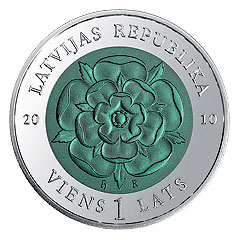
The one-lat ““Coin of Time III” was released Dec. 2. The obverse of the coin features a rose in tribute to the discoverer of niobium, German chemist Heinrich Rose, who launched his career in Latvia. The reverse has the phases of the moon.

The coin contains both silver and niobium, is of uncirculated quality and has a mintage of just 7,000. The coin was designed by Laimonis Šēnbergs and modelled by Jānis Strupulis, and was struck by Münze Österreich, Austria.

This is the third “Coin of Time.” The first was released in 2004 and the second in 2007.

Additionally, the Bank of Latvia on Dec. 2 released two special one-lat circulation coins, both with horseshoes, with one coin having the horseshoe pointing upwards, the other downwards.

The horseshoe has long been a symbol of good fortune. In Latvian beliefs, if the horseshoe ends are pointing upwards, good fortune will come from the heavens, but if the horseshoe ends are pointing downwards, good fortune will come from the land. The designers were Frančeska Kirke (graphic design) and Laura Medne (plaster model). The coin was minted by Staatliche Münze Berlin, Germany.

Circulation of the two horseshoe coins is 500,000 pieces each.

For further information, visit the Bank of Latvia website at www.bank.lv.

Coin of Time

A new commemorative one-lat coin honors the Latvia-born German chemist Heinrich Rose, who discovered niobium.

Egils Kaljo is an American-born Latvian from the New York area . Kaljo began listening to Latvian music as soon as he was able to put a record on a record player, and still has old Bellacord 78 rpm records lying around somewhere.

Recording serves as memento of historic concert of Šimkus playing Vasks

Description of image

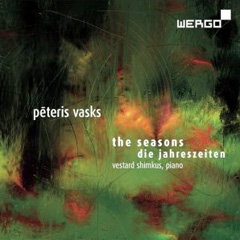
One of the most memorable concerts that I attended in 2009 was the September solo performance of pianist Vestards Šimkus at the Rīga Great Guild. What made this night particularly notable and significant was the fact that Šimkus was performing, for the first time, all four parts of composer Pēteris Vasks’ cycle Gadalaiki (The Seasons).

This was the first time the compositions were performed as a whole, with “Zaļā ainava” (Green Scenery) and “Vasaras vakara mūzika” (Music for a Summer Evening) enjoying their world premiere that night. I wasn’t the only one to be impressed by the concert: The performance was given the “Best Concert Award” as part of the Latvian Great Music Awards.

Due to the historical significance of the evening, it was also recorded for release on compact disc. Produced by the Latvian Concert Agency Latvijas koncerti, the recording of the performance was released in 2010 by the German label Wergo, which has already released a number of Vasks’ works on CD.

Šimkus has already made a worldwide name for himself. In addition to being awarded for performing this cycle, he also received a Latvian Great Music Award in 2002 for his victory at the Franz Liszt competition in Los Angeles, as well as for performances at the Latvian National Opera and at the House of the Blackheads in Rīga.

Vasks, internationally the best-known Latvian composer, was considered to be an “enemy of the state” during Soviet times in Latvia (due to being the son of a Baptist minister and a non-party member) and was forbidden from studying at the Riga Conservatory, though he was able to study in Vilnius, according to the CD booklet.

The first movement to be composed in the Gadalaiki cycle was “Baltā ainava” (White Scenery) in 1980, followed by the second movement, “Rudens mūzika” (Autumn Music), in 1981. Both were composed for his friend Tālivaldis Deksnis, a distinguished Latvian organist.

The third movement, “Pavasara mūzika. Quasi una sonata” (Spring Music), was first performed in Stockholm by pianist Bengt Forsberg in 1996. After hearing Šimkus perform this work in 2004, Vasks was so impressed that he was inspired to compose the final “season” in this cycle, “Zaļā ainava”  (Green Scenery). The final piece in this cycle, “Vasaras vakara mūzika” (Music for a Summer Evening) was composed in 2009.

As with much of Vasks’ compositions, the music itself is designed to evoke imagery through sound, rather than focusing on melodies and harmonies. In fact, all of the pieces except “Zaļā ainava” and “Vasaras vakara mūzika” are metrically free—they do not have time signatures, giving them an almost improvisational feel. This could potentially make these piano works difficult to listen to for some, but I think they provide a very rewarding and enjoyable experience to the listener.

“Baltā ainava” begins with quiet melancholy, a peaceful winter scene, a sense of meditation indicating a new beginning of a year—perhaps even a sense of hibernation, of something preparing to wake up.

That awakening comes in “Pavasara mūzika” (a particularly demanding piece that provides a way for Šimkus to display his technical skills), which depicts the arrival of spring, with a thunderous conclusion.

The first section of “Zaļā ainava” is full of constant activity and energy, which then changes to a slower, more subtle view of the season, with Šimkus effortlessly making the very drastic transition between the energetic opening and the nuanced conclusion.

This then leads into “Rudens mūzika,” which also has a very quiet beginning but then grows into a stormy crescendo, concluding with imagery of snow appearing once again, returning the listener to the landscapes of winter.

Finally, there is “Vasaras vakara mūzika,” initially calm, later emotional, but in all an engrossing portrait of a summer evening.

The CD also includes extensive liner notes on the works, as well as in-depth biographies of both Šimkus and Vasks, by Christopher Schlüren (in both German and English).

On a different note, I must also commend the work of the recording engineers, including recording producer and editor Normunds Šnē and recording engineer Andris Ūze, Having attended the concert myself, I recall that there seemed to be a perpetual maelstrom of coughing fits going on throughout the concert, even in very quiet sections. I was quite astonished that none of that thunderous noise has made it into the recording, at least not that I can hear.

Besides being a historically significant release, it is an impressive memento of that memorable evening in September 2009 at the Rīga Great Guild. With the able hands of one of Latvia’s brightest young piano talents, guided by the prowess of the distinguished Vasks, this CD captures some of the finest works in the composer’s oeuvre and makes for very rewarding and captivating listening.

Details

Die Jahreszeiten / The Seasons

Pēteris Vasks, Vestards Šimkus

Wergo,  2010

WER 67342

Track listing:

Baltā ainava (White Scenery)

Pavasara mūzika (Spring Music)

Zaļā ainava (Green Scenery)

Rudens mūzika (Autumn Music)

Vasaras vakara mūzika (Music for a Summer Evening)

Where to buy

Purchase Die Jahreszeiten / The Seasons from Amazon.com.

Note: Latvians Online receives a commission on purchases.

Egils Kaljo is an American-born Latvian from the New York area . Kaljo began listening to Latvian music as soon as he was able to put a record on a record player, and still has old Bellacord 78 rpm records lying around somewhere.