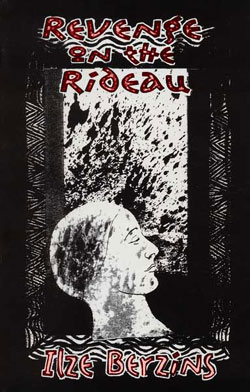
Portrait of the artist as amateur sleuth

Revenge on the Rideau

The wife of a respected Canadian judge, Leah Holm leads a pampered life. She spends her days having lunch and rejuvenating in an exclusive spa. In her diary and in her memory, however, she’s Leah Nusbaum, a 10-year-old Jewish girl who escaped the slaughter of her family and community when German authorities cleaned out the ghetto in occupied Liepāja, Latvia.

And then one day, decades and leagues removed from her past, she spies the Monster of Liepāja in Ottawa. Her mission becomes bringing the man she suspects to justice. But a fifth of the way into Ilze Berzins’ newest book, Revenge on the Rideau, Leah Holm is dead, floating face down in a hot tub at the My Lady Spa.

Who killed her—and why? Was it Clairelise Leowen, daughter of Erich von Leowen, the Baltic German baron Leah Holm suspects of ordering the extermination of her family? Was it Wilma Sprott, the mentally disturbed cleaning woman at the spa, a friend to Clairelise and who doesn’t like Leah? Or was it Judge Ken Holm, who is nearing retirement and pondering life with his sexy mistress, Ginette Ladouceur? Or was it one of several other characters?

Revenge on the Rideau takes place one winter near Ottawa’s famed Rideau Canal, billed by tourism promoters as the world’s longest skating rink. Berzins knows Ottawa and used the setting already in her 1999 murder mystery, Death in the Glebe. And Berzins also knows the broad outlines of Latvian history. Her autobiographical skewering of contemporary Latvian society, 1997’s Happy Girl, also gave readers a taste of who Berzins is—and we find plenty of her in this novel.

In a review of Death in the Glebe, Diana Kiesners made comparison to the "moral relativism" of that story’s fictional characters and the real people Berzins encountered in Happy Girl. We find that in Revenge in the Rideau, too. Few of the characters are outright lovable or off-putting.

But we also find similarity between Death and Revenge. Doreen Bell, the artist and amateur sleuth, is key in both tales, and she still is the romantic interest of a detective working on the case (in fact, Revenge alludes to Death at one point). Doreen in both murder mysteries and Berzins in Happy Girl also are dog lovers. And in Revenge, as in Death, women are victims of various kinds and most of the men can’t be trusted ("How come you’re so sure it’s a man?," Doreen asks her detective boyfriend, Barry Mullins, as they consider who might be the murderer. "Well, isn’t it always," Barry answers.).

Revenge is a relatively well-fashioned story, containing enough twists to keep the tale moving along at a comfortable pace. But few of the characters have engaging depth, perhaps a function of having too large a cast. As in Death, it’s Doreen who appears the most interesting and best-developed. Readers may hope that Berzins’ next work clearly becomes a Doreen Bell Mystery, more confidently using the character the author seems to know best. And while Revenge certainly makes use of Berzins’ artistic experience to describe places, people and the effects of light, it often seems a hasty job.

No publication is immune from technical errors. Berzins has worked to make Revenge cleaner than her previous efforts, but several of the final chapters are peppered with typographical errors, almost as if the rush to finish caused the author to drop her guard. And given its similarity to a made-for-TV movie (and that’s not necessarily a bad thing), a reader may be struck by a glaring continuity problem: is the name of the place Leah Holm dies My Lady Spa or Milady Spa?

At the same time, Berzins makes good use of the English language. A number of phrases are turned so well that they bring a smile to the reader. The overall flow of the story—particularly its resolution—is satisfying, especially for readers familiar with Berzins’ work so far. In the closing moments of the story, Doreen thinks to herself that "[s]he had always believed in happy. People were meant to be happy. She had always known that." Has Doreen found that which Berzins could not?

Dealing with the sensitive question of the Holocaust in Latvia and the process of Nazi-hunting as a backdrop for Revenge may be perceived by some readers as a risky move. But the novel doesn’t shock and perhaps could have gone out even farther onto the limb. As Berzins further explores her own background and develops the character of Doreen Bell, perhaps readers will be treated to an increasingly complex world.

(Corrected 12 APR 2001)

Details

Revenge on the Rideau

Ilze Berzins

Halifax, Nova Scotia:  Albert Street Press,  2000
Andris Straumanis is a special correspondent for and a co-founder of Latvians Online. From 2000–2012 he was editor of the website.

Strong turnout expected in local elections

A fish inspector from Rīga became the first person to vote in Latvia’s municipal elections March 11, according to the Rīga City Elections Commission. Ilmārs Pētersons was at a polling place set up at the 3rd Rīga High School on Grēcinieku Street by 8 a.m., earning him the title of “First Voter of the Third Millenium.”

Photo opportunity aside, the man’s apparent eagerness to vote may be an indication of how other disgruntled Latvians reportedly were going to take in municipal elections around the nation. Pre-election predictions said that the Latvian Socialdemocratic Labour Party (LSDSP) and other leftwing parties were sure to sweep up control of eastern Latvia, particularly in rural areas and other communities where voters have grown tired of slow economic reform, corruption and other problems.

These were the third municipal elections in Latvia. Turnout was expected to be high (the last elections, in 1997, saw 56.8 percent of eligible voters cast ballots). By 4 p.m., nearly 50 percent of eligible voters had cast ballots, either in person or by mail. A study last year by the Central Elections Commission found that 58 percent of eligible voters definitely planned to partipate in this year’s election, while another 24.6 percent said they were likely to participate.

Throughout Latvia, hundreds of candidates were running for seats on various local government councils. The election for Jelgava City Council, according to media reports, saw the most competition with more than 200 candidates for 15 seats. In the capital city of Rīga, 17 different parties fielded candidates for 60 seats. Rīga’s incumbent Mayor Andris Ārgalis was expected to be returned to office.

The run-up to the election, as well as the election itself, has not been without some scandal, although the amount of trouble has appeared minimal. A few weeks before the election, Diena reported that an independent television production company preparing material on the campaign had asked up to LVL 200 from mayoral candidates to participate in televized discussions. On election day, according to the LETA news agency, reports of vote-buying were recorded in Rezekne.

Andris Straumanis is a special correspondent for and a co-founder of Latvians Online. From 2000–2012 he was editor of the website.

Child’s story reveals humanity’s disgrace

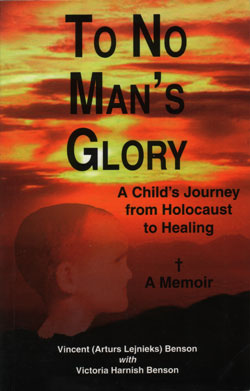
To No Man's Glory

One of our dogs had worms when she was a puppy. I still recoil at the memory of the long, white worms mixed in with her excrement—and at having to gather up some for a veterinarian’s analysis.

Arturs, the little boy who is the subject of Vincent and Victoria Benson’s To No Man’s Glory, also had worms. He had to pull them from his rectum with his fingers.

This is just one of many disgraces Arturs Lejnieks, a young Jewish orphan, had to face as he and his group of refugees wandered around Latvia during World War II in an attempt to escape death at the hands of the enemy, whoever that might be at any given moment. Young Arturs later became Vincent Benson, the adopted son of an Iowa farm couple.

To No Man’s Glory takes the reader along with Arturs as he in 1941 leaves an orphanage in Majori with his beloved Auntie and embarks on several years of constant running from those who would wish them dead. The child doesn’t understand his Jewishness, nor does he understand why people would want to kill him because he is a Jew. But he learns there are many who cannot be trusted: Germans, Russians, Latvians. As the bumper sticker says: "Mean people suck."

After he and his Auntie survive several close calls in Latvia, they wind up in Germany as Displaced Persons. From there, Arturs is shipped off to America where he is placed in Iowa with an ungrateful adoptive father but a loving adoptive mother. Only after he converts to Christianity does Arturs, now known as Vincent Benson, find the strength to forgive all those who have hurt or betrayed him in Latvia, in Germany, in America.

This is, obviously, a story of survival. It is not a happy book, even with an ending that sees Vincent Benson finally have some normalcy in his life. It is a matter-of-fact book, with horrid wartime scenes that require little embellishment to paint powerful images. It also is a revealing book: Vincent Benson doesn’t shield himself or the reader from the nastiness of everyday life, even in the relative security of postbellum, midwestern America.

What is especially troubling about the story is that despite being a Jew—and being persecuted for being one—Vincent Benson never really had the chance to be one. German soldiers wanted to kill him for being a Jew before he even knew what being Jewish meant. As a Displaced Person there was precious little time to learn about his heritage. In Iowa, his adoptive father pushed him to forget his past and become a good Lutheran. Taken together, that is perhaps the greatest disgrace experienced by Vincent Benson.

Although it has the markings of a self-published book, To No Man’s Glory is well done. Victoria Benson presents herself as a competent writer who has taken her husband’s story and shaped it into prose.

Illustrations are few, mostly some small snapshots of the Lejnieks family taken during better times in prewar Latvia. But one group of pictures, taken from an assignment book Arturs used while a student in a DP school, deserved to be displayed much larger. These include drawings by the child, depicting war and other scenes that were etched into his memory.

The Bensons obviously researched events beyond simply relying on the decades-old memories of Vincent. In the first part of the book, brief introductions to some chapters provide historical context in terms of Nazi Germany’s plans for the "Final Solution." But what is lacking is a clear understanding of where in Latvia many of the events unfold. Yes, we know where Rīga is, but where are the roads young Arturs and Auntie travelled? Where are the forests in which they hid? Where are the mass graves they saw? Of course, it may be difficult to resurrect geographical context from childhood memories, but even a general fix on where events occurred would be of great benefit to the reader.

To No Man’s Glory joins the still small but growing literature on the Latvian experience during and after World War II (see Aurora and A Woman in Amber for other examples). Call it victim literature, call it refugee literature. Whatever its name, it’s an important story that must be told.

Details

To No Man’s Glory: A Child’s Journey From Holocaust to Healing

Vincent (Arturs Lejnieks) Benson with Victoria Harnish Benson

Medford, Oregon:  Silver Dove Publishing,  2000

ISBN 0967656605

Andris Straumanis is a special correspondent for and a co-founder of Latvians Online. From 2000–2012 he was editor of the website.