Naumova gives up Tibet for trip to Tallinn

No one can predict the future, singer Marija Naumova agrees. All she knows is that if she wasn’t headed for Tallinn next month to compete in the Eurovision Song Contest, she would be on her way to a monastery in Tibet.

Naumova, who speaks five languages including her native Russian, will represent Latvia as one of 24 countries participating in Eurovision. Sometimes maligned as a showcase for packaged pop, the contest nonetheless draws a large international television audience and momentarily heightens feelings of national pride across Europe. Last year, in the contest held in Copenhagen, the Estonian duet of Tanel Pader and Dave Benton won first place, earning Estonia the honor of hosting this year’s competition on May 25.

Could Latvia and Marie N, as Naumova’s stage presence will be known in Tallinn, come out on top this year? Perhaps. But that’s not a goal she’s set.

“I have a wish for myself,” Naumova said in a telephone interview from Rīga, “and that is that I always have plenty to do.”

And right now she does. Naumova is perhaps one of few musical artists in Latvia who, for the moment, can make a living as just a musical artist. Even before she and her backup performers could begin to make final preparations for Eurovision, Naumova was setting her sights on an upcoming concert with Raimonds Pauls in Moscow as well as continuing a tour around Latvia. At the same time, work was continuing on a compact disc that is to contain several of Naumova’s songs, including a couple of mixes of the Eurovision entry, “I Wanna.”

The album in part will showcase Naumova’s ability to sing in English. She’s already released albums in Russian, in Latvian and in French. Those albums, especially Ieskaties acīs and Ma voix, ma voie, combined with her acclaimed performance in the musical production of “Sister Carrie” to help make her one of the most popular performers in Latvia.

Her victory in the national Eurovision contest in March was resounding, with more than 26,500 votes cast by fans to take her to No. 1. (The second-place winners, Linda Leen and Horens, scored about 18,100 votes.) Not bad, considering she came up with the song just two days before entries were due in early January.

“In the shower I’m always humming something,” she said. That’s how “I Wanna” came to her. Although she won, it was not without the requisite controversy that seems to have attached itself to the Latvian run-up to Eurovision. Critics claimed “I Wanna” was plagiarized from Ricky Martin’s hit song from 2000, “She Bangs.” But a group of experts determined that while “I Wanna” may have been inspired by “She Bangs,” it was not plagiarism. Still, some fans of other contestants remain disgruntled that Naumova won. One fan even posted an MP3 file on the Internet, weaving together Naumova’s and Martin’s songs in a mix that may leave some to wonder whether more than inspiration was at work.

Whatever the criticism over “I Wanna,” Naumova is still viewed by many as a talented individual. Besides speaking five languages, she also holds a bachelor’s degree in law.

Naumova credits the popular composer Pauls with kicking off her singing career. It was Pauls who discovered Naumova performing in Jūrmala several years ago. Their collaboration has continued.

Although Naumova said she avoids the politics of ethnicity, she noted that with her surname it usually would be difficult to get a break. But thanks in part to Pauls’ endorsement, “Many Latvians think that I am Latvian.”

Naumova also has kept her image and her music fresh by constantly updating it, trying different styles.

“A character that changes is interesting,” Naumova said. For example, on the cover of Ieskaties acīs she looked like a modern-day flapper, with short hair and an expression of happy innocence. But on Ma voix, ma voie, she literally let down her hair and appeared more distant.

Her stage presence for the Eurovision contest is sure to be different again, especially considering “I Wanna” is touched with salsa rhythms.

But winning a song contest isn’t the most important thing for her. “A contest is a lottery,” she said. First place isn’t represented by a number. “First place is a feeling you have inside,” Naumova said.

Last year, Naumova was passed over for a spot in Eurovision. Instead, Arnis Mednis went for Latvia, but finished 18th out of 23 countries participating. Two years ago, Prāta Vētra (BrainStorm) finished third and saw its star slightly rise among European music fans.

And as for the future beyond this year’s Eurovision? Naumova said she would like to improve her Italian and also learn Spanish. More concerts also are in the offing, perhaps some day even in America. But for now, her plans to travel to Tibet for some quiet time are on hold.
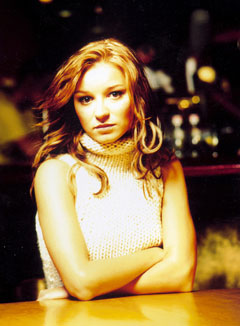
Marija Naumova

Marija Naumova adopted a new image for the release of her French-language album, Ma voix, ma voie. (Photo courtesy of Baltic Records Group)

Andris Straumanis is a special correspondent for and a co-founder of Latvians Online. From 2000–2012 he was editor of the website.

OSCE official opens mouth, inserts foot

Memo to Gerard Stoudmann: The next time someone asks you about language policy in Latvia, keep your mouth shut. Stoudmann is director of the Office for Democratic Institutions and Human Rights for the Organization for Security and Co-operation in Europe.

During a two-day visit to Rīga that concluded March 20, Stoudmann met with government officials and discussed a number of issues. He also pressed Latvia to remove a provision in the country’s election law that requires political candidates to prove their proficiency in the Latvian language, according to an OSCE press release. The need for reform, he suggested, is urgent as Latvia heads toward its next parliamentary election on Oct. 5 and looks beyond that date to potential membership in the NATO defense alliance and in the European Union.

But then, in a remark about language policy made during a conference on OSCE and Latvian cooperation, Stoudmann stepped over the line, according to media reports. He said Russian should be made Latvia’s second official language. A third of the nation’s inhabitants speak Russian as their first language.

The OSCE, for those not familiar with this powerful international body, traces its roots back to the early Cold War era. It attempts to resolve disagreements between European nations before they rupture into armed conflicts.

Human rights and democratic reforms have been among the OSCE’s key concerns. But so has the principle of self-determination.

Stoudmann, as Latvians would say, izgāza podu (upset the pot). His remark, widely reported in local media, soon brought a groundswell of rebuke. Even Latvian Prime Minister Andris Bērziņš called for his resignation.

Apparently realizing that he was guilty of a major faux pas, Stoudmann on March 21 recanted, saying his comments were meant as "personal reflection," not a statement of OSCE policy. "I wish to stress that my intention never was to suggest that Russian be made the second state language in Latvia, or that this issue was on the agenda," Stoudmann said in a press release. "I am fully aware of the sensitivities surrounding the issue in Latvia."

Unfortunately, the damage had already been done.

The Russian Foreign Ministry, for example, piggy-backed on Stoudmann’s remark and once again complained that Latvia isn’t mindful of the rights of its Russian-speaking minority.

The OSCE is correct to point out problems in Latvia’s election law. Asking that political candidates prove their language ability is discriminatory and unconstitutional, as a language commission appointed by President Vaira Vīķe-Freiberga said earlier this year. To be a candidate for political office in Latvia, you must be a citizen. Citizens should not be asked such questions. Let the voters decide whether a candidate is fit for office.

But to suggest, even as "personal reflection," that Russian be made a second official language is unfair to a nation that is still trying to clean up the mess left by a half-century of occupation. It’s particularly unfair because the loudest voice in the language debate is across the border and some 800 kilometers away in Moscow. Who’s watching out for the interest of the Latvians?

If the OSCE really wants to help, it could do more to promote Latvian language education as part of the process of becoming a citizen. Of Latvia’s 2.3 million inhabitants, 22.3 percent are still classed as noncitizens, according to government figures. Russians make up nearly 350,000 of the noncitizens.

In the meantime, Stoudmann’s remark is a reminder for ethnic Latvians that they are the only ones who will look after their interests. Already a number of readers of the SVEIKS mailing list are planning an electronic notification "tree" that would serve to mobilize letter-writing campaigns and other activities for the next time someone like Stoudmann says something damaging to Latvia’s cause. According to Jānis Trallis, better known online as "Rodrigo," there are plans to set up a Web site to coordinate the effort. SVEIKS readers are trying to come up with a name, with "e-Taure" slightly favored over "e-Koks."

The unintended result of Stoudmann’s "personal reflection" may well be the strengthening of Latvians’ resolve on the language issue. If he survives in his OSCE post, he’s sure to find his job in Latvia will have become much tougher.

Andris Straumanis is a special correspondent for and a co-founder of Latvians Online. From 2000–2012 he was editor of the website.

Berzins hits her stride with latest mystery

A Tear in God's Eye

It takes a while before Doreen Bell, the main character of Ilze Berzins’ latest crime thriller, is introduced to the reader. And it takes an even longer time before someone is found dead. Combined, they are among the elements that make A Tear in God’s Eye the author’s best work so far.

Readers familiar with her earlier mysteries—1999’s Death in the Glebe and 2000’s Revenge on the Rideau—will recognize certain Berzins trademarks. Bell, the middle-aged Ottawa artist who becomes amateur sleuth, of course figures prominently, as does her cop boyfriend, Barry Mullins. And Berzins soon had better provide a map to Canada’s capital city; she’s using more of the geography of Ottawa now.

Men, as they did in the earlier novels, are mostly cast as disagreeable characters, although their rough edges are softening. "Men need to feel powerful and in control," Bell tells her neighbor, Constable Julie Barnes. “And when they feel they’re losing it, they lash out—attack, even kill.”

But there the similarity ends. A Tear in God’s Eye is more layered and complex than the earlier crime novels. I kept expecting Doreen Bell to jump out at ever turn of the page, but it wasn’t until about a quarter of the way through that the story finally got to her. Along the way, the author had already introduced and developed several characters, among them the two-bit criminal Ivan Pavnick and his wheelchair-bound sister, Val Pavnick, the owner of a women’s shelter.

Berzins also has developed a much more intricate plot, one that she slowly unwinds before getting to the key element in a murder mystery: a body.

When death finally comes—to Linda Pedersen, wife of policeman Carl Pedersen—we are just past the halfway point in the book’s 315 pages.

The novel offers the reader a view of a grittier Ottawa, complete with corrupt cops and the drug underworld, not just the artsy Glebe or the fashionable Rideau districts that were featured in Berzins’ previous works. A Tear in God’s Eye also has a sexual tension that was lacking earlier.

Berzins also is funnier here. Sometimes the turn of a phrase seems a bit overplayed, but at other times the irony and weird humor work well. Linda Petersen, for example, is killed in a parking lot. "The killer had left a signature," Berzins writes. "The V from a Pontiac Aztek was found lodged in the dead woman’s torso." I had to laugh, because Pontiac Azteks really are disagreeable-looking vehicles.

Without the benefits of a large publishing house that might advise against going to press before an author is ready, Berzins in a few short years has churned out three crime mysteries, plus her recently re-released memoir of trying to start a new life in Latvia, Happy Girl. She’s received both accolades and criticism, of course, but has also matured as a writer. With A Tear in God’s Eye, Berzins has hit her stride.

Details

A Tear in God’s Eye

Ilze Berzins

Halifax, Nova Scotia:  Albert Street Press,  2001

Andris Straumanis is a special correspondent for and a co-founder of Latvians Online. From 2000–2012 he was editor of the website.