Predictable story of rebel youth, made in Rīga

Red Hot

With Elvis Presley’s “All Shook Up” blaring, the camera swept across the surface of the Daugava River and, panning left, revealed the skyline of Rīga’s Old Town. Oh my, I said to myself, to actually see Rī;ga in a Hollywood movie! This was a treat. Too bad the rest of Red Hot wasn’t, well, so hot.

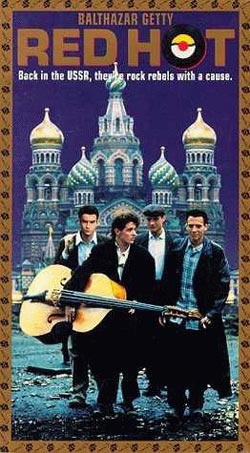
Red Hot was director Paul Haggis’ 1993 take on a fairly familiar story line: teenagers buck authority to do what teenagers want to do. In this case, the setting was Soviet Latvia in 1959. A group of music students discover the forbidden fruit of American rock ‘n’ roll. But the film, as the videotape sleeve suggests, could just as well have been Footloose or The Commitments. In other words, if you’ve seen one, you’ve seen them all.

Red Hot begins when a few 45 rpm records are smuggled into the country by Uncle Dmitri (Armin Mueller-Stahl), a seaman. He gives the records to his nephew, Alexi Fradis (Balthazar Getty). The records are ingeniously copied and the music spreads. Before long a quartet of students decides to turn a deserted industrial building into a rehearsal studio. Complicating the story are Alexi’s humble roots and his evolving love affair with Valentina Kirov (Carla Gugino), the privileged daughter of a highly placed but jaded KGB colonel (Donald Sutherland). It’s all just kid stuff until an overambitious KGB underling decides cracking a case of musical anti-Soviet propaganda might lead to his rise in power.

Admittedly, it is interesting to see acted out what scholars of culture in the Soviet era have noted: Western rock music seeped into the U.S.S.R. and was copied onto various media, including X-ray negatives. But beyond that the story is predicatable, the characters are wanting and the historical realism is skin deep.

Although the movie was filmed in Rīga (a number of scenes, such as one apparently filmed inside the National Library of Latvia or of the Dome Church, will bring nods of recognition), there is little that is Latvian about Red Hot. The characters are almost all Russians, although it appears the cast and crew counted few ethnic Russians among them. And about the only Latvians you’ll see are the back-bench actors who portray some of the students, jail guards and so forth. In one brief moment, the camera pans past a group of young musicians practicing the tune to “Tūdaliņ, tagadiņ.”

Careful viewers may catch an anachronistic glimpse of the radio and television tower on Zaķusala, visible as Alexi bicycles across the Daugava. Construction on the tower didn’t begin until 1979, two decades after the Red Hot story supposedly took place.

Still, the film no doubt provided a needed infusion of money and inspiration for local talent when Hollywood came to Rīga. For example, readers of the credits will notice that former émigré and now successful Rīga restaurateur Mārtiņš Ritiņš did the catering. Too bad the story is formulaic.

One odd thing about Red Hot has been its almost Soviet-style way of disappearing from filmographies and video stores. A search of the Web found only cursory information about the movie (one incorrectly categorizing this as a comedy), while few online stores seem to carry the film (one claimed the price was USD 93.65). This might suggest Red Hot is a “sleeper.” It’s not.

Details

Red Hot

Paul Haggis

Columbia Tristar,  1993

Notes: In English. Drama, color, 95 minutes. Principal cast: Balthazar Getty, Carla Gugino, Armin Mueller-Stahl, Jan Niklas, Hugh O’Conor and Donald Sutherland; music: Peter Breiner; costumes: Judith England; editor: Nick Rotundo; director of photography: Vernon Layton; screenplay: Paul Haggis and Michael Maurer.
Andris Straumanis is a special correspondent for and a co-founder of Latvians Online. From 2000–2012 he was editor of the website.

Story of self-discovery has simple view of Latvia

In July 1994, Bill Clinton became the first American president to visit an independent Latvia. As he spoke near the Freedom Monument, thousands of Latvians thronged to hear his words. Many more listened on radio or watched on television. Among them was Kevin, then a young midwestern American who had come to Latvia to visit his penpal. Jeff Keenan tells the story of that first visit in his book, The Main.

The following month we traveled to Latvia for the first time. The trip was hectic, requiring visit after visit to new and old relatives, excursions around Rīga and throughout Latvia to places we had only read about, and occasional jaunts to various institutions for business and research purposes. In short, we were busy.

Kevin wasn’t.

His first trip was made specifically to visit his penpal Māra and her family. The Main describes his two weeks with the family and his growing need to “find himself.”

Kevin comes across naive—and I’m trying to use that word objectively, without attaching to it the negativity that we often do. Here he is, a young man of 25 from northeast Iowa who is making his first voyage beyond the Midwest. Even before he’s out of the country, he is apprehensive and amazed by New York, where he has to change planes and airports.

I went to Latvia for the first time with baggage. Besides the overstuffed suitcase, there were three decades of accumulated history, family lore and black-and-white photographs etched in memory. I don’t think I went with a romanticized vision of what Latvia might be like, but I’m sure that what I saw was quite different from what Kevin did.

Kevin, without that baggage, also doesn’t find a romanticized—or even a romantic—Latvia. What he does find is simplicity, so much so that at times it begins to grate the reader: The home in Rīga where he stays is simple. The meals are simple. The people are simple.

But sprinkled through the book are hints that things are not so simple in Latvia:

Amazed by the simplicity he was experiencing, he questioned Mara about her everyday life.

“Everything seems very peaceful here in Latvia,” he said. “Is life always this simple?”

Māra explains about the lack of heat in her family’s apartment, about the loneliness and depression that some people experience. Still, Kevin continues to see Latvia as a peaceful and simple place. Perhaps it is, but The Main begs for Kevin to dig a bit deeper, to seek what the country and the people are really like. He has several opportunities to do so, but is reluctant to ask questions when they may reveal much to him.

At one point in this short book of 110 pages, Kevin puts aside a travel guide, realizing that it provided inadequate preparation for the Latvia he finds. It’s a telling moment, one that shows the effect of being placed in a different culture, even if for a while. Nothing you read is like the real thing.

Keenan’s book about a journey of self-discovery allows us to see Latvia through fresh eyes. I only wish he had looked a bit harder.

Details

The Main

Jeff Keenan

Minneapolis:  Peace River Publishing,  2001

ISBN 1930209002

Andris Straumanis is a special correspondent for and a co-founder of Latvians Online. From 2000–2012 he was editor of the website.

Naumova does it her way on French album

Ma voix, ma voie

During a year when a number of pop artists in Latvia turned to English as the language of their music, Marija Naumova decided on French. Her Ma voix, ma voie (My Voice, My Way) showcases not just her French-language skills, but also her ability to modify her singing style and image to fit the mood.

Ma voix, ma voie is Naumova’s third album. The first, in her native Russian, saw little exposure in Latvia. But her second, the Latvian-language album Ieskaties acīs, had her teamed with Niks Matvejevs in an effort that resonated with audiences, sending the record to platinum status.

Released late last year, Ma voix, ma voie features 11 tracks. Several are compositions by Raimonds Pauls, whom Naumova credits for helping launch her career. Lyrics were written by several songwriters, but in “Une voix” we are treated to a translation of Vizma Belševica’s words, while in “Cher ami” it’s Imants Ziedonis’ work. Also lending a hand with the lyrics was Astra Skrabane, an instructor of French.

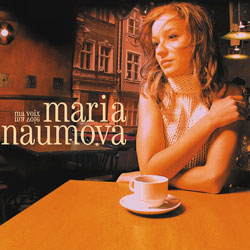
Listening to this album, don’t expect to hear Naumova trying to emulate such well-known French singers as the late Edith Piaf or the contemporary Patricia Kaas. Instead, Naumova here tries to carve out her own style, sounding more like an up-and-coming bistro singer. In doing so, she’s gone as far as to change her looks from her previous album, as well as the presentation of her name. On Ieskaties acīs, she was Marija Naumova, but on Ma voix, ma voie the “j” disappears. Naumova also will represent Latvia in the 2002 Eurovision Song Contest in Tallinn, where she will be known as Marie N.

The album opens with the jazzy “Sous le soleil du nord” (Under the Northern Sun). Credited to Pauls and Skrabane, the song is about a person’s search for her way in the world. It sets the mood for the rest of the album, both emotionally and musically.

Naumova’s voice on this recording is soothing, not as throaty as with other French singers. She succeeds in using her voice to set the tone of each song.

My favorite track is “Je t’aime!” (I Love You!), in which the singer acknowledges her love for another, but not yet publically, to the world. I’ve been calling this a “2 a.m. song”: as a private moment wanes, perhaps the last sways of a slow dance in a subdued bar, a rising saxophone heralds the lights coming up, signalling that it’s time to part.

A feeling of nostalgia seeps through several songs. In “Ecris-moi” (Write Me), for example, the singer laments that she once made fun of a clumsy fellow who used to write love notes to her in school. Now, years later, she longs to be with him, to have someone send her something written on paper, not in e-mail.

Some bright songwriting comes through in “Aux coins du vieux Riga” (On the Corners of Old Rīga). Credited to Matvejevs and Skrabane, the song has Naumova walking through the cobbled streets of the city while musing on the vagaries of fate in relationships: “Un pas, Et tu ne partiras jamais…” (One step, And you will never leave…).

While not a consistently strong album, nothing overly bothersome leaps out, either. If anything, listeners who aren’t huge fans of Pauls’ style of piano music might be irritated by his presence on songs such as “Cher ami” (Dear Friend), where his work on the keyboard seems just a bit out of place. However, on “Souviens-toi” (Remember) his playing is more reserved and fits better with the song.

The liner notes are a linguistic challenge. The lyrics and the acknowledgements are all in French. Short descriptions of the songs are provided in Latvian and Russian.

Listen to this album at the end of a long day and you might just find your mind drifting away to the French quarter of Rīga.

Details

Ma voix, ma voie

Marija Naumova

Baltic Records Group,  2001

BRG CD 114

Andris Straumanis is a special correspondent for and a co-founder of Latvians Online. From 2000–2012 he was editor of the website.