Census data on Latvians cause bewilderment

A dozen years ago, about 1,000 people with Latvian ancestry lived in Arizona, according to the U.S. Census Bureau. Perhaps lured by the dry climate, the sunshine or the dramatic vistas of the Grand Canyon, the number of Latvians in Arizona had tripled by the year 2000, new census data suggest.

Or perhaps not.

If that many Latvians were living in Arizona even 12 years ago, said Rasma Ekmanis, former chairperson of the Arizona Latvian Club, they would be renting a ballroom to host dances.

“We don’t have the slightest idea where they are,” she said of the 3,020 Arizonans the census bureau estimates had Latvian ancestry when the latest count was made two years ago.

The current chairperson, Jānis Baltiņš, agreed. The Latvian club only has about 40-60 members from throughout the state, he said.

Arizona is not the only state with doubtful numbers of Latvians. Data about Americans’ ancestry is included in the latest batch of Census 2000 figures released to the public in the past several weeks, but the numbers have Latvian leaders in several communities scratching their heads in bewilderment.

The tally of “long form” questionnaires given to one in six American homes during the 2000 census shows that Americans with Latvian ancestry totaled an estimated 94,905 in 2000, down 5.4 percent from the 100,331 recorded in 1990.

The numbers are derived by adding the “first ancestry” and the “second ancestry” reported on the long form. The numbers also are estimates, interpolated by the census bureau from the national sample. The census bureau also reported lower and upper bounds for the data, which suggest that nationally the number of Americans with Latvian ancestry could be as low as 31,351 or as high as 174,711. The census also found that 10,780 persons in the United States were born in Latvia.

While the national number may appear believable, state-by-state breakdowns reveal some astonishing population shifts. One explanation may be that the Census Bureau’s sampling of ancestry and its interpretation of the numbers just gave bad results for Latvians. Or perhaps the numbers are accurate and ethnic Latvians are in fact escaping some states and flocking to others. Perhaps people who never considered themselves Latvian have seen a reawakening of their ethnic identity. The numbers may also raise questions about what exactly Latvian identity means, whether to be counted it’s enough to be from Latvia rather than be a “real” Latvian.

For example, the Latvian population tripled in Utah, Hawaii and Arizona during the 1990s, according to the census. Utah’s Latvians—some of whom became quite visible during the Winter Olympics in Salt Lake City—grew to an estimated 583, while Hawaii’s rose to 683.

Curiously, even North Dakota has more Latvians now than 10 years ago. A total of 182 persons claimed Latvian ancestry in the most recent census, compared to 64 in 1990.

Oregon saw its Latvian population swell by almost 83 percent from 1990 to 2000, the census estimates. One explanation might be found in the influx of Russian-speaking immigrants, said Juris Orle, the leader of the Portland-based Oregon Latvian Evangelical Lutheran Church. “In America there’s a certain prejudice against Russians,” Orle said, suggesting that the new immigrants who came from Latvia identified themselves as Latvian in the census rather than Russian.

According to census figures, Oregon has 50,162 persons of Russian ancestry. Overall, according to the daily newspaper The Oregonian, the 2000 census shows that the Pacific Northwest is the fastest-growing region for the Russian population in the United States.

But only about 400 ethnic Latvians live in Oregon, Orle told Latvians Online.

Several states that for decades have had strong Latvian populations saw significant decreases during the past decade. New Jersey, for example, experienced a nearly 70 percent plunge in persons claiming Latvian ancestry. In the 2000 census, 1,671 persons said they had some Latvian blood, compared to 5,393 in 1990. Pennsylvania saw a 28 percent drop, to 3,468 Latvians, while Washington experienced a nearly 21 percent slide, to 2,319 Latvians.

The figures for New Jersey may be believable, said I. Gabliks, head of the New Jersey Latvian Society. According to the census, the number of New Jersey residents with Latvian ancestry stood at 1,671 in 2000, down 69 percent from the 5,393 reported in 1990. The Latvian society, Babliks said, has about 300 members.

Latvians also appear to have abandoned a number of Midwestern and Western states. Arkansas, Colorado, Iowa, Kansas, Louisiana, Nebraska, New Mexico, South Dakota, Texas and Wyoming—none of which had large Latvian populations in 1990—reported decreases of 20 to 100 percent. Decreases may in part be credited to assimilation. Throughout the United States, more people than in the 1990 census reported their ancestry as simply “American.”

But even in states that had relatively stable Latvian populations, doubts arise about census figures. Florida in 1990 had 5,725 Latvians, increasing 5.9 percent by 2000 to 6,605.

“Around here we have a hard time understanding that,” Andris Ritums, head of the St. Petersburg Latvian Society, said of the numbers. “In St. Petersburg with all the snowbirds we get 500-600,” he said. The St. Petersburg area is home to the largest number of Latvians in Florida he said, and the number shrinks when temporary residents go back north.

The society, he added, has about 300 members.

If the numbers are right, it’s good news for New York, which reclaims bragging rights as the state with the most Latvians. The 2000 census revealed 12,758 people with Latvian ancestry, compared to California’s second-place total of 12,041. Ten years earlier, the largest state on the West Coast had the most.

Also in the top five states in terms of Latvian population are Michigan with 6,972, Illinois with 6,619 and Florida with 6,065. But that’s if you believe the numbers.
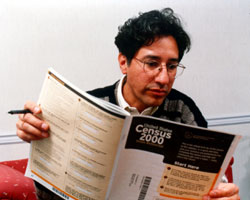
Man answering census questions

Millions of U.S. residents completed census forms in 2000, with one in six getting the “long form.” (Photo courtesy of U.S. Census Bureau)
Andris Straumanis is a special correspondent for and a co-founder of Latvians Online. From 2000–2012 he was editor of the website.

Changes in election law benefit Latvians abroad

Latvian citizens living abroad—including World War II exiles and their descendents who reclaimed citizenship after 1991—may find it a bit easier to vote in the upcoming parliamentary elections. Latvia’s parliament, the Saeima, on May 30 approved changes to the election law that were sought by several Latvian emigre organizations.

Under the revised law, voters abroad will be able to mail in absentee ballots at least 15 days before the official election day. Latvia’s national election day this year is set for Saturday, Oct. 5.

Some citizens abroad had complained that in their countries of residence mail service is not offered on Saturdays, while Latvia’s election law said that citizens abroad could vote either in person or post their absentee ballots on the day of the election. Mailed ballots also had to be received and opened in polling offices within three days of the election.

The World Federation of Free Latvians (Pasaules brīvo latviešu apvienība, or PBLA) was among emigre organizations pushing for the changes.

“The PBLA is very satisfied,” Linda Kovaļevska, head of the federation’s Rīga office, said in an e-mail to Latvians Online, “because the adopted amendment that allows voting by mail 15 days before election day was proposed by the PBLA.”

The president of the Latvian National Federation in Canada (Latviešu nacionālā apvienība Kanādā, or LNAK) agreed the changes are good.

“The changes definitely will help Latvians living in Canada to participate in the elections,” said Imants Purvs. The federation already has begun discussions with the Latvian Embassy in Ottawa about how best to publicize the changes and increase voter participation.

Under the revised election law, citizens living abroad may still vote at an official polling place.

The emigre organizations’ concerns were addressed in election law amendments proposed Oct. 31 by the Central Elections Commission, according to a press release. The commission oversees elections in Latvia. Arnis Cimdars, chair of the commission, also had noted that in some large countries even three days may not be enough time for a ballot to reach a local polling place.

Although the changes may satisfy the concerns of many Latvian citizens abroad, one catch might be that in order to receive an absentee ballot, voters will have to mail their Latvian passport to their polling place to prove their eligibility. Because a unified and computerized registry of voters is not yet available in Latvia, the passport is needed to verify eligibility. By the time the next parliamentary elections would be scheduled in 2006, such a registry should be ready, Kovaļevska said.

The PBLA also headed off an amendment proposed by the Latvian Foreign Ministry which would have barred citizens without a passport from voting, Kovaļevska said. Some citizens may not have a passport, but instead have a document from the Department of Citizenship and Migration Affairs that proves their citizenship.

Also struck from the proposed legislation was a provision that would have allowed a citizen voting abroad by mail to change their ballot by showing up in person at the polling place, taking back their absentee ballot and voting again.

Voters on Oct. 5 will elect 100 members of parliament. Citizens who are at least 18 years old are eligible to vote. Candidates for parliament have a 20-day window, beginning 80 days before the election, in which to apply to be on the ballot.

In the meantime, the Central Elections Commission also will need to decide where polling places will be established abroad. In Canada, Purvs said, LNAK is considering opening an election office in Toronto.

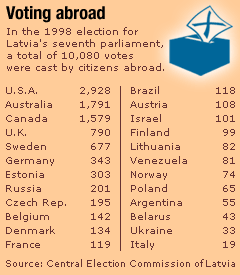
For the last parliamentary elections in 1998, the Central Elections Commission set up a total of 31 polling places abroad, most of them in embassies. Three of those were in the United States: the Latvian House in Chicago, the Latvian Social Center in Los Angeles and the Latvian Embassy in Washington, D.C. Two were in Canada: the Latvian Embassy in Ottawa and the Latvian Canadian Cultural Centre in Toronto. Australia also had two, in the honorary consulates in Sydney and Melbourne.

In all, 10,080 votes were recorded from Latvian citizens living abroad, with 2,928 (29 percent) coming from the United States. Australia had the next largest bloc of votes, 1,791 (17.7 percent), while Canada contributed 1,579 (15.6 percent). Together, Latvian voters in the three countries represented more than 62 percent of votes cast abroad.

Voters abroad in general were a conservative group. Of the 10,080 votes cast, 46 percent went to Tēvzemei un brīvībai/LNNK (For Fatherland and Freedom/LNNK), Latvia’s leading conservative party. Overall, the party took third in national elections, earning 17 spots in the 100-seat Saeima. A third of ballots abroad were cast for Tautas partija (People’s Party), the conservative reform party that recorded the best results in the election, earning 24 seats.

More than 32,000 Latvian citizens were living abroad in 2000, according to the Department of Citizenship and Migration Affairs. More than a third—a total of 11,344—were in the United States, followed by 4,447 in Australia and 4,198 in Canada.

Voting in 7th Saeima election

Andris Straumanis is a special correspondent for and a co-founder of Latvians Online. From 2000–2012 he was editor of the website.

Sorry, Marija, we didn’t think you’d win

Our apologies to Marija Naumova, because we didn’t think she would win. The night before the Eurovision Song Contest was to begin in Tallinn, my daughter and I sat down at her computer and watched all 24 videos of this year’s entries. Our conclusion was that Naumova and her song “I Wanna” certainly was well above average, but not necessarily good enough to win the contest.

If we had any favorites in addition to Latvia, they were Austria, Denmark, Macedonia and perhaps France and the United Kingdom.

Austria’s Manuel Ortega—who, despite what his name suggests, was born in Linz—surprised us with his upbeat “Say a Word.” We also liked Denmark’s Malene Winther Mortensen and her performance of “Tell Me Who You Are.” The video especially brought smiles, as the singer vandalizes the apartment of her lover whom she suspects of having walked out on her (but returns bearing a couple of baguettes).

And Macedonia’s young pop star, Karolina Gocheva, sang wonderfully the tune, “Od nas zavisi” (It Depends On Us). Her participation in Eurovision saw one of several minor scandals this year. Gocheva wanted to perform the song in English in Tallinn, but was convinced by the powers that be back home that Macedonian was the way to go.

France’s Sandrine Francois performed “Il faut du temps” (“It Takes Time”), a fittingly moody French song that was a refreshing change of pace from the all-too-happy pop songs offered by many other artists.

Finally, the United Kingdom’s Jessica Garlick, who many thought was a virtual shoo-in this year thanks in part to heavy pre-contest promotion, seemed like she would do well with the soulful “Come Back.” When I interviewed Naumova in April, she said Garlick’s song was her favorite among all the entries.

But when I booted up the computer mid-afternoon Saturday to check the results, I was surprised to find that voting was still underway. The Webcast from the Saku Suurhall in Tallinn reported that Latvia was in the lead with 118 points, tussling with Malta for control of first place. My jaw must have hit the keyboard as I watched during the next half hour as Latvia’s score continued to mount. And then Lithuanian television reported that Latvia’s neighbors to the south were giving 12 points to Naumova, boosting her to a score of 176 and clear victory.

Malta’s Ira Losco, who performed “7th Wonder,” came in second with 164 points. The U.K.‘s Garlick tied with Estonia at 111 points. (We were a bit disappointed that Estonia employed a ringer: Young Swedish singer Sahlene sang “Runaway,” a tune with lyrics and music created by Estonians.) And France was next with 104. Unfortunately, one of our favorites, Denmark, ended up in last place with only 7 points, right behind Lithuania in 23rd place.

Yes, Eurovision is a silly contest, but it’s one that’s been running for 47 years. Yes, most of the songs are nothing special. But the point, at least this year, is that in Latvia’s third time in the Eurovision contest it has come away with a victory. Coupled with Estonia’s win last year, the results should help convince any doubters that the Baltics are not some backwater region of Europe.

I guess it’s time to start saving for airfare to next year’s Eurovision contest, which is to be held in Latvia as part of the spoils of victory. The next months are sure to see a debate about whether Latvia can even afford to pull off a Eurovision event and, if it can, whether it should be held in Rīga or in Ventspils, which is where the national runup to Eurovision has been staged.

In the meantime, our congratulations to Marija Naumova, even if we didn’t think you’d win.

Andris Straumanis is a special correspondent for and a co-founder of Latvians Online. From 2000–2012 he was editor of the website.